501 posters, 2 videos, 1 audios, 8 topics, 37 sessions, 395 authors, 307 institutions
ePostersLive by SciGen Technologies S.A. All rights reserved.
23rd Annual Pain Medicine Meeting 2024
November 21-23, 2024 | Caesars Palace, Las Vegas, Nevada

6183
UNRAVELING THE LAYERS: CHRONIC PAIN IN AUTOIMMUNE MYOSITIS THROUGH THE LENS OF PAIN SENSITIZATION AND CO -MORBIDITIES: CASE REPORT
Poster Presenter
Authors
Affiliations
Part of Topic
Medically Challenging Cases
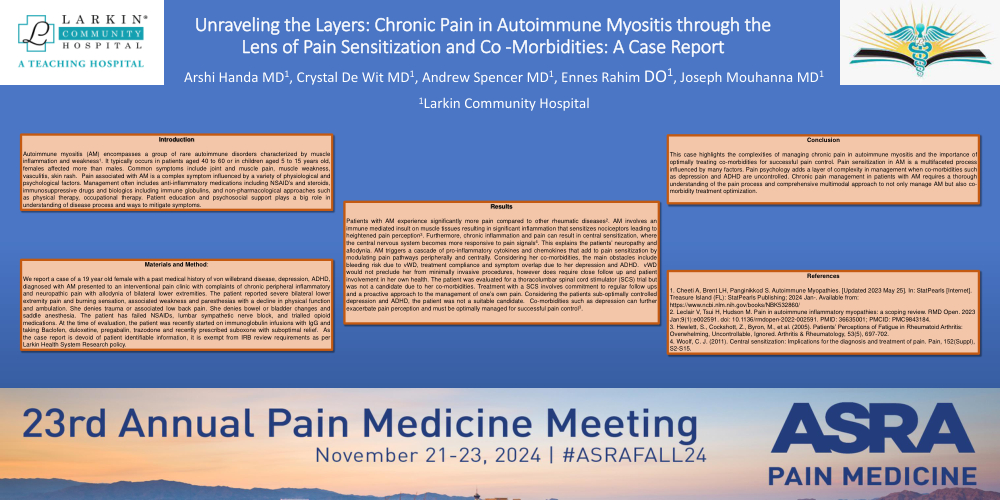
Unraveling the Layers: Chronic Pain in Autoimmune Myositis through the Lens of Pain Sensitization and Co -Morbidities: A Case Report
Introduction:
Autoimmune myositis (AM) encompasses a group of rare autoimmune disorders characterized by muscle inflammation and weakness1. It typically occurs in patients aged 40 to 60 or in children aged 5 to 15 years old, females affected more than males. Common symptoms include joint and muscle pain, muscle weakness, vasculitis, skin rash. Pain associated with AM is a complex symptom influenced by a variety of physiological and psychological factors. Management often includes anti-inflammatory medications including NSAID’s and steroids, immunosuppressive drugs and biologics including immune globulins, and non-pharmacological approaches such as physical therapy, occupational therapy. Patient education and psychosocial support plays a big role in understanding of disease process and ways to mitigate symptoms.
Materials and Method:
We report a case of a 19 year old female with a past medical history of von willebrand disease, depression, ADHD, diagnosed with AM presented to an interventional pain clinic with complaints of chronic peripheral inflammatory and neuropathic pain with allodynia of bilateral lower extremities. The patient reported severe bilateral lower extremity pain and burning sensation, associated weakness and paresthesias with a decline in physical function and ambulation. She denies trauma or associated low back pain. She denies bowel or bladder changes and saddle anesthesia. The patient has failed NSAIDs, lumbar sympathetic nerve block, and trialled opioid medications. At the time of evaluation, the patient was recently started on immunoglobulin infusions with IgG and taking Baclofen, duloxetine, pregabalin, trazodone and recently prescribed suboxone with suboptimal relief. As the case report is devoid of patient identifiable information, it is exempt from IRB review requirements as per Larkin Health System Research policy.
Results:
Patients with AM experience significantly more pain compared to other rheumatic diseases2. AM involves an immune mediated insult on muscle tissues resulting in significant inflammation that sensitizes nociceptors leading to heightened pain perception3. Furthermore, chronic inflammation and pain can result in central sensitization, where the central nervous system becomes more responsive to pain signals4. This explains the patients’ neuropathy and allodynia. AM triggers a cascade of pro-inflammatory cytokines and chemokines that add to pain sensitization by modulating pain pathways peripherally and centrally. Considering her co-morbidities, the main obstacles include bleeding risk due to vWD, treatment compliance and symptom overlap due to her depression and ADHD. vWD would not preclude her from minimally invasive procedures, however does require close follow up and patient involvement in her own health. The patient was evaluated for a thoracolumbar spinal cord stimulator (SCS) trial but was not a candidate due to her co-morbidities. Treatment with a SCS involves commitment to regular follow ups and a proactive approach to the management of one’s own pain. Considering the patients sub-optimally controlled depression and ADHD, the patient was not a suitable candidate. Co-morbidities such as depression can further exacerbate pain perception and must be optimally managed for successful pain control3.
Conclusion:
This case highlights the complexities of managing chronic pain in autoimmune myositis and the importance of optimally treating co-morbidities for successful pain control. Pain sensitization in AM is a multifaceted process influenced by many factors. Pain psychology adds a layer of complexity in management when co-morbidities such as depression and ADHD are uncontrolled. Chronic pain management in patients with AM requires a thorough understanding of the pain process and comprehensive multimodal approach to not only manage AM but also co-morbidity treatment optimization.