501 posters, 2 videos, 1 audios, 8 topics, 37 sessions, 395 authors, 307 institutions
ePostersLive by SciGen Technologies S.A. All rights reserved.
23rd Annual Pain Medicine Meeting 2024
November 21-23, 2024 | Caesars Palace, Las Vegas, Nevada

6123
TREATMENT OF BILATERAL ALLODYNIA IN PEDIATRIC COMPLEX REGIONAL PAIN SYNDROME (CRPS) PATIENT WITH STELLATE GANGLION BLOCK
Poster Presenter
Authors
Affiliations
Part of Topic
Medically Challenging Cases
Treatment of Bilateral Allodynia in Pediatric Complex Regional Pain Syndrome Patient with Stellate Ganglion Block
Michael Goldberg, M.D.1, Mateus dos Santhos, M.D., Vanathi Ganesan, Alin Ponici, M.D., Shantha Ganesan, M.D.
1Department of Anesthesiology, State University of New York - Downstate Health Sciences University, Brooklyn, NY 11203;
2Department of Anesthesiology, Kings County Hospital Center, Brooklyn, NY 11203
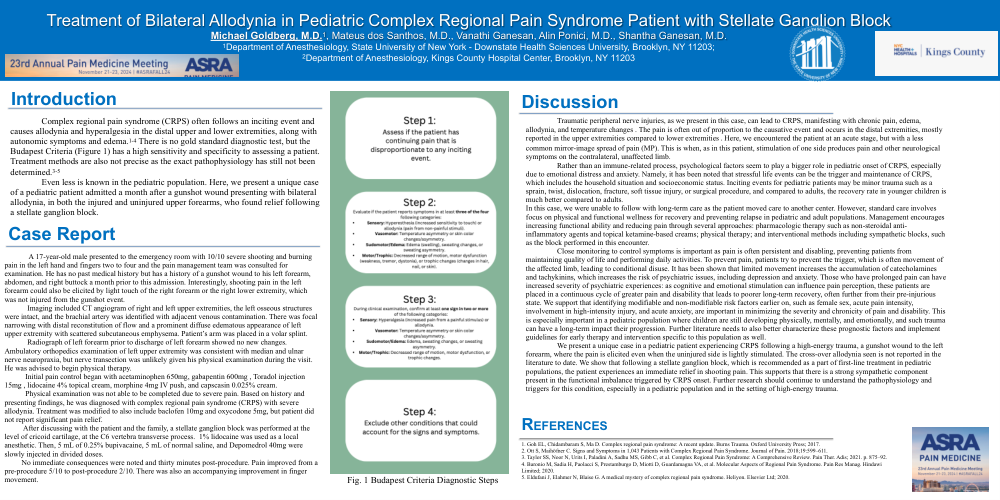
Complex regional pain syndrome (CRPS) often follows an inciting event and causes allodynia and hyperalgesia in the distal upper and lower extremities, along with autonomic symptoms and edema.1-4 There is no gold standard diagnostic test, but the Budapest Criteria (Figure 1) has a high sensitivity and specificity to assessing a patient. Treatment methods are also not precise as the exact pathophysiology has still not been determined.3-5
Even less is known in the pediatric population. Here, we present a unique case of a pediatric patient admitted a month after a gunshot wound presenting with bilateral allodynia, in both the injured and uninjured upper forearms, who found relief following a stellate ganglion block.
A 17-year-old male presented to the emergency room with 10/10 severe shooting and burning pain in the left hand and fingers two to four and the pain management team was consulted for examination. He has no past medical history but has a history of a gunshot wound to his left forearm, abdomen, and right buttock a month prior to this admission. Interestingly, shooting pain in the left forearm could also be elicited by light touch of the right forearm or the right lower extremity, which was not injured from the gunshot event.
Imaging included CT angiogram of right and left upper extremities, the left osseous structures were intact, and the brachial artery was identified with adjacent venous contamination. There was focal narrowing with distal reconstitution of flow and a prominent diffuse edematous appearance of left upper extremity with scattered subcutaneous emphysema. Patient’s arm was placed in a volar splint.
Radiograph of left forearm prior to discharge of left forearm showed no new changes. Ambulatory orthopedics examination of left upper extremity was consistent with median and ulnar nerve neuropraxia, but nerve transection was unlikely given his physical examination during the visit. He was advised to begin physical therapy.
Initial pain control began with acetaminophen 650mg, gabapentin 600mg , Toradol injection 15mg , lidocaine 4% topical cream, morphine 4mg IV push, and capscasin 0.025% cream.
Physical examination was not able to be completed due to severe pain. Based on history and presenting findings, he was diagnosed with complex regional pain syndrome (CRPS) with severe allodynia. Treatment was modified to also include baclofen 10mg and oxycodone 5mg, but patient did not report significant pain relief.
After discussing with the patient and the family, a stellate ganglion block was performed at the level of cricoid cartilage, at the C6 vertebra transverse process. 1% lidocaine was used as a local anesthetic. Then, 5 mL of 0.25% bupivacaine, 5 mL of normal saline, and Depomedrol 40mg were slowly injected in divided doses.
No immediate consequences were noted and thirty minutes post-procedure. Pain improved from a pre-procedure 5/10 to post-procedure 2/10. There was also an accompanying improvement in finger movement.
Traumatic peripheral nerve injuries, as we present in this case, can lead to CRPS, manifesting with chronic pain, edema, allodynia, and temperature changes . The pain is often out of proportion to the causative event and occurs in the distal extremities, mostly reported in the upper extremities compared to lower extremities . Here, we encountered the patient at an acute stage, but with a less common mirror-image spread of pain (MP). This is when, as in this patient, stimulation of one side produces pain and other neurological symptoms on the contralateral, unaffected limb.
Rather than an immune-related process, psychological factors seem to play a bigger role in pediatric onset of CRPS, especially due to emotional distress and anxiety. Namely, it has been noted that stressful life events can be the trigger and maintenance of CRPS, which includes the household situation and socioeconomic status. Inciting events for pediatric patients may be minor trauma such as a sprain, twist, dislocation, fracture, soft tissue injury, or surgical procedure, and compared to adults, the recovery rate in younger children is much better compared to adults.
In this case, we were unable to follow with long-term care as the patient moved care to another center. However, standard care involves focus on physical and functional wellness for recovery and preventing relapse in pediatric and adult populations. Management encourages increasing functional ability and reducing pain through several approaches: pharmacologic therapy such as non-steroidal anti-inflammatory agents and topical ketamine-based creams; physical therapy; and interventional methods including sympathetic blocks, such as the block performed in this encounter.
Close monitoring to control symptoms is important as pain is often persistent and disabling, preventing patients from maintaining quality of life and performing daily activities. To prevent pain, patients try to prevent the trigger, which is often movement of the affected limb, leading to conditional disuse. It has been shown that limited movement increases the accumulation of catecholamines and tachykinins, which increases the risk of psychiatric issues, including depression and anxiety. Those who have prolonged pain can have increased severity of psychiatric experiences: as cognitive and emotional stimulation can influence pain perception, these patients are placed in a continuous cycle of greater pain and disability that leads to poorer long-term recovery, often further from their pre-injurious state. We support that identifying modifiable and non-modifiable risk factors earlier on, such as female sex, acute pain intensity, involvement in high-intensity injury, and acute anxiety, are important in minimizing the severity and chronicity of pain and disability. This is especially important in a pediatric population where children are still developing physically, mentally, and emotionally, and such trauma can have a long-term impact their progression. Further literature needs to also better characterize these prognostic factors and implement guidelines for early therapy and intervention specific to this population as well.
We present a unique case in a pediatric patient experiencing CRPS following a high-energy trauma, a gunshot wound to the left forearm, where the pain is elicited even when the uninjured side is lightly stimulated. The cross-over allodynia seen is not reported in the literature to date. We show that following a stellate ganglion block, which is recommended as a part of first-line treatment in pediatric populations, the patient experiences an immediate relief in shooting pain. This supports that there is a strong sympathetic component present in the functional imbalance triggered by CRPS onset. Further research should continue to understand the pathophysiology and triggers for this condition, especially in a pediatric population and in the setting of high-energy trauma.