501 posters, 2 videos, 1 audios, 8 topics, 37 sessions, 395 authors, 307 institutions
ePostersLive by SciGen Technologies S.A. All rights reserved.
23rd Annual Pain Medicine Meeting 2024
November 21-23, 2024 | Caesars Palace, Las Vegas, Nevada

5851
BILATERAL ULNAR AND MEDIAN NERVE BLOCK FOR POST OPERATIVE PAIN FROM WRIST HARDWARE REMOVAL
Poster Presenter
Authors
Affiliations
Part of Topic
Medically Challenging Cases
BILATERAL ULTRASOUND GUIDED ULNAR AND MEDIAN NERVE BLOCKS FOR POST OPERATIVE PAIN FROM WRIST HARDWARE REMOVAL:
Aariya Srinivasan1,Jibran Ikram1, Ivy Co1,2, Sabry Ayad1,2
1. Department of Anesthesiology Research, Cleveland Clinic, Cleveland, OH, USA1, 2. Anesthesiology Institute, Cleveland Clinic, Cleveland, OH, USA2
INTRODUCTION:
Peripheral Nerve Blocks (PNBs) are increasingly utilized for postoperative pain management in both upper and lower extremity surgeries, forming a key component of multimodal analgesia strategies. These blocks have demonstrated significant efficacy in reducing opioid consumption when combined with other analgesic methods during the postoperative period1. Effective pain management is particularly critical in wrist surgeries, especially those involving hardware removal. Such procedures often entail considerable soft tissue manipulation and potential exposure of sensory nerves, which can result in significant postoperative discomfort. Previously, the management of postoperative pain in these cases has relied heavily on systemic opioids, which are associated with adverse effects such as nausea, vomiting, constipation, and respiratory depression.
In this case, bilateral single-shot ulnar and median nerve blocks were administered to manage postoperative pain in a patient who underwent bilateral distal radius hardware removal under general anesthesia. This approach highlights the potential for targeted analgesia to manage pain effectively while reducing reliance on opioids.
CASE PRESENTATION:
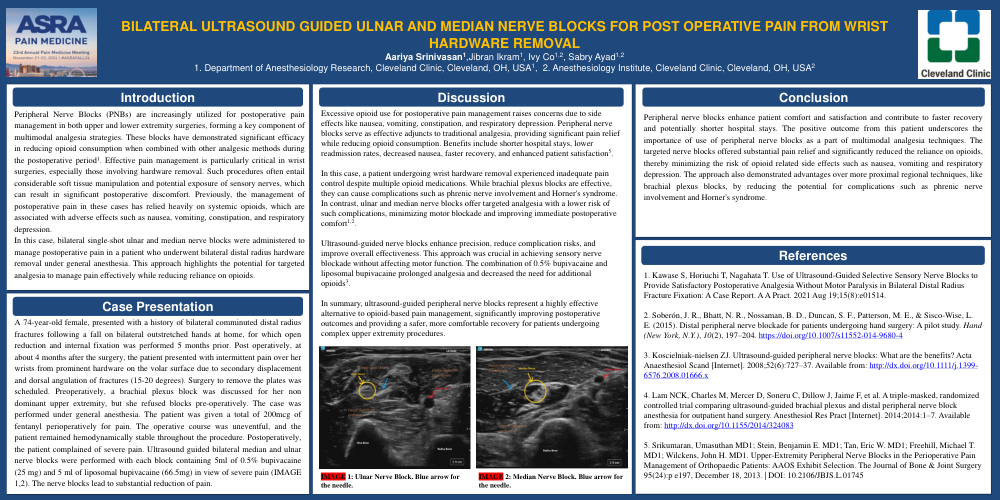
A 74-year-old female, presented with a history of bilateral comminuted distal radius fractures following a fall on bilateral outstretched hands at home, for which open reduction and internal fixation was performed 5 months prior. Post operatively, at about 4 months after the surgery, the patient presented with intermittent pain over her wrists from prominent hardware on the volar surface due to secondary displacement and dorsal angulation of fractures (15-20 degrees). Surgery to remove the plates was scheduled. Preoperatively, a brachial plexus block was discussed for her non dominant upper extremity, but she refused blocks pre-operatively. The case was performed under general anesthesia. The patient was given a total of 200mcg of fentanyl perioperatively for pain. The operative course was uneventful, and the patient remained hemodynamically stable throughout the procedure. Postoperatively, the patient complained of severe pain. Ultrasound guided bilateral median and ulnar nerve blocks were performed with each block containing 5ml of 0.5% bupivacaine (25 mg) and 5 ml of liposomal bupivacaine (66.5mg) in view of severe pain (IMAGE 1,2). The nerve blocks lead to substantial reduction of pain.
DISCUSSION:
Excessive opioid use for postoperative pain management raises concerns due to side effects like nausea, vomiting, constipation, and respiratory depression. Peripheral nerve blocks serve as effective adjuncts to traditional analgesia, providing significant pain relief while reducing opioid consumption. Benefits include shorter hospital stays, lower readmission rates, decreased nausea, faster recovery, and enhanced patient satisfaction5.
In this case, a patient undergoing wrist hardware removal experienced inadequate pain control despite multiple opioid medications. While brachial plexus blocks are effective, they can cause complications such as phrenic nerve involvement and Horner's syndrome. In contrast, ulnar and median nerve blocks offer targeted analgesia with a lower risk of such complications, minimizing motor blockade and improving immediate postoperative comfort1,2.
Ultrasound-guided nerve blocks enhance precision, reduce complication risks, and improve overall effectiveness. This approach was crucial in achieving sensory nerve blockade without affecting motor function. The combination of 0.5% bupivacaine and liposomal bupivacaine prolonged analgesia and decreased the need for additional opioids3.
In summary, ultrasound-guided peripheral nerve blocks represent a highly effective alternative to opioid-based pain management, significantly improving postoperative outcomes and providing a safer, more comfortable recovery for patients undergoing complex upper extremity procedures.
CONCLUSION:
Peripheral nerve blocks enhance patient comfort and satisfaction and contribute to faster recovery and potentially shorter hospital stays. The positive outcome from this patient underscores the importance of use of peripheral nerve blocks as a part of multimodal analgesia techniques. The targeted nerve blocks offered substantial pain relief and significantly reduced the reliance on opioids, thereby minimizing the risk of opioid related side effects such as nausea, vomiting and respiratory depression. The approach also demonstrated advantages over more proximal regional techniques, like brachial plexus blocks, by reducing the potential for complications such as phrenic nerve involvement and Horner's syndrome.
REFERENCES:
1. Kawase S, Horiuchi T, Nagahata T. Use of Ultrasound-Guided Selective Sensory Nerve Blocks to Provide Satisfactory Postoperative Analgesia Without Motor Paralysis in Bilateral Distal Radius Fracture Fixation: A Case Report. A A Pract. 2021 Aug 19;15(8):e01514.
2. Soberón, J. R., Bhatt, N. R., Nossaman, B. D., Duncan, S. F., Patterson, M. E., & Sisco-Wise, L. E. (2015). Distal peripheral nerve blockade for patients undergoing hand surgery: A pilot study. Hand (New York, N.Y.), 10(2), 197–204. https://doi.org/10.1007/s11552-014-9680-4
3. Koscielniak-nielsen ZJ. Ultrasound‐guided peripheral nerve blocks: What are the benefits? Acta Anaesthesiol Scand [Internet]. 2008;52(6):727–37. Available from: http://dx.doi.org/10.1111/j.1399-6576.2008.01666.x
4. Lam NCK, Charles M, Mercer D, Soneru C, Dillow J, Jaime F, et al. A triple-masked, randomized controlled trial comparing ultrasound-guided brachial plexus and distal peripheral nerve block anesthesia for outpatient hand surgery. Anesthesiol Res Pract [Internet]. 2014;2014:1–7. Available from: http://dx.doi.org/10.1155/2014/324083
5. Srikumaran, Umasuthan MD1; Stein, Benjamin E. MD1; Tan, Eric W. MD1; Freehill, Michael T. MD1; Wilckens, John H. MD1. Upper-Extremity Peripheral Nerve Blocks in the Perioperative Pain Management of Orthopaedic Patients: AAOS Exhibit Selection. The Journal of Bone & Joint Surgery 95(24):p e197, December 18, 2013. | DOI: 10.2106/JBJS.L.01745