501 posters, 2 videos, 1 audios, 8 topics, 37 sessions, 395 authors, 307 institutions
ePostersLive by SciGen Technologies S.A. All rights reserved.
23rd Annual Pain Medicine Meeting 2024
November 21-23, 2024 | Caesars Palace, Las Vegas, Nevada

5734
EPIDURAL BLOOD PATCH TREATMENT FOR POSTDURAL PUNCTURE HEADACHE FROM DIAGNOSTIC LUMBAR PUNCTURE IN PATIENT WITH PSEUDOTUMOR CEREBRI
Poster Presenter
Authors
Affiliations
Part of Topic
Medically Challenging Cases
Epidural Blood Patch treatment for PDPH due to diagnostic Lumbar puncture in patient with Pseudotumor Cerebri
Introduction
Epidural blood patch (EBP) is the definitive treatment for post dural puncture headache (PDPH), yet there is a paucity of information regarding its use in patients with elevated intracranial pressures at baseline. Although most commonly associated with epidural placement, the incidence of PDPH is roughly 11% during various procedures involving lumbar punctures. [1] This case presents the use of EBP in treating PDPH in a patient with psuedotumor cerebri after a diagnostic lumbar puncture
Case Description
A 28 year old female with a history of psuedotumor cerebri presented for diagnostic LP for evaluating continuation of acetazolamide. MRI imaging revealed optic sheath distention supporting the diagnosis. Procedure was performed under fluoroscopic guidance with 22-gauge spinal needle at the L2-3 interspace. Opening pressure was measured at 31 mm H2O, and 21 cc of CSF was collected. Closing pressure was measured at 22 mm H20. (5-20 mm H2O is normal, up to 25 mm H2O may be considered normal in obese patients). [2]Four days after diagnostic LP with a 3 day history of positional headache with photophobia indicative of PDPH.
She was initially treated with fluids, metaclopramide, diphenhydramine, IV caffeine, and ketorolac without significant improvement. Epidural blood patch was performed using a 25-gauge Touhy needle insert cephalad at 60 degrees angle through the interspinous ligament. Advance the epidural needle, testing for loss of resistance. Needle is inserted through ligamentum flavum and loss of resistance allows for injection of air indicates the epidural space. Draw 20cc of peripheral blood using sterile technique. Inject blood via epidural needle. According to our institutional policy informed consent is not required for case reports without patient identifiers.
Ultimately EBP performed with 20cc of blood in the L3-4 interspace. During the acute post-operative period the patient was without complications and postural headache resolved completely. Follow-up two weeks after the procedure, the patient remained symptom free and diagnostic lumbar puncture under fluoroscopic guidance was negative for significantly elevated pressures from the previous baseline. Using aseptic technique prep the skin.
Discussion
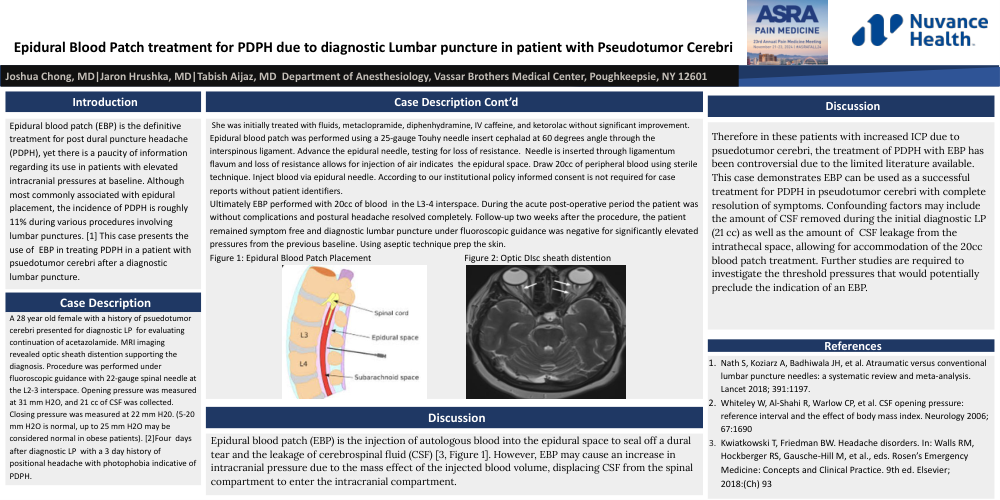
Epidural blood patch (EBP) is the injection of autologous blood into the epidural space to seal off a dural tear and the leakage of cerebrospinal fluid (CSF) [3, Figure 1]. However, EBP may cause an increase in intracranial pressure due to the mass effect of the injected blood volume, displacing CSF from the spinal compartment to enter the intracranial compartment.
Therefore in these patients with increased ICP due to psuedotumor cerebri, the treatment of PDPH with EBP has been controversial due to the limited literature available. This case demonstrates EBP can be used as a successful treatment for PDPH in pseudotumor cerebri with complete resolution of symptoms. Confounding factors may include the amount of CSF removed during the initial diagnostic LP (21 cc) as well as the amount of CSF leakage from the intrathecal space, allowing for accommodation of the 20cc blood patch treatment. Further studies are required to investigate the threshold pressures that would potentially preclude the indication of an EBP.
-
Nath S, Koziarz A, Badhiwala JH, et al. Atraumatic versus conventional lumbar puncture needles: a systematic review and meta-analysis. Lancet 2018; 391:1197.
-
Whiteley W, Al-Shahi R, Warlow CP, et al. CSF opening pressure: reference interval and the effect of body mass index. Neurology 2006; 67:1690
-
Kwiatkowski T, Friedman BW. Headache disorders. In: Walls RM, Hockberger RS, Gausche-Hill M, et al., eds. Rosen’s Emergency Medicine: Concepts and Clinical Practice. 9th ed. Elsevier; 2018:(Ch) 93