501 posters, 2 videos, 1 audios, 8 topics, 37 sessions, 395 authors, 307 institutions
ePostersLive by SciGen Technologies S.A. All rights reserved.
23rd Annual Pain Medicine Meeting 2024
November 21-23, 2024 | Caesars Palace, Las Vegas, Nevada

5733
COMBINED SPINAL-EPIDURAL ANESTHESIA IN A PATIENT WITH BILATERAL VOCAL CORD PARALYSIS AND FORMALIZED STOMA
Poster Presenter
Authors
Affiliations
Part of Topic
Medically Challenging Cases
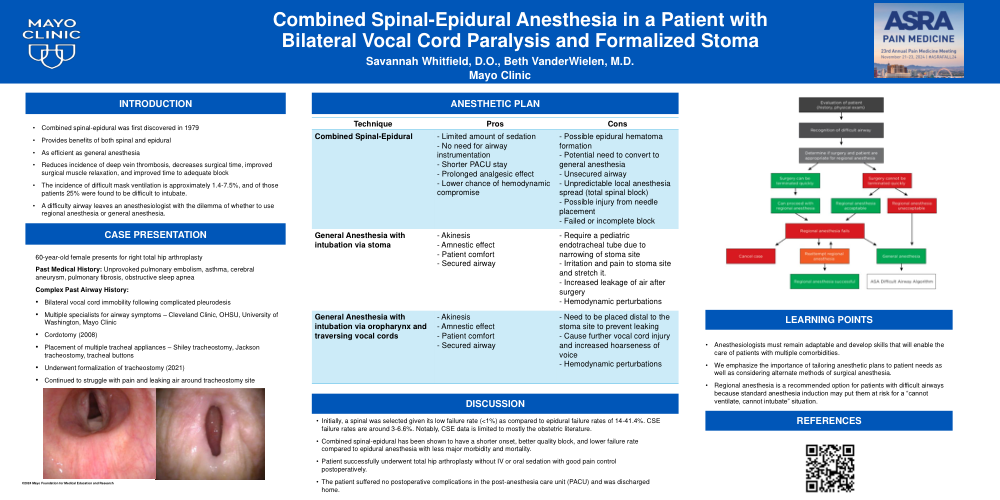
Combined Spinal-Epidural Anesthesia in a Patient with Bilateral Vocal Cord Paralysis and Formalized Stoma
Introduction:
•Combined spinal-epidural was first discovered in 1979
•Provides benefits of both spinal and epidural
•As efficient as general anesthesia
•Reduces incidence of deep vein thrombosis, decreases surgical time, improved surgical muscle relaxation, and improved time to adequate block
•The incidence of difficult mask ventilation is approximately 1.4-7.5%, and of those patients 25% were found to be difficult to intubate.
•A difficulty airway leaves an anesthesiologist with the dilemma of whether to use regional anesthesia or general anesthesia.
Case Presentation:
60-year-old female presents for right total hip arthroplasty
Past Medical History: Unprovoked pulmonary embolism, asthma, cerebral aneurysm, pulmonary fibrosis, obstructive sleep apnea
Complex Past Airway History:
•Bilateral vocal cord immobility following complicated pleurodesis
•Multiple specialists for airway symptoms – Cleveland Clinic, OHSU, University of Washington, Mayo Clinic
•Cordotomy (2008)
•Placement of multiple tracheal appliances – Shiley tracheostomy, Jackson tracheostomy, tracheal buttons
•Underwent formalization of tracheostomy (2021)
•Continued to struggle with pain and leaking air around tracheostomy site
Discussion:
•Initially, a spinal was selected given its low failure rate (<1%) as compared to epidural failure rates of 14-41.4%. CSE failure rates are around 3-6.6%. Notably, CSE data is limited to mostly the obstetric literature.
•Combined spinal-epidural has been shown to have a shorter onset, better quality block, and lower failure rate compared to epidural anesthesia with less major morbidity and mortality.
•Patient successfully underwent total hip arthroplasty without IV or oral sedation with good pain control postoperatively.
•The patient suffered no postoperative complications in the post-anesthesia care unit (PACU) and was discharged home.
Learning Points:
•Anesthesiologists must remain adaptable and develop skills that will enable the care of patients with multiple comorbidities.
•We emphasize the importance of tailoring anesthetic plans to patient needs as well as considering alternate methods of surgical anesthesia.
•Regional anesthesia is a recommended option for patients with difficult airways because standard anesthesia induction may put them at risk for a “cannot ventilate, cannot intubate” situation.