501 posters, 2 videos, 1 audios, 8 topics, 37 sessions, 395 authors, 307 institutions
ePostersLive by SciGen Technologies S.A. All rights reserved.
23rd Annual Pain Medicine Meeting 2024
November 21-23, 2024 | Caesars Palace, Las Vegas, Nevada

5704
SPINAL CORD STIMULATOR PLACEMENT IN A PATIENT WITH MITOCHONDRIAL MYOPATHY
Poster Presenter
Authors
Affiliations
Part of Topic
Medically Challenging Cases
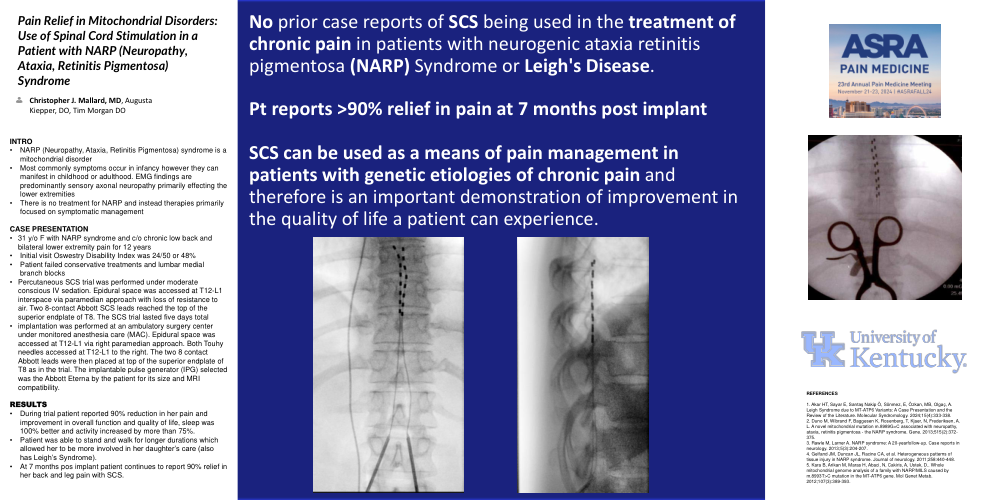
Pain Relief in Mitochondrial Disorders: Use of Spinal Cord Stimulation in a Patient with NARP (Neuropathy, Ataxia, Retinitis Pigmentosa) Syndrome
INTRO
•NARP (Neuropathy, Ataxia, Retinitis Pigmentosa) syndrome is a mitochondrial disorder
•Most commonly symptoms occur in infancy however they can manifest in childhood or adulthood. EMG findings are predominantly sensory axonal neuropathy primarily effecting the lower extremities
•There is no treatment for NARP and instead therapies primarily focused on symptomatic management
CASE PRESENTATION
•31 y/o F with NARP syndrome and c/o chronic low back and bilateral lower extremity pain for 12 years
•Initial visit Oswestry Disability Index was 24/50 or 48%
•Patient failed conservative treatments and lumbar medial branch blocks
•Percutaneous SCS trial was performed under moderate conscious IV sedation. Epidural space was accessed at T12-L1 interspace via paramedian approach with loss of resistance to air. Two 8-contact Abbott SCS leads reached the top of the superior endplate of T8. The SCS trial lasted five days total
•implantation was performed at an ambulatory surgery center under monitored anesthesia care (MAC). Epidural space was accessed at T12-L1 via right paramedian approach. Both Touhy needles accessed at T12-L1 to the right. The two 8 contact Abbott leads were then placed at top of the superior endplate of T8 as in the trial. The implantable pulse generator (IPG) selected was the Abbott Eterna by the patient for its size and MRI compatibility.
RESULTS
•During trial patient reported 90% reduction in her pain and improvement in overall function and quality of life, sleep was 100% better and activity increased by more than 75%.
•Patient was able to stand and walk for longer durations which allowed her to be more involved in her daughter’s care (also has Leigh’s Syndrome).
At 7 months post implant patient continues to report 90% pain relief.