501 posters, 2 videos, 1 audios, 8 topics, 37 sessions, 395 authors, 307 institutions
ePostersLive by SciGen Technologies S.A. All rights reserved.
23rd Annual Pain Medicine Meeting 2024
November 21-23, 2024 | Caesars Palace, Las Vegas, Nevada

6308
EPIDURAL STEROID INJECTION FOR RADICULAR PAIN IN CONGENITAL MYASTHENIC SYNDROME: CONSIDERATIONS FOR THE PAIN PHYSICIAN
Poster Presenter
Authors
Affiliations
Part of Topic
Medically Challenging Cases
Successful Pediatric Epidural Steroid Injection for Radicular Pain in Congenital Myasthenic Syndrome: Considerations for the Pain Physician
Munfarid Zaidi, MD; Henry Huang, MD
Baylor College of Medicine, Texas Children’s Hospital
INTRODUCTION
Congenital myasthenic syndromes (CMS) are:
Childhood presentations can be complicated by neuropathic pain
Epidural steroid injections (ESI) involve the administration of medicines associated with increased risk of muscle weakness in CMS
CASE PRESENTATION
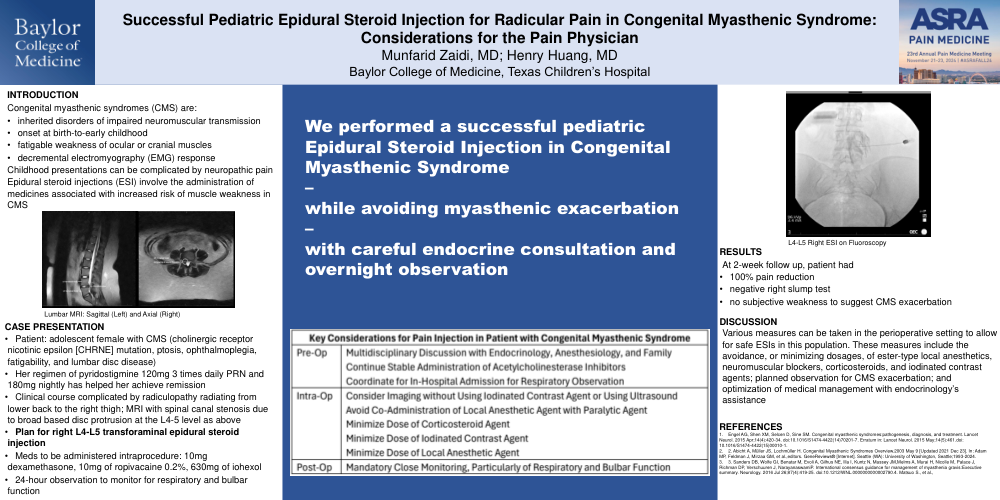
We performed a successful pediatric Epidural Steroid Injection in Congenital Myasthenic Syndrome
–
while avoiding myasthenic exacerbation
–
with careful endocrine consultation and overnight observation
RESULTS
At 2-week follow up, patient had
DISCUSSION
Various measures can be taken in the perioperative setting to allow for safe ESIs in this population. These measures include the avoidance, or minimizing dosages, of ester-type local anesthetics, neuromuscular blockers, corticosteroids, and iodinated contrast agents; planned observation for CMS exacerbation; and optimization of medical management with endocrinology’s assistance