501 posters, 2 videos, 1 audios, 8 topics, 37 sessions, 395 authors, 307 institutions
ePostersLive by SciGen Technologies S.A. All rights reserved.
23rd Annual Pain Medicine Meeting 2024
November 21-23, 2024 | Caesars Palace, Las Vegas, Nevada

6029
REGIONAL ANESTHETIC APPROACH TO PERSISTENT PMVT: STELLATE GANGLION BLOCK
Poster Presenter
Authors
Affiliations
University of Southern California KSOM Anesthesiology Residency
Part of Topic
Medically Challenging Cases
Regional Anesthetic Approach to Persistent PMVT: Stellate Ganglion Block
Sahej Samra, MD, Gautham Pavar, MD, Aseem Hemmad, MD
Department of Pain Medicine, University of Southern California Keck School of Medicine & LA General Medical Center, Los Angeles, CA
Introduction
Polymorphic ventricular tachycardia (PMVT) is a life-threatening arrhythmia associated with sympathetic nervous system activation (SNS) (1). The arrhythmia involves a changing QRS pattern that can cause debilitating symptoms, and is often associated with underlying cardiac conditions (i.e. channelopathies, ischemic heart disease, electrolyte abnormalities). If left untreated, PMVT can deteriorate into ventricular fibrillation, leading to sudden cardiac arrest & death. While PMVT has traditionally been treated with various strategies (antiarrhythmic medications, electrical cardioversion, implantable cardioverter defibrillator (ICD) placement), it can also be treated with a regional anesthetic technique, the stellate ganglion block (SGB).
Case Presentation
We report the case of a 68F with a complicated medical history who first presented with inferior STEMI of the ostial and proximal RCA. The patient then experienced runs of non-sustained ventricular tachycardia (NSVT) as captured on telemetry. A dual chamber PPM/ICD was placed after an episode of pulseless VT arrest. She continued to experience intermittent VT, resulting in defibrillations from her ICD. She had repeated episodes of PMVT despite being on an amiodarone and lidocaine gtt. The regional anesthesia team was consulted for SGB as a potential therapeutic intervention regarding her refractory PMVT.
At the time of anesthesia consultation, it was determined (via device interrogation) the patient had experienced multiple episodes of pleomorphic VT initiated with a PVC mediated R on T phenomenon.
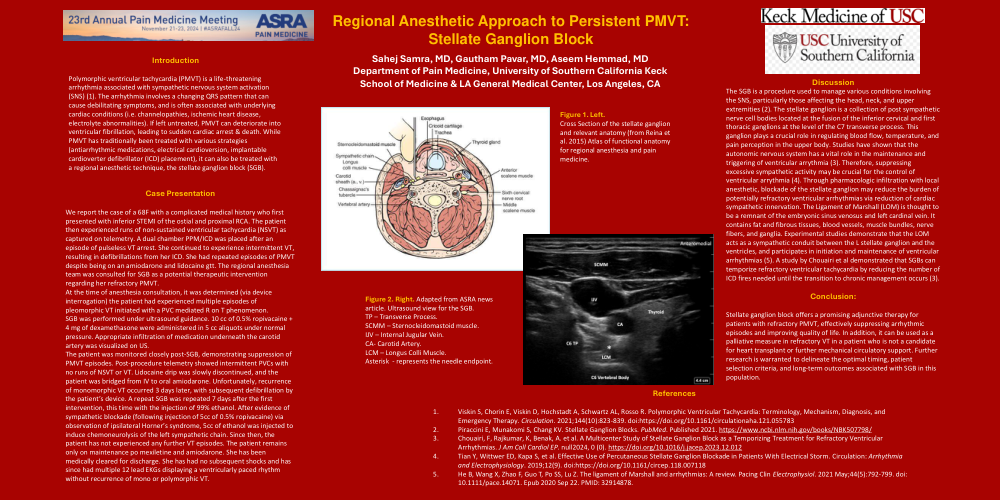
SGB was performed under ultrasound guidance. 10 cc of 0.5% ropivacaine + 4 mg of dexamethasone were administered in 5 cc aliquots under normal pressure. Appropriate infiltration of medication underneath the carotid artery was visualized on US.
The patient was monitored closely post-SGB, demonstrating suppression of PMVT episodes. Post-procedure telemetry showed intermittent PVCs with no runs of NSVT or VT. Lidocaine drip was slowly discontinued, and the patient was bridged from IV to oral amiodarone. Unfortunately, recurrence of monomorphic VT occurred 3 days later, with subsequent defibrillation by the patient’s device. A repeat SGB was repeated 7 days after the first intervention, this time with the injection of 99% ethanol. After evidence of sympathetic blockade (following injection of 5cc of 0.5% ropivacaine) via observation of ipsilateral Horner’s syndrome, 5cc of ethanol was injected to induce chemoneurolysis of the left sympathetic chain. Since then, the patient has not experienced any further VT episodes. The patient remains only on maintenance po mexiletine and amiodarone. She has been medically cleared for discharge. She has had no subsequent shocks and has since had multiple 12 lead EKGs displaying a ventricularly paced rhythm without recurrence of mono or polymorphic VT.
Discussion
The SGB is a procedure used to manage various conditions involving the SNS, particularly those affecting the head, neck, and upper extremities (2). The stellate ganglion is a collection of post sympathetic nerve cell bodies located at the fusion of the inferior cervical and first thoracic ganglions at the level of the C7 transverse process. This ganglion plays a crucial role in regulating blood flow, temperature, and pain perception in the upper body. Studies have shown that the autonomic nervous system has a vital role in the maintenance and triggering of ventricular arrythmia (3). Therefore, suppressing excessive sympathetic activity may be crucial for the control of ventricular arrythmia (4). Through pharmacologic infiltration with local anesthetic, blockade of the stellate ganglion may reduce the burden of potentially refractory ventricular arrhythmias via reduction of cardiac sympathetic innervation. The Ligament of Marshall (LOM) is thought to be a remnant of the embryonic sinus venosus and left cardinal vein. It contains fat and fibrous tissues, blood vessels, muscle bundles, nerve fibers, and ganglia. Experimental studies demonstrate that the LOM acts as a sympathetic conduit between the L stellate ganglion and the ventricles, and participates in initiation and maintenance of ventricular arrhythmias (5). A study by Chouairi et al demonstrated that SGBs can temporize refractory ventricular tachycardia by reducing the number of ICD fires needed until the transition to chronic management occurs (3).
Conclusion:
Stellate ganglion block offers a promising adjunctive therapy for patients with refractory PMVT, effectively suppressing arrhythmic episodes and improving quality of life. In addition, it can be used as a palliative measure in refractory VT in a patient who is not a candidate for heart transplant or further mechanical circulatory support. Further research is warranted to delineate the optimal timing, patient selection criteria, and long-term outcomes associated with SGB in this population.
References
Figure 1. Left.
Cross Section of the stellate ganglion and relevant anatomy (from Reina et al. 2015) Atlas of functional anatomy for regional anesthesia and pain medicine.
Figure 2. Right. Adapted from ASRA news article. Ultrasound view for the SGB.
TP – Transverse Process.
SCMM – Sternocleidomastoid muscle.
IJV – Internal Jugular Vein.
CA- Carotid Artery.
LCM – Longus Colli Muscle.
Asterisk - represents the needle endpoint.