501 posters, 2 videos, 1 audios, 8 topics, 37 sessions, 395 authors, 307 institutions
ePostersLive by SciGen Technologies S.A. All rights reserved.
23rd Annual Pain Medicine Meeting 2024
November 21-23, 2024 | Caesars Palace, Las Vegas, Nevada

6010
A SUPERIOR HYPOGASTRIC PLEXUS BLOCK FOR MANAGING CHRONIC PELVIC PAIN AFTER KIDNEY AUTOTRANSPLANTATION
Poster Presenter
Authors
Affiliations
Part of Topic
Medically Challenging Cases
Superior Hypogastric Plexus Block for Managing Chronic Pelvic Pain after Kidney Autotransplantation
Abanoub Tadrousse, DO1,Thomas DiSanto, MD1, Anthony Bishara, BA 2 , Mina Gaballa, DO 1
Chronic pelvic pain (CPP) is defined as pain in the pelvic region persisting for more than six months, commonly stemming from mechanical, inflammatory, or neuropathic etiologies. Common etiologies of CPP: gastrointestinal, urological, and gynecological conditions. Conservative treatment often yields suboptimal relief. Superior hypogastric plexus (SHP) block is an interventional technique traditionally performed for oncological pain management. This case highlights the use of pulsed radiofrequency (PRF) of the SHP for the management of refractory CPP in a patient with a complex medical history.
A 54-year-old female with a history of nutcracker syndrome, kidney autotransplantation, and multiple urological interventions, presented with chronic left lower quadrant (LLQ) abdominal pain. Pain characterized as constant, stabbing, radiating to the lower back, and rated at 6/10 on the pain scale, exacerbated by abdominal straining. Denied any associated neuropathic symptoms such as numbness or weakness. Previous conservative treatments, including ibuprofen, gabapentin, and Xanax, were ineffective in providing long-term symptom relief. Physical examination revealed significant LLQ tenderness on deep palpation.
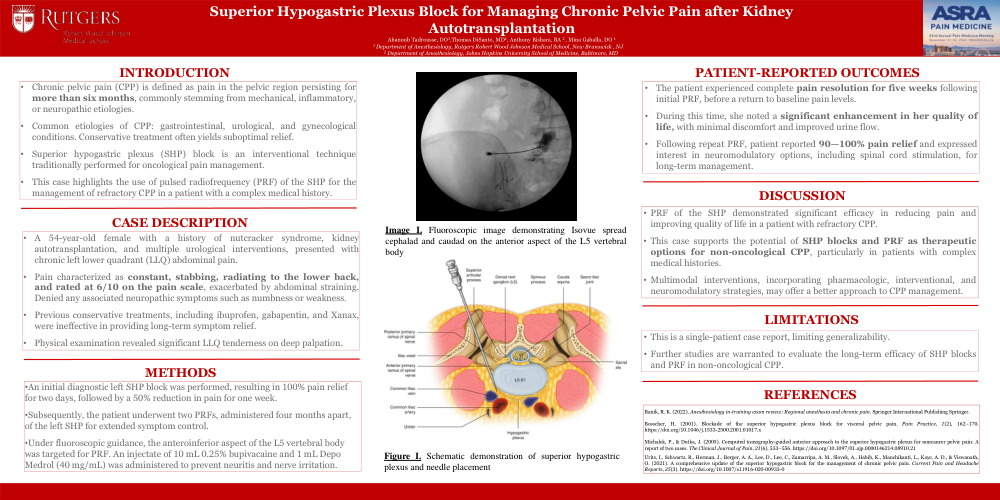
An initial diagnostic left SHP block was performed, resulting in 100% pain relief for two days, followed by a 50% reduction in pain for one week.Subsequently, the patient underwent two PRFs, administered four months apart, of the left SHP for extended symptom control. Under fluoroscopic guidance, the anteroinferior aspect of the L5 vertebral body was targeted for PRF. An injectate of 10 mL 0.25% bupivacaine and 1 mL Depo Medrol (40 mg/mL) was administered to prevent neuritis and nerve irritation.
The patient experienced complete pain resolution for five weeks following initial PRF, before a return to baseline pain levels. During this time, she noted a significant enhancement in her quality of life, with minimal discomfort and improved urine flow. Following repeat PRF, patient reported 90—100% pain relief and expressed interest in neuromodulatory options, including spinal cord stimulation, for long-term management.
PRF of the SHP demonstrated significant efficacy in reducing pain and improving quality of life in a patient with refractory CPP. This case supports the potential of SHP blocks and PRF as therapeutic options for non-oncological CPP, particularly in patients with complex medical histories. Multimodal interventions, incorporating pharmacologic, interventional, and neuromodulatory strategies, may offer a better approach to CPP management.
This is a single-patient case report, limiting generalizability. Further studies are warranted to evaluate the long-term efficacy of SHP blocks and PRF in non-oncological CPP.