501 posters, 2 videos, 1 audios, 8 topics, 37 sessions, 395 authors, 307 institutions
ePostersLive by SciGen Technologies S.A. All rights reserved.
23rd Annual Pain Medicine Meeting 2024
November 21-23, 2024 | Caesars Palace, Las Vegas, Nevada

5950
BUPRENORPHINE TO METHADONE CONVERSION FOR ACUTE PAIN MANAGEMENT IN A PATIENT WITH SUBSTANCE USE DISORDER
Poster Presenter
Authors
Affiliations
Part of Topic
Medically Challenging Cases
Buprenorphine to Methadone Conversion For Acute Pain Management in a Patient with Substance Use Disorder
Rakhi Dayal MD, George Mina BS
UCI School of Medicine
Introduction
-
Acute pain management is challenging, especially with rising trends in substance use disorders.
-
Lack of addiction medicine specialists often leaves pain management physicians responsible for managing untreated substance use disorders.
-
A recent NIH study found that 74% of physicians reported insufficient skill, and 72% reported inadequate knowledge in managing addiction.
-
This case focuses on the pharmacological conversion to Methadone for a patient with recent high-dose Fentanyl and Suboxone use, and examines the correlation between Fentanyl dosage and Methadone recommendations.
Case Description
-
Patient: 28-year-old male with daily 1g Fentanyl use, recent Suboxone use (2 mg QID), and legal constraints on his medical record.
-
Presented with uncontrolled pain after facial wound exploration surgery.
-
Initial pain management:
-
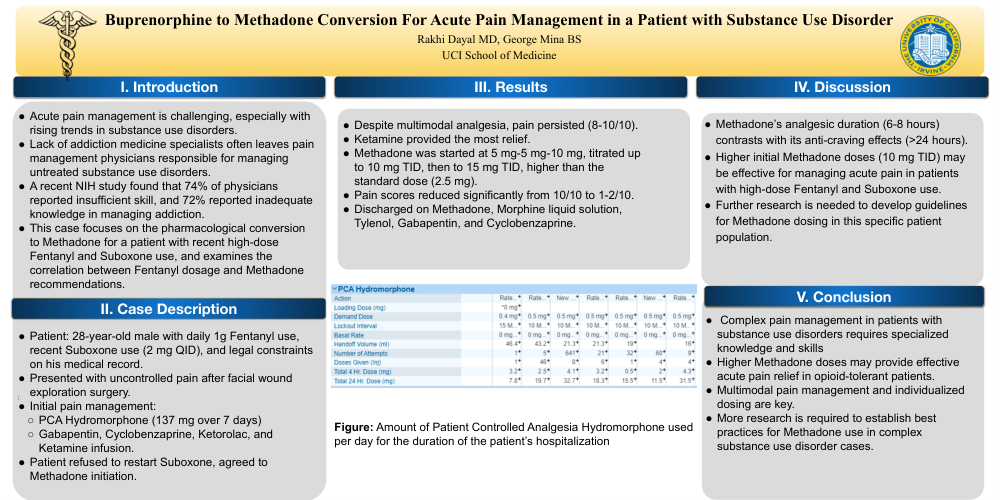
PCA Hydromorphone (137 mg over 7 days)
-
Gabapentin, Cyclobenzaprine, Ketorolac, and Ketamine infusion.
-
Patient refused to restart Suboxone, agreed to Methadone initiation.
Results
-
Despite multimodal analgesia, pain persisted (8-10/10).
-
Ketamine provided the most relief.
-
Methadone was started at 5 mg-5 mg-10 mg, titrated up to 10 mg TID, then to 15 mg TID, higher than the standard dose (2.5 mg).
-
Pain scores reduced significantly from 10/10 to 1-2/10.
-
Discharged on Methadone, Morphine liquid solution, Tylenol, Gabapentin, and Cyclobenzaprine.
Discussion
-
Methadone’s analgesic duration (6-8 hours) contrasts with its anti-craving effects (>24 hours).
-
Higher initial Methadone doses (10 mg TID) may be effective for managing acute pain in patients with high-dose Fentanyl and Suboxone use.
-
Further research is needed to develop guidelines for Methadone dosing in this specific patient population.
Conclusion
-
Complex pain management in patients with substance use disorders requires specialized knowledge and skills
-
Higher Methadone doses may provide effective acute pain relief in opioid-tolerant patients.
-
Multimodal pain management and individualized dosing are key.
-
More research is required to establish best practices for Methadone use in complex substance use disorder cases.
-
-
-
-