501 posters, 2 videos, 1 audios, 8 topics, 37 sessions, 395 authors, 307 institutions
ePostersLive by SciGen Technologies S.A. All rights reserved.
23rd Annual Pain Medicine Meeting 2024
November 21-23, 2024 | Caesars Palace, Las Vegas, Nevada

5901
CASE REPORT: CONSECUTIVE MULTI-LEVEL KYPHOPLASTY RELATED TO DISCONTINUATION OF DENOSUMAB
Poster Presenter
Authors
Affiliations
Part of Topic
Medically Challenging Cases
Vertebral compression fractures are a result of axial or compressive load with biomechanical failure of the bone, frequently compromising the anterior half of the vertebral body. Studies have demonstrated that cement augmentation improves pain relief, quality of life, and functional recovery compared to conservative care. While there is evidence that early kyphoplasty can decrease the risk for adjacent vertebral fractures, there is also evidence that the likelihood of an adjacent level fracture increases within sixty days of the procedure. Therefore it is important that underlying causes of osteoporosis be addressed before or concurrently with the kyphoplasty to avoid adjacent level injury.
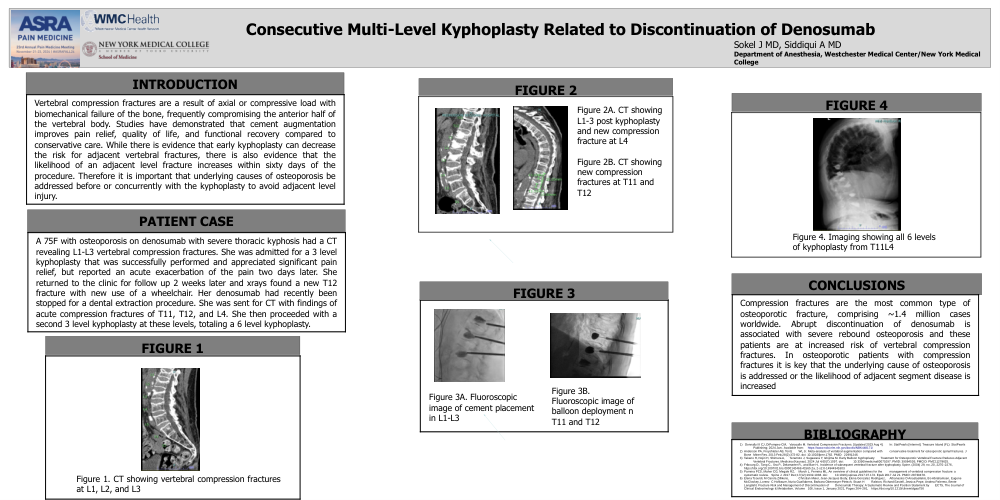
A 75F with osteoporosis on denosumab with severe thoracic kyphosis had a CT revealing L1-L3 vertebral compression fractures. She was admitted for a 3 level kyphoplasty that was successfully performed and appreciated significant pain relief, but reported an acute exacerbation of the pain two days later. She returned to the clinic for follow up 2 weeks later and xrays found a new T12 fracture with new use of a wheelchair. Her denosumab had recently been stopped for a dental extraction procedure. She was sent for CT with findings of acute compression fractures of T11, T12, and L4. She then proceeded with a second 3 level kyphoplasty at these levels, totaling a 6 level kyphoplasty.
Compression fractures are the most common type of osteoporotic fracture, comprising ~1.4 million cases worldwide. Abrupt discontinuation of denosumab is associated with severe rebound osteoporosis and these patients are at increased risk of vertebral compression fractures. In osteoporotic patients with compression fractures it is key that the underlying cause of osteoporosis is addressed or the likelihood of adjacent segment disease is increased