501 posters, 2 videos, 1 audios, 8 topics, 37 sessions, 395 authors, 307 institutions
ePostersLive by SciGen Technologies S.A. All rights reserved.
23rd Annual Pain Medicine Meeting 2024
November 21-23, 2024 | Caesars Palace, Las Vegas, Nevada

5897
INTERCOSTAL NERVE BLOCK (ICNB) IS AN EFFECTIVE NON-OPIOID PAIN MANAGEMENT MODALITY FOR RIB FRACTURES.
Poster Presenter
Authors
Affiliations
Part of Topic
Medically Challenging Cases
Intercostal Nerve Block (ICNB) is an Effective Non-Opioid Pain Management Modality for Rib Fractures
Jin Yoo, M.D.1, Andrew Ryu , M.D. 1, Oktay Shuminov, M.D. 1
1Northwell Health, Bay Shore, NY, 11706.
Early pain control in patients with traumatic chest injuries are associated with improved outcomes (Proaño-Zamudio 2023). Opioids are often sought as an efficient modality in the emergency department (Todd 2007). Yet, with the development of multimodal pain regimens and ultrasound-guided regional anesthesia, providers now have more alternatives for pain management. Targeted intercostal nerve blocks (ICNB) may be an effective analgesic to reduce opioid exposure in patients with rib fractures.
Case reports of up to three patients are exempt from IRB review per institutional policy. Usage of medications involved abide by FDA indications. All participants provided informed consent for retrospective data collection in this report, which excludes any protected health information.
Patients presenting in July 2024 with rib fractures who received ICNBs were selected at a random time point in consecutive order. Exclusion criteria was receiving an ICNB with liposomal
bupivacaine. An anesthesiologist performed ultrasound-guided ICNBs within 24 hours of patient presentation. All blocks consisted of divided doses of bupivacaine hydrochloride 0.25% with 0.5cc of dexamethasone sodium phosphate (10mg/cc, preservative-free), used due to its synergistic properties (Vieira 2010).
Demographic information include gender, age, pulmonary comorbidities, trauma etiology, injuries on presentation imaging, pain location, rib fracture and ICNB location, ICNB bupivacaine volume, and pre-arrival analgesic prescriptions. Primary outcome was prescription of opioids at discharge. Secondary outcomes were Pain Inspiration Cough (PIC) scores over hospital course, relative pain scores or descriptions, hospital length of stay (LOS), intensive care unit (ICU) LOS, opioid and non-opioid analgesics received, and discharged non-opioid analgesic prescriptions.
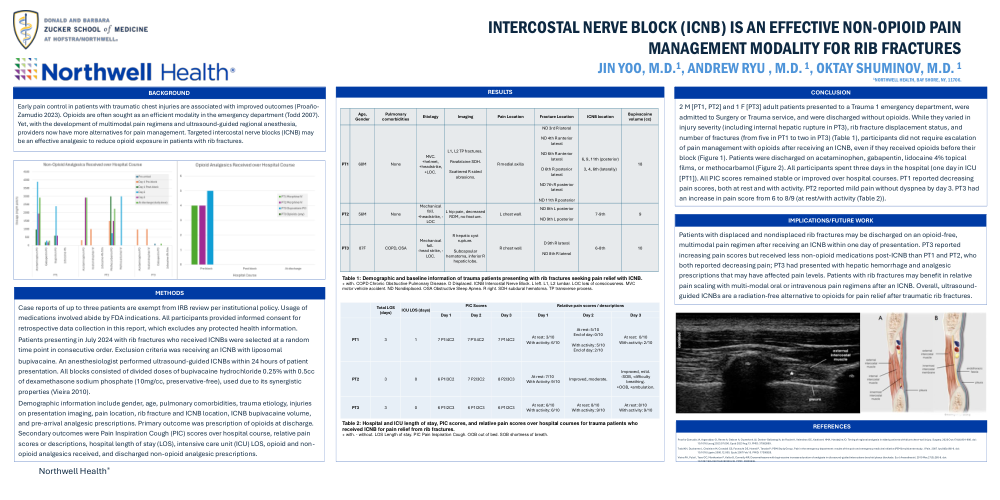
2 M [PT1, PT2] and 1 F [PT3] adult patients presented to a Trauma 1 emergency department, were admitted to Surgery or Trauma service, and were discharged without opioids. While they varied in injury severity (including internal hepatic rupture in PT3), rib fracture displacement status, and number of fractures (from five in PT1 to two in PT3) (Table 1), participants did not require escalation of pain management with opioids after receiving an ICNB, even if they received opioids before their block (Figure 1). Patients were discharged on acetaminophen, gabapentin, lidocaine 4% topical films, or methocarbamol (Figure 2). All participants spent three days in the hospital (one day in ICU [PT1]). All PIC scores remained stable or improved over hospital courses. PT1 reported decreasing pain scores, both at rest and with activity. PT2 reported mild pain without dyspnea by day 3. PT3 had an increase in pain score from 6 to 8/9 (at rest/with activity (Table 2)).
Patients with displaced and nondisplaced rib fractures may be discharged on an opioid-free, multimodal pain regimen after receiving an ICNB within one day of presentation. PT3 reported increasing pain scores but received less non-opioid medications post-ICNB than PT1 and PT2, who both reported decreasing pain; PT3 had presented with hepatic hemorrhage and analgesic prescriptions that may have affected pain levels. Patients with rib fractures may benefit in relative pain scaling with multi-modal oral or intravenous pain regimens after an ICNB. Overall, ultrasound-guided ICNBs are a radiation-free alternative to opioids for pain relief after traumatic rib fractures.