501 posters, 2 videos, 1 audios, 8 topics, 37 sessions, 395 authors, 307 institutions
ePostersLive by SciGen Technologies S.A. All rights reserved.
23rd Annual Pain Medicine Meeting 2024
November 21-23, 2024 | Caesars Palace, Las Vegas, Nevada

5847
VASTUS LATERALIS NERVE BLOCK IN KNEE HARDWARE REMOVAL SURGERY
Poster Presenter
Authors
Affiliations
Part of Topic
Medically Challenging Cases
VASTUS LATERALIS NERVE BLOCK FOR KNEE SURGERY:
Aariya Srinivasan1,Jibran Ikram1, Cassandra Williams1, Nicholas Swerchowsky1,2, Sabry Ayad1,2
1. Department of Anesthesiology Research, Cleveland Clinic, Cleveland, OH, USA1, 2. Anesthesiology Institute, Cleveland Clinic, Cleveland, OH, USA2
INTRODUCTION
Pain control following knee surgery can be challenging, as the exquisite pain felt intraoperatively and postoperatively must be addressed while there is also a need to preserve mobility for physical therapy1.Regional anesthesia can be used to decrease intraoperative and/or postoperative pain while reducing opioid consumption. Our case involves a patient who underwent hardware removal surgery under general anesthesia with severe postoperative pain. Rescuing peripheral nerve blocks, including the vastus lateralis block, was performed and resulted in complete pain resolution.
CASE PRESENTATION
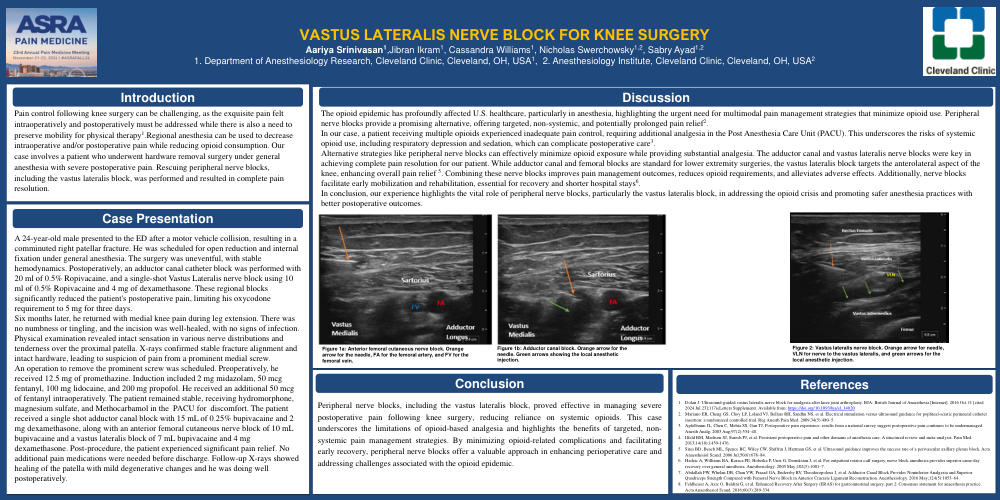
A 24-year-old male presented to the ED after a motor vehicle collision, resulting in a comminuted right patellar fracture. He was scheduled for open reduction and internal fixation under general anesthesia. The surgery was uneventful, with stable hemodynamics. Postoperatively, an adductor canal catheter block was performed with 20 ml of 0.5% Ropivacaine, and a single-shot Vastus Lateralis nerve block using 10 ml of 0.5% Ropivacaine and 4 mg of dexamethasone. These regional blocks significantly reduced the patient's postoperative pain, limiting his oxycodone requirement to 5 mg for three days.
Six months later, he returned with medial knee pain during leg extension. There was no numbness or tingling, and the incision was well-healed, with no signs of infection. Physical examination revealed intact sensation in various nerve distributions and tenderness over the proximal patella. X-rays confirmed stable fracture alignment and intact hardware, leading to suspicion of pain from a prominent medial screw.
An operation to remove the prominent screw was scheduled. Preoperatively, he received 12.5 mg of promethazine. Induction included 2 mg midazolam, 50 mcg fentanyl, 100 mg lidocaine, and 200 mg propofol. He received an additional 50 mcg of fentanyl intraoperatively. The patient remained stable, receiving hydromorphone, magnesium sulfate, and Methocarbamol in the PACU for discomfort. The patient received a single shot adductor canal block with 15 mL of 0.25% bupivacaine and 2 mg dexamethasone, along with an anterior femoral cutaneous nerve block of 10 mL bupivacaine and a vastus lateralis block of 7 mL bupivacaine and 4 mg dexamethasone. Post-procedure, the patient experienced significant pain relief. No additional pain medications were needed before discharge. Follow-up X-rays showed healing of the patella with mild degenerative changes and he was doing well postoperatively.
DISCUSSION
The opioid epidemic has profoundly affected U.S. healthcare, particularly in anesthesia, highlighting the urgent need for multimodal pain management strategies that minimize opioid use. Peripheral nerve blocks provide a promising alternative, offering targeted, non-systemic, and potentially prolonged pain relief2.
In our case, a patient receiving multiple opioids experienced inadequate pain control, requiring additional analgesia in the Post Anesthesia Care Unit (PACU). This underscores the risks of systemic opioid use, including respiratory depression and sedation, which can complicate postoperative care3.
Alternative strategies like peripheral nerve blocks can effectively minimize opioid exposure while providing substantial analgesia. The adductor canal and vastus lateralis nerve blocks were key in achieving complete pain resolution for our patient. While adductor canal and femoral blocks are standard for lower extremity surgeries, the vastus lateralis block targets the anterolateral aspect of the knee, enhancing overall pain relief 5. Combining these nerve blocks improves pain management outcomes, reduces opioid requirements, and alleviates adverse effects. Additionally, nerve blocks facilitate early mobilization and rehabilitation, essential for recovery and shorter hospital stays6.
In conclusion, our experience highlights the vital role of peripheral nerve blocks, particularly the vastus lateralis block, in addressing the opioid crisis and promoting safer anesthesia practices with better postoperative outcomes.
CONCLUSION
Peripheral nerve blocks, including the vastus lateralis block, proved effective in managing severe postoperative pain following knee surgery, reducing reliance on systemic opioids. This case underscores the limitations of opioid-based analgesia and highlights the benefits of targeted, non-systemic pain management strategies. By minimizing opioid-related complications and facilitating early recovery, peripheral nerve blocks offer a valuable approach in enhancing perioperative care and addressing challenges associated with the opioid epidemic.
REFERENCES