501 posters, 2 videos, 1 audios, 8 topics, 37 sessions, 395 authors, 307 institutions
ePostersLive by SciGen Technologies S.A. All rights reserved.
23rd Annual Pain Medicine Meeting 2024
November 21-23, 2024 | Caesars Palace, Las Vegas, Nevada

5805
BUPRENORPHINE INDUCTION IN PATIENT WITH HISTORY OF DELUSIONAL PARASITOSIS AND ACUTE ON CHRONIC PAIN OF SELF-INFLICTED SCALP WOUND
Poster Presenter
Authors
Affiliations
Part of Topic
Medically Challenging Cases
Delusions, Dependence, and Pain:
Buprenorphine Induction in Patient with History of Delusional Parasitosis and Acute on Chronic Pain of Self-Inflicted Scalp Wound
Authors Kavan Maguire Mulloy MD, Cylena Stewart MD, David Martinez-Garza MD
INTRO
-
● Buprenorphine (BUP) is highly efficacious as a medication for opioid use disorder (mOUD).
-
● Partial receptor activation has led to theoretical concern for poor analgesic performance, however BUP’s high affinity for opiate receptors is favorable for analgesia.
-
● Clinical studies have demonstrated sublingual BUP’s analgesic potency, “with 85% of cancer patients reporting pain control as good-very good.”
-
● Delusional Parasitosis (DP) is a rare condition where patients firmly believe they are infested by parasites despite clear/convincing evidence of the contrary, and is considered a rule out diagnosis.
-
● Psychiatric differential for DP includes
substance-induced pruritus, psychotic disorders,
and “other psychiatric disorders (i.e. OCD).”
Non-Cognitive Predictors of Student Success:
A Predictive Validity Comparison Between Domestic and International Students
METHODS
● See QR Code for full case presentation that provided the basis for this discussion.
DISCUSSION
-
● Studies have demonstrated sublingual BUP as an effective analgesic, as replicated here in this case.
-
● Given the overlap between chronic pain and OUD,
BUP is an excellent option for co-occurring
patients.
-
● BUP does not bind persistently to the mu receptor,
allowing other opiates for breakthrough pain relief.
-
● A diagnosis of DP carries heavy stigma for
patients. Alternative psychiatric diagnoses should be considered, and treatment must be initiated promptly to reduce morbidity and mortality in this high-risk population.
-
● Second-generation antipsychotics are considered first-line treatment for DP and for the more common differential diagnoses of patients presenting with a history of DP.
CASE REPORT
-
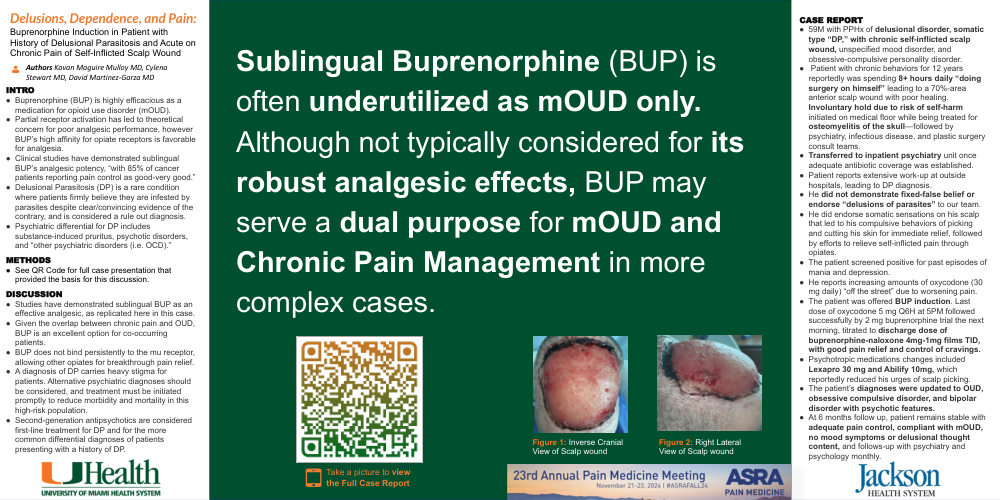
● 59M with PPHx of delusional disorder, somatic type “DP,” with chronic self-inflicted scalp wound, unspecified mood disorder, and obsessive-compulsive personality disorder.
-
● Patient with chronic behaviors for 12 years reportedly was spending 8+ hours daily “doing surgery on himself” leading to a 70%-area anterior scalp wound with poor healing. Involuntary hold due to risk of self-harm initiated on medical floor while being treated for osteomyelitis of the skull—followed by psychiatry, infectious disease, and plastic surgery consult teams.
-
● Transferred to inpatient psychiatry unit once adequate antibiotic coverage was established.
-
● Patient reports extensive work-up at outside hospitals, leading to DP diagnosis.
-
● He did not demonstrate fixed-false belief or endorse “delusions of parasites” to our team.
-
● He did endorse somatic sensations on his scalp
that led to his compulsive behaviors of picking
and cutting his skin for immediate relief, followed
by efforts to relieve self-inflicted pain through
Non-Cognitive Predictors of Student Success:
opiates.
-
● The patient screened positive for past episodes of
mania and depression.
-
● He reports increasing amounts of oxycodone (30
mg daily) “off the street” due to worsening pain.
-
● The patient was offered BUP induction. Last
dose of oxycodone 5 mg Q6H at 5PM followed successfully by 2 mg buprenorphine trial the next morning, titrated to discharge dose of buprenorphine-naloxone 4mg-1mg films TID, with good pain relief and control of cravings.
-
● Psychotropic medications changes included Lexapro 30 mg and Abilify 10mg, which reportedly reduced his urges of scalp picking.
-
● The patient’s diagnoses were updated to OUD, obsessive compulsive disorder, and bipolar disorder with psychotic features.
-
● At 6 months follow up, patient remains stable with
adequate pain control, compliant with mOUD, no mood symptoms or delusional thought content, and follows-up with psychiatry and psychology monthly.