501 posters, 2 videos, 1 audios, 8 topics, 37 sessions, 395 authors, 307 institutions
ePostersLive by SciGen Technologies S.A. All rights reserved.
23rd Annual Pain Medicine Meeting 2024
November 21-23, 2024 | Caesars Palace, Las Vegas, Nevada

6334
SUBTHRESHOLD SPINAL CORD STIMULATION IN A FONTAN PATIENT WITH SUPERIMPOSED REFRACTORY ANGINA AND POST-THORACOTOMY: A CASE REPORT
Poster Presenter
Authors
Affiliations
Part of Topic
Medically Challenging Cases
Subthreshold Spinal Cord Stimulation in a Fontan Patient with Superimposed Refractory Angina and Post-Thoracotomy: A Case Report
This case discusses an 18-year-old female with prothrombin mutation requiring perpetual anticoagulation, hypoplastic left ventricle status-post staged Norwood to Glenn procedures with respective sterno-thoracotomies and ultimately extracardiac non-fenestrated Fontan complicated by post-thoracotomy pain syndrome (PTPS) pain since her surgeries. She started experiencing tricuspid regurgitation and refractory anginal pain at age 12. Angina and thoracotomy pain persisted despite pharmacologic optimization, angioplasty and re-do sternotomy. Given limited response to prior therapies, activity intolerance, and progressing debility, a trial of SCS (spinal cord stimulation) was pursued.
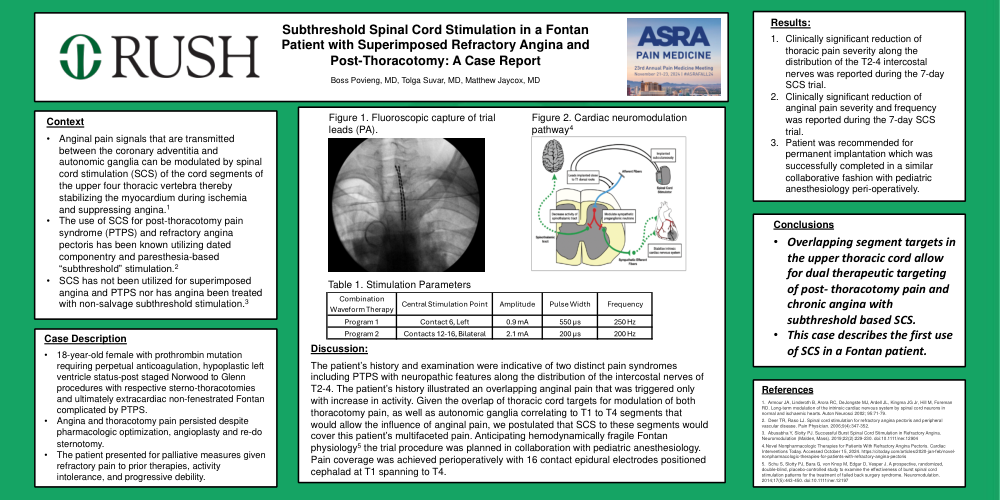
The patient’s history and examination were indicative of two distinct pain syndromes including PTPS with neuropathic features along the distribution of the intercostal nerves of T2-4. The patient’s history illustrated an overlapping anginal pain that was triggered only with increase in activity. Given the overlap of thoracic cord targets for modulation of both thoracotomy pain, as well as autonomic ganglia correlating to T1 to T4 segments that would allow the influence of anginal pain, we postulated that SCS to these segments would cover this patient’s multifaceted pain. Anticipating hemodynamically fragile Fontan physiology the trial was successfully completed in collaboration with pediatric anesthesiology. Pain coverage was achieved perioperatively with 16 contact epidural electrodes positioned cephalad at T1 spanning to T4. Subthreshold stimulation was set at 250hz, 0.9mA, and 550μs pulse width with an intra-burst period containing 3 pulses followed by 40hz rest period. Co-coverage of the patient’s symptoms was reported with reduction of thoracic and anginal pain severity and frequency on follow-ups during the 7-day trial.
SCS has not been utilized for superimposed angina and PTPS nor has angina been treated with non-salvage subthreshold stimulation. We report the demonstrated feasibility of subthreshold stimulation for the treatment of co-existing refractory angina and PTPS. This case also describes the first use of SCS in a Fontan patient, who subsequently underwent permanent implantation.