501 posters, 2 videos, 1 audios, 8 topics, 37 sessions, 395 authors, 307 institutions
ePostersLive by SciGen Technologies S.A. All rights reserved.
23rd Annual Pain Medicine Meeting 2024
November 21-23, 2024 | Caesars Palace, Las Vegas, Nevada

6259
PAIN MANAGEMENT OF A GIANT CELL SACRAL TUMOR: A CHALLENGING CASE REVIEW
Poster Presenter
Authors
Affiliations
Part of Topic
Medically Challenging Cases
Giant cell tumors are benign bone tumors that most commonly occur in femurs or tibias of young adults1. Only 2-8% of these tumors develop in the sacrum – a highly vascularized area – making their treatment and pain management particularly difficult2.
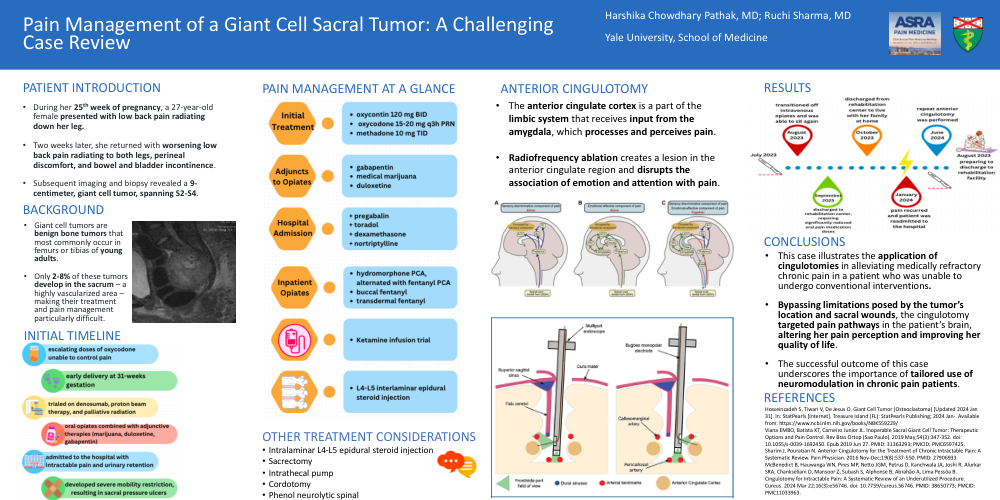
During her 25th week of pregnancy, a 27-year-old female presented with low back pain radiating down her leg and was diagnosed with pregnancy-related sciatica. Two weeks later, she returned with worsening low back pain radiating to both legs, perineal discomfort, and bowel and bladder incontinence. Subsequent imaging and biopsy revealed a 9-centimeter, giant cell tumor, spanning S2-S4. Despite taking escalating doses of oxycodone, her pain persisted, prompting an early delivery at 31 weeks gestation. Consequently, she was trialed on denosumab, proton beam therapy, and palliative radiation with minimal improvement. She followed a substantial regimen of oral opiates combined with adjunctive therapies, such as medical marijuana, duloxetine, and gabapentin. A few months later, she was admitted to the hospital with intractable pain and urinary retention. Her mobility became severely restricted, resulting in the development sacral pressure ulcers. For pain control, the patient was initiated on an alternating regimen of very high doses of hydromorphone and fentanyl patient-controlled analgesia, supplemented with transdermal and buccal fentanyl, ketorolac, pregabalin, dexamethasone, and nortriptyline. A brief ketamine infusion trial was not effective. In addition to pharmacological therapy, she underwent a L4-L5 interlaminar epidural steroid injection, providing only transient pain relief. Other therapeutic modalities, including sacrectomy, tumor debulking, intrathecal pumps, cordotomy, and phenol neurolytic spinal injections, were not pursued due to the proximity of the tumor to neurovascular structures, risk of seeding infection, and dangerous adverse effect profiles.
After a multidisciplinary discussion, including neurosurgery, palliative care, pain medicine, and oncology teams, anterior cingulotomy was deemed the best option to mitigate the patient’s medically refractory pain3. The anterior cingulate cortex is a part of the limbic system that receives input from the amygdala, which processes and perceives pain3,4. Radiofrequency ablation creates a lesion in the anterior cingulate region and disrupts the association of emotion and attention with pain3,4. Two months following the procedure, the patient transitioned off intravenous opiates and was able to sit again. She continued oral pain relief therapies, though at a fraction of the doses previously needed. With extensive rehabilitation, the patient was able to live at home with her family, but her pain relief was temporary. Her pain recurred, and a repeat anterior cingulotomy was performed. Following the second cingulotomy, the patient experienced marked improvement in her pain levels and is preparing to discharge to a rehabilitation facility.
This case illustrates the application of cingulotomies in alleviating medically refractory chronic pain in a patient who was unable to undergo conventional interventions3,4. Bypassing limitations posed by the tumor’s location and sacral wounds, the cingulotomy targeted pain pathways in the patient’s brain, altering her pain perception and improving her quality of life. The successful outcome of this case underscores the importance of tailored use of neuromodulation in chronic pain patients.