501 posters, 2 videos, 1 audios, 8 topics, 37 sessions, 395 authors, 307 institutions
ePostersLive by SciGen Technologies S.A. All rights reserved.
23rd Annual Pain Medicine Meeting 2024
November 21-23, 2024 | Caesars Palace, Las Vegas, Nevada

6253
ALTERNATIVES TO EPIDURAL FOR ACUTE PAIN CONTROL FOLLOWING MAJOR LOWER LIMB SURGERY: A PREEMPTIVE PLANNING
Poster Presenter
Authors
Affiliations
Part of Topic
Medically Challenging Cases
Introduction
-
Femur resection and allografting in the setting of osteosarcoma can lead to major postoperative pain, requiring a multimodal approach with preemptive planning
-
We describe the management of postoperative pain for a 15-year-old male who underwent left femur resection and allograft reconstruction using perineural femoral and sciatic nerve catheters
Methods
-
Consent was obtained from the patient’s legal guardian to review and collect information about their care in the hospital.
-
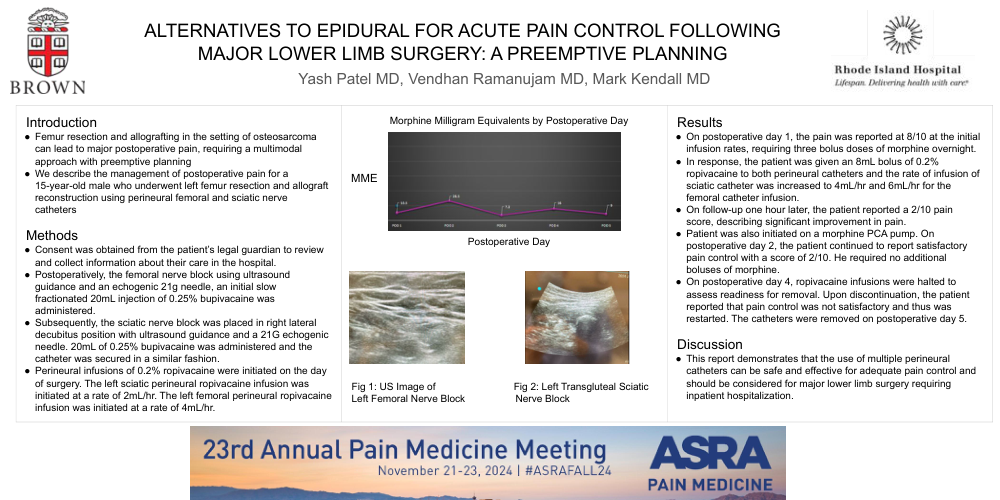
Postoperatively, the femoral nerve block using ultrasound guidance and an echogenic 21g needle, an initial slow fractionated 20mL injection of 0.25% bupivacaine was administered.
-
Subsequently, the sciatic nerve block was placed in right lateral decubitus position with ultrasound guidance and a 21G echogenic needle. 20mL of 0.25% bupivacaine was administered and the catheter was secured in a similar fashion.
-
Perineural infusions of 0.2% ropivacaine were initiated on the day of surgery. The left sciatic perineural ropivacaine infusion was initiated at a rate of 2mL/hr. The left femoral perineural ropivacaine infusion was initiated at a rate of 4mL/hr.
Results
-
On postoperative day 1, the pain was reported at 8/10 at the initial infusion rates, requiring three bolus doses of morphine overnight.
-
In response, the patient was given an 8mL bolus of 0.2% ropivacaine to both perineural catheters and the rate of infusion of sciatic catheter was increased to 4mL/hr and 6mL/hr for the femoral catheter infusion.
-
On follow-up one hour later, the patient reported a 2/10 pain score, describing significant improvement in pain.
-
Patient was also initiated on a morphine PCA pump. On postoperative day 2, the patient continued to report satisfactory pain control with a score of 2/10. He required no additional boluses of morphine.
-
On postoperative day 4, ropivacaine infusions were halted to assess readiness for removal. Upon discontinuation, the patient reported that pain control was not satisfactory and thus was restarted. The catheters were removed on postoperative day 5.
Discussion
-
This report demonstrates that the use of multiple perineural catheters can be safe and effective for adequate pain control and should be considered for major lower limb surgery requiring inpatient hospitalization.