501 posters, 2 videos, 1 audios, 8 topics, 37 sessions, 395 authors, 307 institutions
ePostersLive by SciGen Technologies S.A. All rights reserved.
23rd Annual Pain Medicine Meeting 2024
November 21-23, 2024 | Caesars Palace, Las Vegas, Nevada

6100
TREATMENT OF LUMBAR RADICULOPATHY PAIN WITH SALINE PLUS LIDOCAINE EPIDURAL INJECTION IN STEROID CONTRAINDICATED PATIENTS.
Poster Presenter
Authors
Affiliations
Part of Topic
Medically Challenging Cases
Treatment of lumbar radiculopathy pain with saline plus lidocaine epidural injection in steroid contraindicated patients
Keshin Purohit MD, David Ho DO, Richard Catabona DO, Edward Chang DO, Edward Barawid DO
UC Irvine Department of PM&R
INTRO
Lumbosacral radiculopathy (LR) is a common etiology of acute and chronic low back pain that affects between 3% to 5% of men and women, respectively.¹ In patients with more severe symptoms, epidural steroid injection (ESI) is an effective and well-tolerated intervention for the treatment of neuropathic radicular pain. However, in patients with comorbidities such as uncontrolled diabetes, hypertension, immunodeficiency, osteoporosis, and glaucoma, steroid use is often contraindicated.2 We present two cases of LR that were successfully treated via transforaminal epidural injection in steroid-contraindicated patients.
Case #1
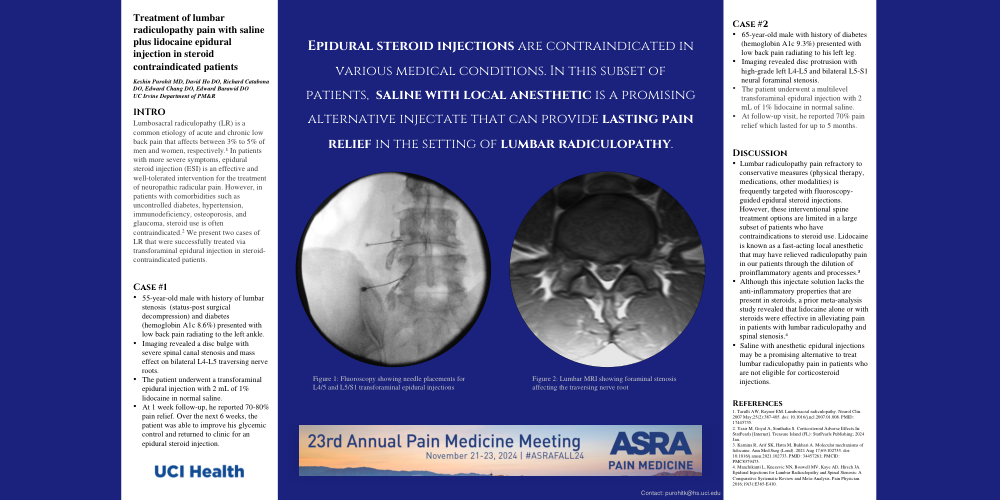
55-year-old male with history of lumbar stenosis (status-post surgical decompression) and diabetes (hemoglobin A1c 8.6%) presented with low back pain radiating to the left ankle.
Imaging revealed a disc bulge with severe spinal canal stenosis and mass effect on bilateral L4-L5 traversing nerve roots.
The patient underwent a transforaminal epidural injection with 2 mL of 1% lidocaine in normal saline.
At 1 week follow-up, he reported 70-80% pain relief. Over the next 6 weeks, the patient was able to improve his glycemic control and returned to clinic for an epidural steroid injection.
Case #2
65-year-old male with history of diabetes (hemoglobin A1c 9.3%) presented with low back pain radiating to his left leg.
Imaging revealed disc protrusion with high-grade left L4-L5 and bilateral L5-S1 neural foraminal stenosis.
The patient underwent a multilevel transforaminal epidural injection with 2 mL of 1% lidocaine in normal saline.
At follow-up visit, he reported 70% pain relief which lasted for up to 5 months.
Discussion
Lumbar radiculopathy pain refractory to conservative measures (physical therapy, medications, other modalities) is frequently targeted with fluoroscopy-guided epidural steroid injections. However, these interventional spine treatment options are limited in a large subset of patients who have contraindications to steroid use. Lidocaine is known as a fast-acting local anesthetic that may have relieved radiculopathy pain in our patients through the dilution of proinflammatory agents and processes.³
Although this injectate solution lacks the anti-inflammatory properties that are present in steroids, a prior meta-analysis study revealed that lidocaine alone or with steroids were effective in alleviating pain in patients with lumbar radiculopathy and spinal stenosis.⁴
Saline with anesthetic epidural injections may be a promising alternative to treat lumbar radiculopathy pain in patients who are not eligible for corticosteroid injections.
Epidural steroid injections are contraindicated in various medical conditions. In this subset of patients, saline with local anesthetic is a promising alternative injectate that can provide lasting pain relief in the setting of lumbar radiculopathy.