501 posters, 2 videos, 1 audios, 8 topics, 37 sessions, 395 authors, 307 institutions
ePostersLive by SciGen Technologies S.A. All rights reserved.
23rd Annual Pain Medicine Meeting 2024
November 21-23, 2024 | Caesars Palace, Las Vegas, Nevada

6042
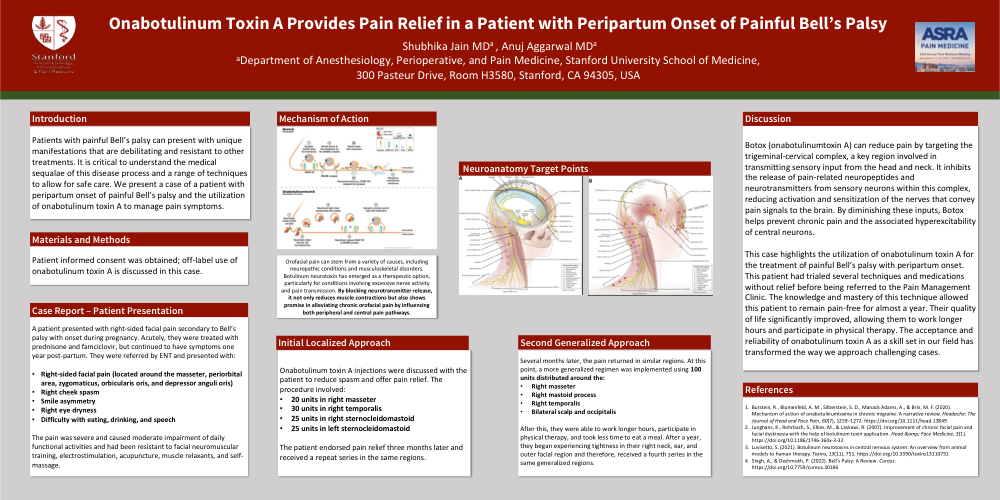
ONABOTULINUM TOXIN A PROVIDES PAIN RELIEF IN A PATIENT WITH PERIPARTUM ONSET OF PAINFUL BELL’S PALSY
Poster Presenter
Authors
Affiliations
Part of Topic
Medically Challenging Cases
Onabotulinum Toxin A Provides Pain Relief in a Patient with Peripartum Onset of Painful Bell’s Palsy
Introduction: Patients with painful Bell’s palsy can present with unique manifestations that are debilitating and resistant to other treatments. It is critical to understand the medical sequalae of this disease process and a range of techniques to allow for safe care. We present a case of a patient with peripartum onset of painful Bell’s palsy and the utilization of onabotulinum toxin A to manage pain symptoms.
Materials and Methods: Patient informed consent was obtained; off-label use of onabotulinum toxin A is discussed in this case.
Case Report:
A patient presented with right-sided facial pain secondary to Bell’s palsy with onset during pregnancy. Acutely, they were treated with prednisone and famciclovir, but continued to have symptoms one year post-partum. They were referred by ENT and presented with:
The pain was severe and caused moderate impairment of daily functional activities and had been resistant to facial neuromuscular training, electrostimulation, acupuncture, muscle relaxants, and self-massage.
Initial Localized Approach:
Onabotulinum toxin A injections were discussed with the patient to reduce spasm and offer pain relief. The procedure involved:
The patient endorsed pain relief three months later and received a repeat series in the same regions.
Second Generalized Approach:
Several months later, the pain returned in similar regions. At this point, a more generalized regimen was implemented using 100 units distributed around the:
After this, they were able to work longer hours, participate in physical therapy, and took less time to eat a meal. After a year, they began experiencing tightness in their right neck, ear, and outer facial region and therefore, received a fourth series in the same generalized regions.
Discussion:
Orofacial pain can stem from a variety of causes, including neuropathic conditions and musculoskeletal disorders. Botulinum neurotoxin has emerged as a therapeutic option, particularly for conditions involving excessive nerve activity and pain transmission. By blocking neurotransmitter release, it not only reduces muscle contractions but also shows promise in alleviating chronic orofacial pain by influencing both peripheral and central pain pathways.
Botox (onabotulinumtoxin A) can reduce pain by targeting the trigeminal-cervical complex, a key region involved in transmitting sensory input from the head and neck. It inhibits the release of pain-related neuropeptides and neurotransmitters from sensory neurons within this complex, reducing activation and sensitization of the nerves that convey pain signals to the brain. By diminishing these inputs, Botox helps prevent chronic pain and the associated hyperexcitability of central neurons.
This case highlights the utilization of onabotulinum toxin A for the treatment of painful Bell’s palsy with peripartum onset. This patient had trialed several techniques and medications without relief before being referred to the Pain Management Clinic. The knowledge and mastery of this technique allowed this patient to remain pain-free for almost a year. Their quality of life significantly improved, allowing them to work longer hours and participate in physical therapy. The acceptance and reliability of onabotulinum toxin A as a skill set in our field has transformed the way we approach challenging cases.
References: