501 posters, 2 videos, 1 audios, 8 topics, 37 sessions, 395 authors, 307 institutions
ePostersLive by SciGen Technologies S.A. All rights reserved.
23rd Annual Pain Medicine Meeting 2024
November 21-23, 2024 | Caesars Palace, Las Vegas, Nevada

5899
A DRAMATIC CASE OF MEDIAN NERVE STIMULATOR MIGRATION
Poster Presenter
Authors
Affiliations
Part of Topic
Medically Challenging Cases
Peripheral nerve stimulators have been progressively gaining traction as a nonsurgical modality for treating chronic pain. While efficacious, it is important to recognize that the incidence of complications can vary between 30% and 40%, with the most common complication being lead migration. [1] In fact, up to 15% of peripheral nerve stimulators are found to migrate. [2] Median nerve stimulator migration, however, has not been well documented. This report illustrates a case of median nerve stimulator migration and highlights symptoms to be cognizant of, as well as a technique to reduce such complication.
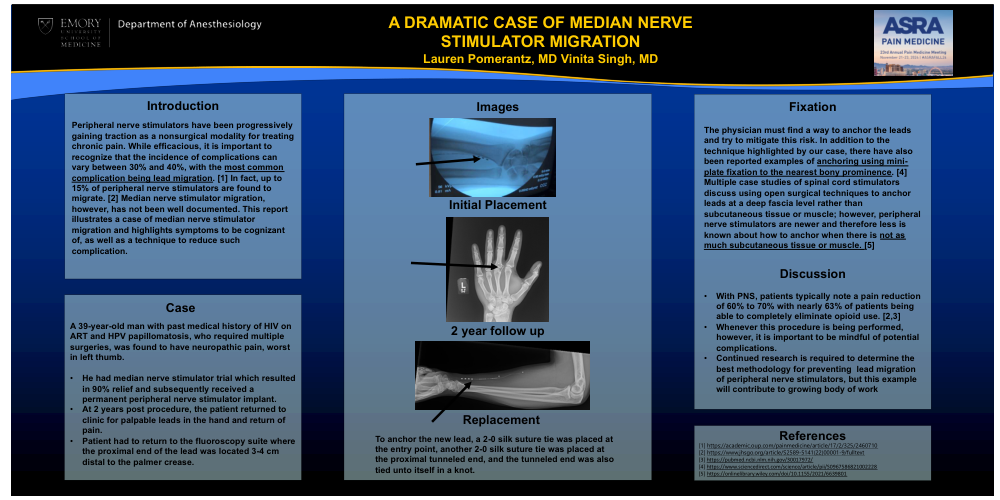
A 39-year-old man with past medical history of HIV on ART and HPV papillomatosis, who required multiple surgeries, was found to have neuropathic pain, worst in left thumb. He had a median nerve stimulator trial which resulted in 90% relief, and subsequently received a permanent peripheral nerve stimulator implant. At 2 years post procedure, the patient returned to clinic for palpable leads in the hand and return of pain. X-ray of hand revealed lead migration to the 3rd finger of the left upper extremity. Patient had to return to the fluoroscopy suite where a combination of fluoroscopy and ultrasound guided imaging were used to locate the proximal end of the lead 3-4 cm distal to the palmer crease. The lead was subsequently removed and a new one was replaced in the correct position. To anchor the new lead, a 2-0 silk suture tie was placed at the entry point, another 2-0 silk suture tie was placed at the proximal tunneled end, and the tunneled end was also tied unto itself in a knot.
Peripheral nerve stimulators have created dramatic advances in the field of pain management. With peripheral nerve stimulation, patients typically note a pain reduction of 60% to 70% with nearly 63% of patients being able to completely eliminate opioid use. [2,3] Whenever this procedure is being performed, however, it is important to be mindful of potential complications. Lead migration remains a challenge in peripheral nerve stimulation. The physician must find a way to anchor the leads and try to mitigate this risk. In addition to the technique highlighted by our case, there have also been reported examples of anchoring using mini-plate fixation to the nearest bony prominence. [4] Multiple case studies of spinal cord stimulators discuss using open surgical techniques in order to anchor leads at a deep fascia level rather than subcutaneous tissue or muscle; however, peripheral nerve stimulators are newer and therefore less is known about how to anchor when there is not as much subcutaneous tissue or muscle. [5] Continued research is required to determine the best methodology for preventing lead migration of peripheral nerve stimulators, but this example will contribute to the growing body of work