501 posters, 2 videos, 1 audios, 8 topics, 37 sessions, 395 authors, 307 institutions
ePostersLive by SciGen Technologies S.A. All rights reserved.
23rd Annual Pain Medicine Meeting 2024
November 21-23, 2024 | Caesars Palace, Las Vegas, Nevada

5868
REGIONAL ANESTHESIA ADMINISTRATION IN PATIENT WITH HISTORY OF TARDIVE DYSKINESIA IN THE SETTING OF SHOULDER ARTHROSCOPY
Poster Presenter
Authors
Affiliations
University of Wisconsin School of Medicine and Public Health
Part of Topic
Medically Challenging Cases
Introduction
Tardive dyskinesia (TD) is a movement disorder characterized by involuntary repetitive movements that some patients develop from long-term use of dopamine receptor antagonists. The pathophysiology involves inhibition of D2 receptors in the mesocortical and mesolimbic pathways and disruption of neural pathways in the basal ganglia. (1)
Regional anesthesia is an exciting frontier in anesthesia that improves patient care by reducing post-operative opioid consumption, thereby promoting quicker recovery and return to mobility while minimizing unwanted effects from traditional intravenous and oral agents. However, to perform regional anesthesia safely, the patient must be able to sit still for the duration of the procedure, limiting options for patients with movement disorders such as tardive dyskinesia.
This case describes the anesthetic management of a patient with tardive dyskinesia and contraindications to narcotics undergoing shoulder surgery.
Case description
A 46-year-old woman presented for right shoulder arthroscopy with capsulolabral reconstruction. Her medical history included Ehlers Danlos syndrome, opioid intolerance, and TD attributed to the patient's long-term psychiatric regimen of quetiapine and venlafaxine. Her condition manifested as constant flinging, choreiform movements of the arms and legs, lip smacking, eye rolling, and an ataxic gait.
Due to the patient’s opioid intolerance, an interscalene nerve block was proposed as a component of a safe, multi-modal post-operative pain plan. Unfortunately, her movement disorder magnified existing risks of an interscalene block, including damage to any of the relevant nerve roots or surrounding neurovascular structures. The peri-operative team contemplated the possibility of heavy sedation with a benzodiazepine in the hopes that this would provide enough relief from involuntary movements to perform the procedure, but this was deemed unlikely to be successful.
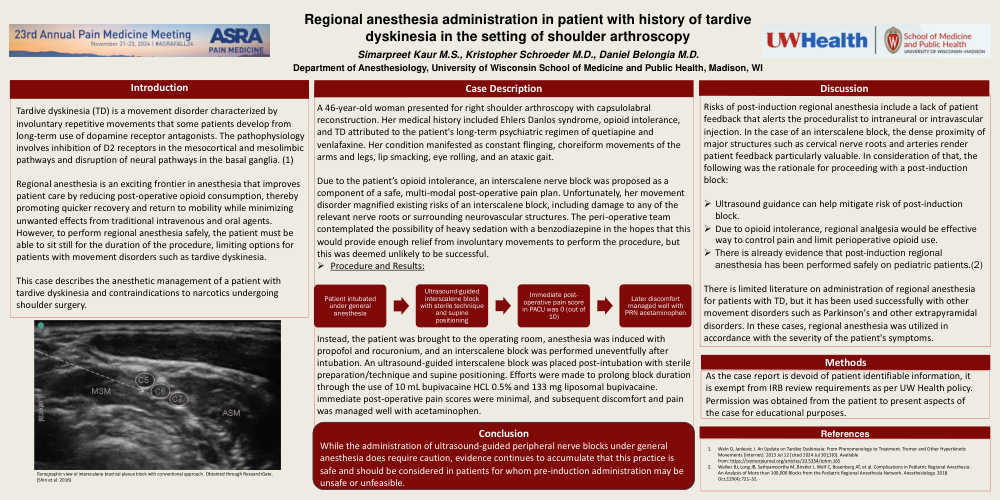
Instead, the patient was brought to the operating room, anesthesia was induced with propofol and rocuronium, and an interscalene block was performed uneventfully after intubation. Her immediate post-operative pain scores were minimal, and subsequent discomfort and pain was managed well with acetaminophen.
Discussion
Risks of post-induction regional anesthesia include a lack of patient feedback that alerts the proceduralist to intraneural or intravascular injection. In the case of an interscalene block, the dense proximity of major structures such as cervical nerve roots and arteries render patient feedback particularly valuable. In consideration of that, the following was the rationale for proceeding with a post-induction block:
-
Due to opioid tolerance, regional analgesia will be an indispensable way to control pain and limit perioperative opioid use for this patient.
-
Ultrasound guidance will help mitigate risks of a post-induction block.
-
There is already evidence that post-induction regional anesthesia has been performed safely on pediatric patients.(2)
There is limited literature on administration of regional anesthesia for patients with TD, but it has been used successfully with other movement disorders such as Parkinson’s and other extrapyramidal disorders. In these cases, regional anesthesia was utilized in accordance with the severity of the patient's symptoms.