501 posters, 2 videos, 1 audios, 8 topics, 37 sessions, 395 authors, 307 institutions
ePostersLive by SciGen Technologies S.A. All rights reserved.
23rd Annual Pain Medicine Meeting 2024
November 21-23, 2024 | Caesars Palace, Las Vegas, Nevada

5802
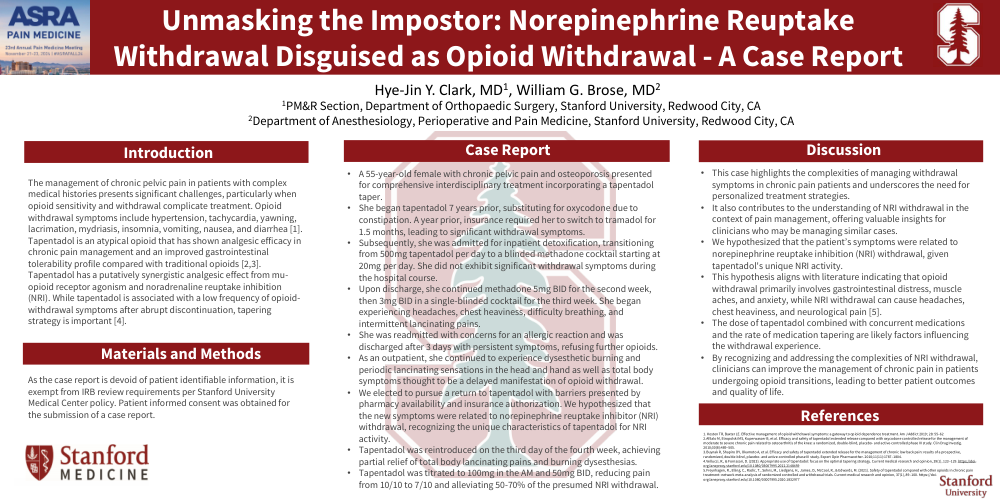
UNMASKING THE IMPOSTOR: NOREPINEPHRINE REUPTAKE WITHDRAWAL DISGUISED AS OPIOID WITHDRAWAL - A CASE REPORT
Poster Presenter
Authors
Affiliations
Part of Topic
Medically Challenging Cases
Title: Unmasking the Impostor: Norepinephrine Reuptake Withdrawal Disguised as Opioid Withdrawal - A Case Report
Introduction: The management of chronic pelvic pain in patients with complex medical histories presents significant challenges, particularly when opioid sensitivity and withdrawal complicate treatment. Opioid withdrawal symptoms include hypertension, tachycardia, yawning, lacrimation, mydriasis, insomnia, vomiting, nausea, and diarrhea [1]. Tapentadol is an atypical opioid that has shown analgesic efficacy in chronic pain management and an improved gastrointestinal tolerability profile compared with traditional opioids [2,3]. Tapentadol has a putatively synergistic analgesic effect from mu-opioid receptor agonism and noradrenaline reuptake inhibition (NRI). While tapentadol is associated with a low frequency of opioid-withdrawal symptoms after abrupt discontinuation, tapering strategy is important [4].
Materials and Methods: As the case report is devoid of patient identifiable information, it is exempt from IRB review requirements per Stanford University Medical Center policy. Patient informed consent was obtained for the submission of a case report.
Case Report: A 55-year-old female with chronic pelvic pain and osteoporosis presented for comprehensive interdisciplinary treatment incorporating a tapentadol taper. She began tapentadol 7 years prior, substituting for oxycodone due to constipation. A year prior, insurance required her to switch to tramadol for 1.5 months, leading to significant withdrawal symptoms. Subsequently, she was admitted for inpatient detoxification, transitioning from 500mg tapentadol per day to a blinded methadone cocktail starting at 20mg per day. She did not exhibit significant withdrawal symptoms during the hospital course. Upon discharge, she continued methadone 5mg BID for the second week, then 3mg BID in a single-blinded cocktail for the third week. She began experiencing headaches, chest heaviness, difficulty breathing, and intermittent lancinating pains. She was readmitted with concerns for an allergic reaction and was discharged after 3 days with persistent symptoms, refusing further opioids. As an outpatient, she continued to experience dysesthetic burning and periodic lancinating sensations in the head and hand as well as total body symptoms thought to be a delayed manifestation of opioid withdrawal. We elected to pursue a return to tapentadol with barriers presented by pharmacy availability and insurance authorization. We hypothesized that the new symptoms were related to norepinephrine reuptake inhibitor (NRI) withdrawal, recognizing the unique characteristics of tapentadolfor NRI activity. Tapentadol was reintroduced on the third day of the fourth week, achieving partial relief of total body lancinating pains and burning dysesthesias. Tapentadol was titrated to 100mg in the AM and 50mg BID, reducing pain from 10/10 to 7/10 and alleviating 50-70% of the presumed NRI withdrawal.
Discussion: This case highlights the complexities of managing withdrawal symptoms in chronic pain patients and underscores the need for personalized treatment strategies. It also contributes to the understanding of NRI withdrawal in the context of pain management, offering valuable insights for clinicians who may be managing similar cases. We hypothesized that the patient’s symptoms were related to norepinephrine reuptake inhibition (NRI) withdrawal, given tapentadol's unique NRI activity. This hypothesis aligns with literature indicating that opioid withdrawal primarily involves gastrointestinal distress, muscle aches, and anxiety, while NRI withdrawal can cause headaches, chest heaviness, and neurological pain [5]. The dose of tapentadol combined with concurrent medications and the rate of medication tapering are likely factors influencing the withdrawal experience. By recognizing and addressing the complexities of NRI withdrawal, clinicians can improve the management of chronic pain in patients undergoing opioid transitions, leading to better patient outcomes and quality of life.
References:
1. Kosten TR, Baxter LE. Effective management of opioid withdrawal symptoms: a gateway to opioid dependence treatment. Am J Addict 2019; 28: 55–62
2.Afilalo M, Etropolski MS, Kuperwasser B, et al. Efficacy and safety of tapentadol extended release compared with oxycodone controlled release for the management of moderate to severe chronic pain related to osteoarthritis of the knee: a randomized, double-blind, placebo- and active-controlled phase III study. Clin Drug Investig. 2010;30(8):489–505.
3.Buynak R, Shapiro DY, Okamoto A, et al. Efficacy and safety of tapentadol extended release for the management of chronic low back pain: results of a prospective, randomized, double-blind, placebo- and active-controlled phase III study. Expert Opin Pharmacother. 2010;11(11):1787–1804.
4.Vellucci, R., & Fornasari, D. (2023). Appropriate use of tapentadol: focus on the optimal tapering strategy. Current medical research and opinion, 39(1), 123–129. https://doi-org.laneproxy.stanford.edu/10.1080/03007995.2022.2148459
5.Freynhagen, R., Elling, C., Radic, T., Sohns, M., Liedgens, H., James, D., McCool, R., & Edwards, M. (2021). Safety of tapentadol compared with other opioids in chronic pain treatment: network meta-analysis of randomized controlled and withdrawal trials. Current medical research and opinion, 37(1), 89–100. https://doi-org.laneproxy.stanford.edu/10.1080/03007995.2020.1832977