501 posters, 2 videos, 1 audios, 8 topics, 37 sessions, 395 authors, 307 institutions
ePostersLive by SciGen Technologies S.A. All rights reserved.
23rd Annual Pain Medicine Meeting 2024
November 21-23, 2024 | Caesars Palace, Las Vegas, Nevada

5750
DISTINGUISHING BETWEEN PREECLAMPSIA AND POST-DURAL PUNCTURE HEADACHE IN A POSTPARTUM PATIENT
Poster Presenter
Authors
Affiliations
Part of Topic
Medically Challenging Cases
Headache Secondary to Atypical Preeclampsia in a Postpartum Patient
Introduction
The majority of headaches in the postpartum period are benign, including post-dural puncture headache, primary headache syndromes such as migraine's and tension headache, and from hormonal changes [1]. • Preeclampsia occurs in 2% to 8% of pregnancies [2] and a headache is often the initial presenting symptom [3]. • It is important to distinguish between causes of headache in a parturient in order to provide the necessary treatment and avoid any unnecessary procedures or interventions. • We present a case of a patient who developed a positional headache a day after epidural placement.
Case Description
38 year old female, G2P1 at 34 weeks gestation, with a past medical history of migraine's and HSV, presenting with preterm premature rupture of membranes. • An epidural was requested and placed uneventfully with a single attempt and the patient reported resolution of her labor pain shortly after. No dural leakage of CSF was noted during placement.
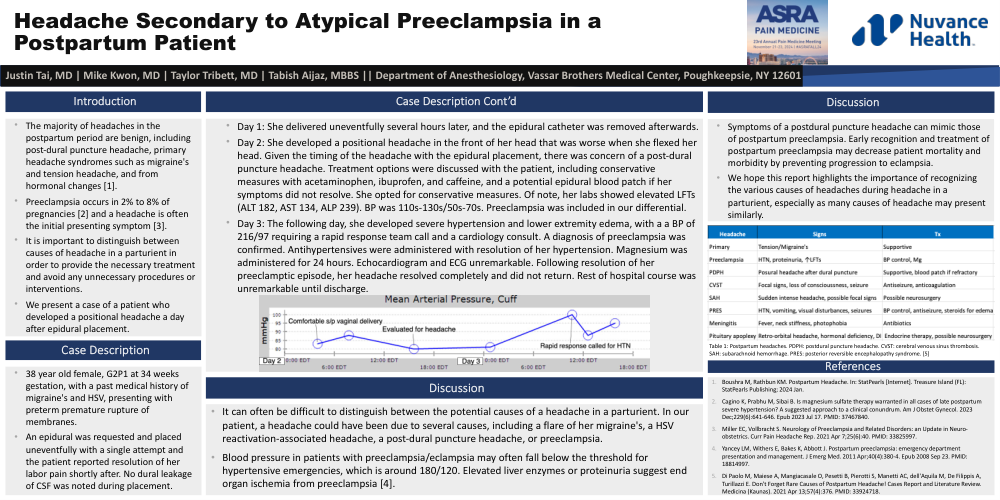
Day 1: She delivered uneventfully several hours later, and the epidural catheter was removed afterwards. • Day 2: She developed a positional headache in the front of her head that was worse when she flexed her head. Given the timing of the headache with the epidural placement, there was concern of a post-dural puncture headache. Treatment options were discussed with the patient, including conservative measures with acetaminophen, ibuprofen, and caffeine, and a potential epidural blood patch if her symptoms did not resolve. She opted for conservative measures. Of note, her labs showed elevated LFTs (ALT 182, AST 134, ALP 239). BP was 110s-130s/50s-70s. Preeclampsia was included in our differential. • Day 3: The following day, she developed severe hypertension and lower extremity edema, with a a BP of 216/97 requiring a rapid response team call and a cardiology consult. A diagnosis of preeclampsia was confirmed. Antihypertensives were administered with resolution of her hypertension. Magnesium was administered for 24 hours. Echocardiogram and ECG unremarkable. Following resolution of her preeclamptic episode, her headache resolved completely and did not return. Rest of hospital course was unremarkable until discharge.
Discussion
It can often be difficult to distinguish between the potential causes of a headache in a parturient. In our patient, a headache could have been due to several causes, including a flare of her migraine's, a HSV reactivation-associated headache, a post-dural puncture headache, or preeclampsia. • Blood pressure in patients with preeclampsia/eclampsia may often fall below the threshold for hypertensive emergencies, which is around 180/120. Elevated liver enzymes or proteinuria suggest end organ ischemia from preeclampsia [4].
Symptoms of a postdural puncture headache can mimic those of postpartum preeclampsia. Early recognition and treatment of postpartum preeclampsia may decrease patient mortality and morbidity by preventing progression to eclampsia. • We hope this report highlights the importance of recognizing the various causes of headaches during headache in a parturient, especially as many causes of headache may present similarly.