501 posters, 2 videos, 1 audios, 8 topics, 37 sessions, 395 authors, 307 institutions
ePostersLive by SciGen Technologies S.A. All rights reserved.
23rd Annual Pain Medicine Meeting 2024
November 21-23, 2024 | Caesars Palace, Las Vegas, Nevada

5749
HORNER'S SYNDROME FOLLOWING EPIDURAL ANESTHESIA
Poster Presenter
Authors
Affiliations
Part of Topic
Medically Challenging Cases
Horner's Syndrome Following Epidural Anesthesia
Introduction
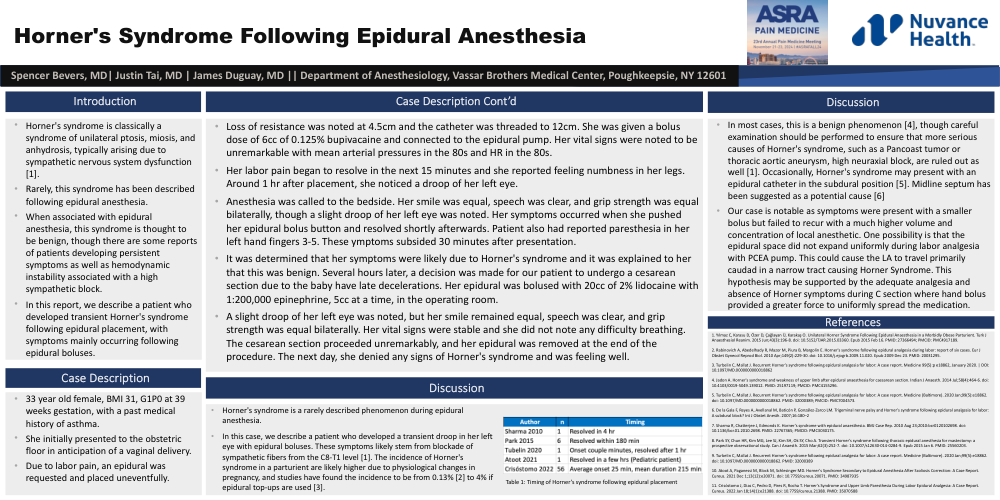
Horner's syndrome is classically a syndrome of unilateral ptosis, miosis, and anhydrosis, typically arising due to sympathetic nervous system dysfunction [1]. • Rarely, this syndrome has been described following epidural anesthesia. • When associated with epidural anesthesia, this syndrome is thought to be benign, though there are some reports of patients developing persistent symptoms as well as hemodynamic instability associated with a high sympathetic block. • In this report, we describe a patient who developed transient Horner's syndrome following epidural placement, with symptoms mainly occurring following epidural boluses.
Case Description
33 year old female, BMI 31, G1P0 at 39 weeks gestation, with a past medical history of asthma. • She initially presented to the obstetric floor in anticipation of a vaginal delivery. • Due to labor pain, an epidural was requested and placed uneventfully
Loss of resistance was noted at 4.5cm and the catheter was threaded to 12cm. She was given a bolus dose of 6cc of 0.125% bupivacaine and connected to the epidural pump. Her vital signs were noted to be unremarkable with mean arterial pressures in the 80s and HR in the 80s. • Her labor pain began to resolve in the next 15 minutes and she reported feeling numbness in her legs. Around 1 hr after placement, she noticed a droop of her left eye. • Anesthesia was called to the bedside. Her smile was equal, speech was clear, and grip strength was equal bilaterally, though a slight droop of her left eye was noted. Her symptoms occurred when she pushed her epidural bolus button and resolved shortly afterwards. Patient also had reported paresthesia in her left hand fingers 3-5. These ymptoms subsided 30 minutes after presentation. • It was determined that her symptoms were likely due to Horner's syndrome and it was explained to her that this was benign. Several hours later, a decision was made for our patient to undergo a cesarean section due to the baby have late decelerations. Her epidural was bolused with 20cc of 2% lidocaine with 1:200,000 epinephrine, 5cc at a time, in the operating room. • A slight droop of her left eye was noted, but her smile remained equal, speech was clear, and grip strength was equal bilaterally. Her vital signs were stable and she did not note any difficulty breathing. The cesarean section proceeded unremarkably, and her epidural was removed at the end of the procedure. The next day, she denied any signs of Horner's syndrome and was feeling well.
Discussion
Horner's syndrome is a rarely described phenomenon during epidural anesthesia. • In this case, we describe a patient who developed a transient droop in her left eye with epidural boluses. These symptoms likely stem from blockade of sympathetic fibers from the C8-T1 level [1]. The incidence of Horner's syndrome in a parturient are likely higher due to physiological changes in pregnancy, and studies have found the incidence to be from 0.13% [2] to 4% if epidural top-ups are used [3].
In most cases, this is a benign phenomenon [4], though careful examination should be performed to ensure that more serious causes of Horner's syndrome, such as a Pancoast tumor or thoracic aortic aneurysm, high neuraxial block, should be considered as well [1]. Occasionally, Horner's syndrome may present with an epidural catheter in the subdural position [5]. Midline septum has been suggested as a potential cause [6] • Our case is notable as symptoms were present with a smaller bolus but failed to recur with a much higher volume and concentration of local anesthetic. One possibility is that the epidural space did not expand uniformly during labor analgesia with PCEA pump. This could cause the LA to travel primarily caudad in a narrow tract causing Horner Syndrome. This hypothesis may be supported by the adequate analgesia and absence of Horner symptoms during C section where hand bolus provided a greater force to uniformly spread the medication.