501 posters, 2 videos, 1 audios, 8 topics, 37 sessions, 395 authors, 307 institutions
ePostersLive by SciGen Technologies S.A. All rights reserved.
23rd Annual Pain Medicine Meeting 2024
November 21-23, 2024 | Caesars Palace, Las Vegas, Nevada

5739
AN UNCOMMON EXTRUSION COMPLICATION OF A SPINAL CORD STIMULATOR'S IMPLANTABLE PULSE GENERATOR: A CASE REPORT
Poster Presenter
Authors
Affiliations
University of California, Irvine, University of California Irvine
Part of Topic
Medically Challenging Cases
An Uncommon Extrusion Complication of a Spinal Cord Stimulator's Implantable Pulse Generator: A Case Report
Edward J. Chang, DO1; Kunal R. Sinha, MD2 ; David Ho, DO1 ; Alexa N. Lean, MD2
Spinal cord stimulation (SCS):
Bacgkround
•Commonly used to treat multiple chronic pain conditions, including post-laminectomy syndrome and complex regional pain syndrome (CRPS).
•Common complications include hardware-related complications (ex. electrode migration, lead fracture, programming issues, hardware leak) and biological complications (ex. allergic reaction, infection, and hematoma) [1]
•Despite multiple improvements in the implantable pulse generator (IPG) size, function and safety, complications can still occur [1,2]
Case Description
•History: 67-year-old female wheelchair bound patient with history of multiple failed back surgeries, left foot drop, and CRPS of the left lower extremity refractory to pharmacologic and interventional modalities including opioids and lumbar sympathetic nerve blocks had two-lead SCS system placement with IPG implantation in the right lumbar region between the iliac crest and lower rib margin.
•Prior Response: excellent pain relief with no complications or concern for IPG migration until six years later
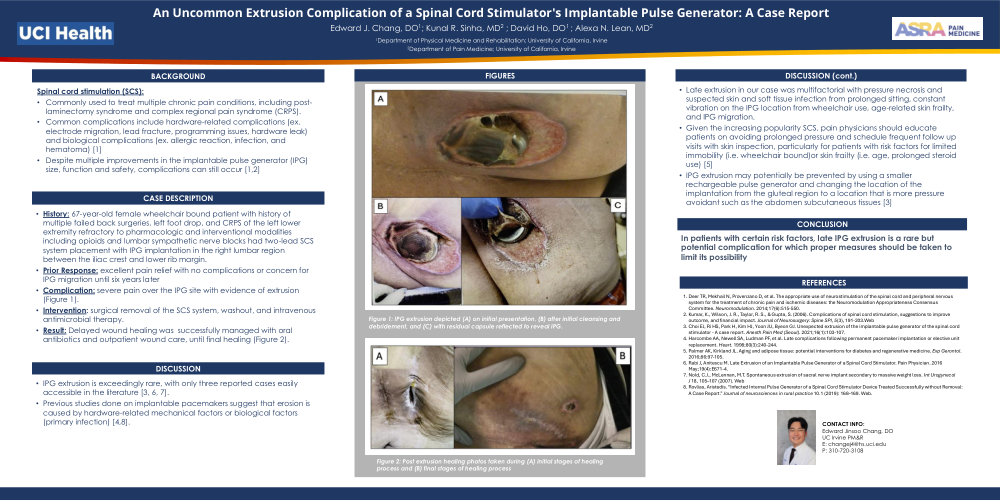
•Complication: severe pain over the IPG site with evidence of extrusion (Figure 1).
•Intervention: surgical removal of the SCS system, washout, and intravenous antimicrobial therapy.
•Result: Delayed wound healing was successfully managed with oral antibiotics and outpatient wound care, until final healing (Figure 2).
Discussion
•IPG extrusion is exceedingly rare, with only three reported cases easily accessible in the literature [3, 6, 7].
•Previous studies done on implantable pacemakers suggest that erosion is caused by hardware-related mechanical factors or biological factors (primary infection) [4,8].
•Late extrusion in our case was multifactorial with pressure necrosis and suspected skin and soft tissue infection from prolonged sitting, constant vibration on the IPG location from wheelchair use, age-related skin frailty, and IPG migration.
•Given the increasing popularity SCS, pain physicians should educate patients on avoiding prolonged pressure and schedule frequent follow up visits with skin inspection, particularly for patients with risk factors for limited immobility (i.e. wheelchair bound)or skin frailty (i.e. age, prolonged steroid use) [5]
•IPG extrusion may potentially be prevented by using a smaller rechargeable pulse generator and changing the location of the implantation from the gluteal region to a location that is more pressure avoidant such as the abdomen subcutaneous tissues [3]
Conclusion:
In patients with certain risk factors, late IPG extrusion is a rare but potential complication for which proper measures should be taken to limit its possibility