501 posters, 2 videos, 1 audios, 8 topics, 37 sessions, 395 authors, 307 institutions
ePostersLive by SciGen Technologies S.A. All rights reserved.
23rd Annual Pain Medicine Meeting 2024
November 21-23, 2024 | Caesars Palace, Las Vegas, Nevada

6335
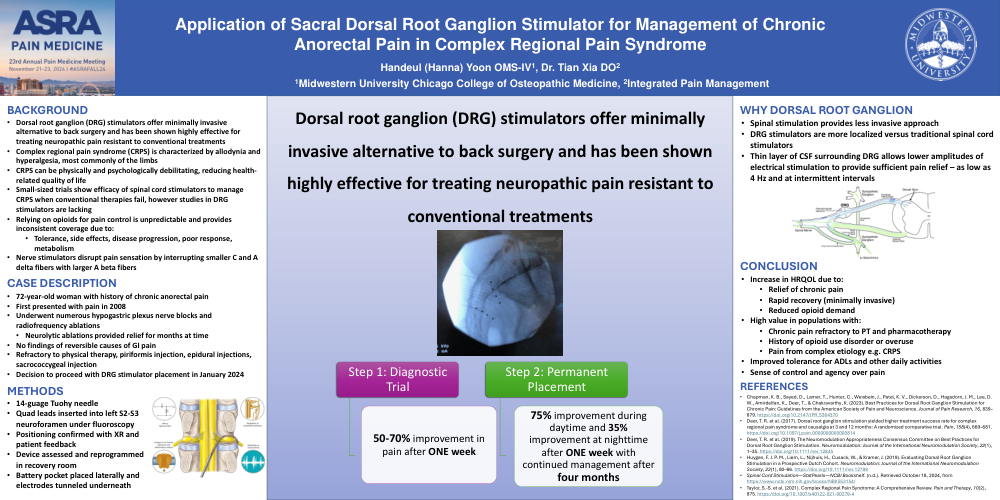
APPLICATION OF SACRAL DORSAL ROOT GANGLION STIMULATOR FOR MANAGEMENT OF CHRONIC ANORECTAL PAIN IN COMPLEX REGIONAL PAIN SYNDROME
Poster Presenter
Part of Topic
Medically Challenging Cases
Application of Sacral Dorsal Root Ganglion Stimulator for Management of Chronic Anorectal Pain in Complex Regional Pain Syndrome
•Dorsal root ganglion (DRG) stimulators offer minimally invasive alternative to back surgery and has been shown highly effective for treating neuropathic pain resistant to conventional treatments
•Complex regional pain syndrome (CRPS) is characterized by allodynia and hyperalgesia, most commonly of the limbs
•CRPS can be physically and psychologically debilitating, reducing health-related quality of life
•Small-sized trials show efficacy of spinal cord stimulators to manage CRPS when conventional therapies fail
•72-year-old woman with history of chronic anorectal pain
•First presented with pain in 2008
•Underwent numerous hypogastric plexus nerve blocks and radiofrequency ablations
•Neurolytic ablations provided relief for months at time
•No findings of reversible causes of GI pain
•Refractory to physical therapy, piriformis injection, epidural injections, sacrococcygeal injection
•Decision to proceed with DRG stimulator placement in January 2024
•14-guage Tuohy needle
•Quad leads inserted into left S2-S3 neuroforamen under fluoroscopy
•Positioning confirmed with XR and patient feedback
•Device assessed and reprogrammed in recovery room
•Battery pocket placed laterally and electrodes tunneled underneath
•Spinal stimulation provides less invasive approach
•DRG stimulators are more localized versus traditional spinal cord stimulators
•Thin layer of CSF surrounding DRG allows lower amplitudes of electrical stimulation to provide sufficient pain relief – as low as 4 Hz and at intermittent intervals
•Increase in HRQOL due to:
•Relief of chronic pain
•Rapid recovery (minimally invasive)
•Reduced opioid demand
•High value in populations with:
•Chronic pain refractory to PT and pharmacotherapy
•History of opioid use disorder or overuse
•Pain from complex etiology e.g. CRPS
•Improved tolerance for ADLs and other daily activities
•Sense of control and agency over pain
Dorsal root ganglion (DRG) stimulators offer minimally invasive alternative to back surgery and has been shown highly effective for treating neuropathic pain resistant to conventional treatments