501 posters, 2 videos, 1 audios, 8 topics, 37 sessions, 395 authors, 307 institutions
ePostersLive by SciGen Technologies S.A. All rights reserved.
23rd Annual Pain Medicine Meeting 2024
November 21-23, 2024 | Caesars Palace, Las Vegas, Nevada

6283
REFRACTORY POST-COVID HEADACHE TREATED WITH STELLATE GANGLION BLOCK
Poster Presenter
Authors
Affiliations
Part of Topic
Medically Challenging Cases
Abstract Title: Refractory post-COVID-19 headache treated with stellate ganglion block
Authors: Justine Pollack, M.D.1, Jung Kim, M.D.1 Darryl Brown, M.D.1 and Aleksey Maryansky, D.O.2
1. Department of Anesthesiology, Perioperative and Pain Medicine, Icahn School of Medicine at Mount Sinai, Morningside and West Hospitals
2. Department of Anesthesiology, Northwell Staten Island University Hospital
Introduction: After an acute symptomatic COVID-19 infection, up to 30% of patients will develop Long COVID, meaning persistent or new symptoms including fatigue, brain fog, sleep disturbances, joint and muscle pain and headache. This case review will focus on one of these symptoms– severe and persistent headaches– which are similar to bilateral tension headaches. However, unlike bilateral tension headaches, severe headaches during Long COVID respond poorly to conventional treatments. The patient is a 34-year-old male with chronic headaches since 2014 that have progressively worsened despite having multiple treatment interventions. In 2018, the patient received inpatient treatment with dihydroergotamine and lidocaine, which provided sustained relief until an acute COVID infection in 2021. Subsequent treatments included: eptinezumab, dihydroergotamine, lidocaine, ketamine, lamotrigine, bupropion, duloxetine, topiramate, gabapentin and kratom. He has also tried many interventional procedures including botulinum toxin injections and peripheral nerve blocks without sustained relief. He did receive some relief with morphine and methadone; however, he was limited by side effects. The headaches he experiences range from 6-10/10 on the NRS scale. When the pain was severe, the patient remained mostly bedridden and could not complete activities of daily living. After an extensive trial of medical and interventional procedures, we decided to trial the left stellate ganglion block, as headache seemed to be a sequelae of Long COVID..
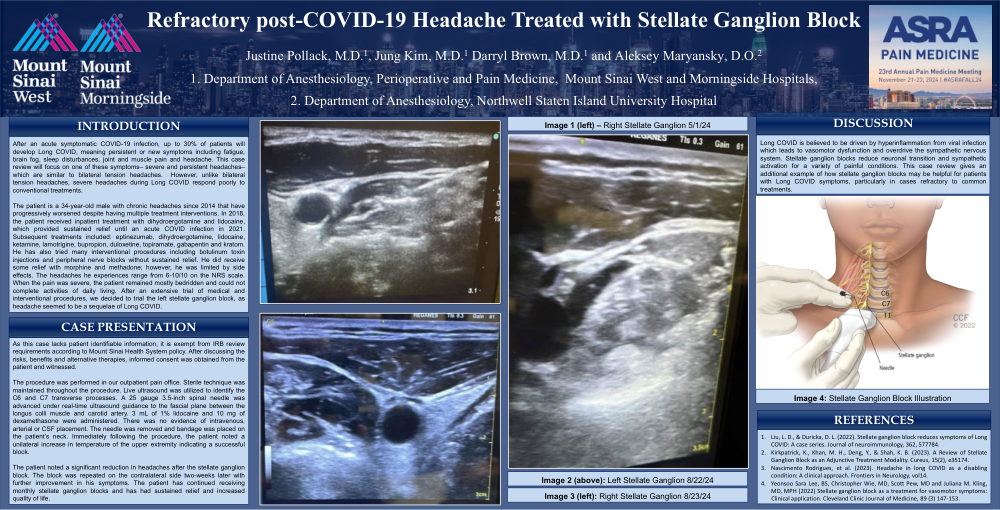
Material and Methods: Since the case lacks patient identifiable information, it is exempt from IRB review requirements according to Mount Sinai Health System policy. After discussing the risks, benefits and alternative therapies, informed consent was obtained from the patient and witnessed. The procedure was performed in our outpatient pain office. Sterile technique was maintained throughout the procedure. Live ultrasound was utilized to identify the C6 and C7 transverse processes. A 25 gauge 3.5-inch spinal needle was advanced under real-time ultrasound guidance to the fascial plane between the longus colli muscle and carotid artery. 3 mL of 1% lidocaine and 10 mg of dexamethasone were administered. There was no evidence of intravenous, arterial or CSF placement. The needle was removed and bandage was placed on the patient’s neck. Immediately following the procedure, the patient noted a unilateral increase in temperature of the upper extremity indicating a successful block.
Results: The patient noted a significant reduction in headaches after the stellate ganglion block. The block was repeated on the contralateral side two-weeks later with further improvement in his symptoms. The patient has continued receiving monthly stellate ganglion blocks and has had sustained relief and increased quality of life.
Discussion: Long COVID is believed to be driven by hyperinflammation from viral infection which leads to vasomotor dysfunction and overdrive the sympathetic nervous system. Stellate ganglion blocks reduce neuronal transition and sympathetic activation for a variety of painful conditions. This case review gives an additional example of how stellate ganglion blocks may be helpful for patients with Long COVID symptoms, particularly in cases refractory to common treatments.