501 posters, 2 videos, 1 audios, 8 topics, 37 sessions, 395 authors, 307 institutions
ePostersLive by SciGen Technologies S.A. All rights reserved.
23rd Annual Pain Medicine Meeting 2024
November 21-23, 2024 | Caesars Palace, Las Vegas, Nevada

6195
STELLATE GANGLION BLOCK FOR CORONARY VASOSPASM
Poster Presenter
Authors
Affiliations
Part of Topic
Medically Challenging Cases
Abstract Title: Stellate Ganglion Block for Coronary Vasospasm
Authors: Travis Burnett, D.O. and Darryl Brown, M.D.
Introduction:
Autonomic blockade has been recognized as a treatment for many acute and chronic painful conditions since the early 20th century. One such blockade is the stellate ganglion block, typically used in the diagnosis and management of sympathetically mediated pain and vascular insufficiency of the upper extremities. Additionally, it has been used as an adjunctive treatment modality to a variety of refractory medical conditions including: phantom limb pain, postherpetic neuralgia, orofacial pain, vascular headache and cardiac arrhythmias.
The patient is a 74-year-old male with a complex medical history including coronary artery disease s/p percutaneous intervention complicated by in-stent restenosis and replacement of drug eluting stent, hypertension, hyperlipidemia, paroxysmal atrial fibrillation, heart failure, pre-diabetes and May-Thurner Syndrome. He initially presented to the hospital with substernal chest pain and subsequently developed ventricular fibrillation arrest. After return of spontaneous circulation, the patient underwent left heart catheterization, which demonstrated coronary vasospasm and patent stents. The patient was transferred to the CCU and despite maximal medical management with nitroglycerin infusion and endotracheal intubation and general anesthesia for control of sympathetic stimulation. He continued to have coronary vasospasm events leading to a subsequent cardiac arrest. After the return of spontaneous circulation, our pain medicine service was consulted for an urgent stellate ganglion block.
Materials/Methods:
As the case report is devoid of patient identifiable information, it is exempt from IRB review requirements as per Mount Sinai policy. After discussing the procedure with the patient's HCP - including the risks, benefits, outcome data and possibility of no effect - informed consent was obtained via telephone and witnessed. All vital signs were monitored prior to, during, and after the procedure and were within normal limits.
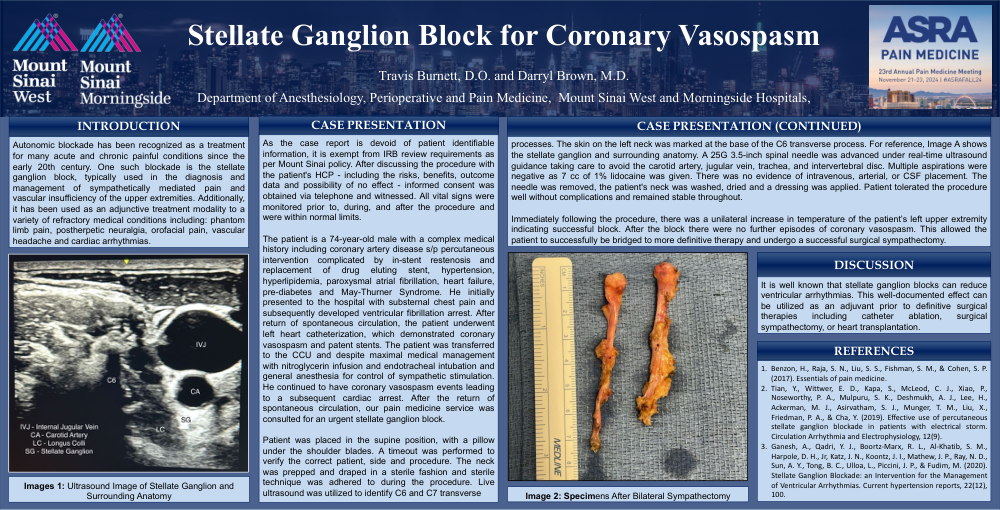
Patient was placed in the supine position, with a pillow under the shoulder blades. A timeout was performed to verify the correct patient, side and procedure. The neck was prepped and draped in a sterile fashion and sterile technique was adhered to during the procedure. Live ultrasound was utilized to identify C6 and C7 transverse processes. The skin on the left neck was marked at the base of the C6 transverse process. For reference, Image A shows the stellate ganglion and surrounding anatomy. A 25G 3.5-inch spinal needle was advanced under real-time ultrasound guidance taking care to avoid the carotid artery, jugular vein, trachea, and intervertebral disc. Multiple aspirations were negative as 7 cc of 1% lidocaine was given. There was no evidence of intravenous, arterial, or CSF placement. The needle was removed, the patient's neck was washed, dried and a dressing was applied. Patient tolerated the procedure well without complications and remained stable throughout.
Results:
Immediately following the procedure, there was a unilateral increase in temperature of the patient’s left upper extremity indicating successful block. After the block there were no further episodes of coronary vasospasm. This allowed the patient to successfully be bridged to more definitive therapy and undergo a successful surgical sympathectomy as seen in Image B.
Discussion:
It is well known that stellate ganglion blocks can reduce ventricular arrhythmias. This well-documented effect can be utilized as an adjuvant prior to definitive surgical therapies including catheter ablation, surgical sympathectomy, or heart transplantation.