501 posters, 2 videos, 1 audios, 8 topics, 37 sessions, 395 authors, 307 institutions
ePostersLive by SciGen Technologies S.A. All rights reserved.
23rd Annual Pain Medicine Meeting 2024
November 21-23, 2024 | Caesars Palace, Las Vegas, Nevada

6175
LUMBAR SYMPATHETIC BLOCK FOR ALCOHOLIC NEUROPATHY, A CASE REPORT
Poster Presenter
Authors
Affiliations
Part of Topic
Medically Challenging Cases
Title: Lumbar Sympathetic Block For Alcoholic Neuropathy, A Case Report
Authors: Aditi Master, Carol Apai, Nivetha Srinivasan, Mia Castiglione, Tabhata Paulet
Introduction
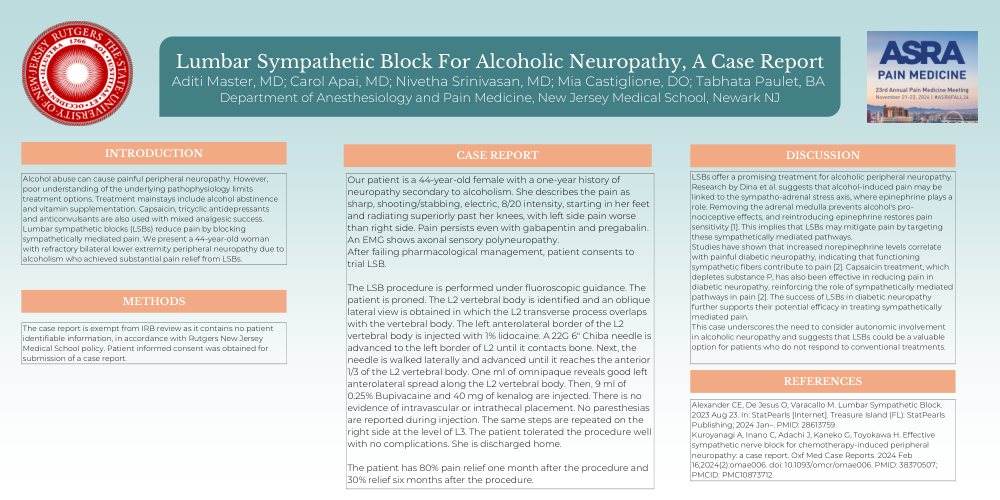
Alcohol abuse can cause painful peripheral neuropathy. However, poor understanding of the underlying pathophysiology limits treatment options. Treatment mainstays include alcohol abstinence and vitamin supplementation. Capsaicin, tricyclic antidepressants and anticonvulsants are also used with mixed analgesic success. Lumbar sympathetic blocks (LSBs) reduce pain by blocking sympathetically mediated pain. We present a 44 year old woman with refractory bilateral lower extremity peripheral neuropathy due to alcoholism who achieved substantial pain relief from LSBs.
Methods
The case report is exempt from IRB review as it contains no patient identifiable information, in accordance with Rutgers New Jersey Medical School policy. Patient informed consent was obtained for submission of a case report.
Case Report
Our patient is a 44 year old female with a one year history of neuropathy secondary to alcoholism. She describes the pain as sharp, shooting/stabbing, electric, 8/20 intensity, starting in her feet and radiating superiorly past her knees, with left side pain worse than right side. Pain persists even with gabapentin and pregabalin. An EMG shows axonal sensory polyneuropathy.
After failing pharmacological management, patient consents to trial LSB.
The LSB procedure is performed under fluoroscopic guidance. The patient is proned. The L2 vertebral body is identified and an oblique lateral view is obtained in which the L2 transverse process overlaps with the vertebral body. The left anterolateral border of the L2 vertebral body is injected with 1% lidocaine. A 22G 6" Chiba needle is advanced to the left border of L2 until it contacts bone. Next, the needle is walked laterally and advanced until it reaches the anterior 1/3 of the L2 vertebral body. One ml of omnipaque reveals good left anterolateral spread along the L2 vertebral body. Then, 9 ml of 0.25% Bupivacaine and 40 mg of kenalog are injected. There is no evidence of intravascular or intrathecal placement. No paresthesias are reported during injection. The same steps are repeated on the right side at the level of L3. The patient tolerated the procedure well with no complications. She is discharged home.
The patient has 80% pain relief one month after the procedure and 30% relief six months after the procedure.
Discussion
LSBs offer a promising treatment for alcoholic peripheral neuropathy. Research by Dina et al. suggests that alcohol-induced pain may be linked to the sympatho-adrenal stress axis, where epinephrine plays a role. Removing the adrenal medulla prevents alcohol's pro-nociceptive effects, and reintroducing epinephrine restores pain sensitivity [1]. This implies that LSBs may mitigate pain by targeting these sympathetically mediated pathways.
Studies have shown that increased norepinephrine levels correlate with painful diabetic neuropathy, indicating that functioning sympathetic fibers contribute to pain [2]. Capsaicin treatment, which depletes substance P, has also been effective in reducing pain in diabetic neuropathy, reinforcing the role of sympathetically mediated pathways in pain [2]. The success of LSBs in diabetic neuropathy further supports their potential efficacy in treating sympathetically mediated pain.
This case underscores the need to consider autonomic involvement in alcoholic neuropathy and suggests that LSBs could be a valuable option for patients who do not respond to conventional treatments.