501 posters, 2 videos, 1 audios, 8 topics, 37 sessions, 395 authors, 307 institutions
ePostersLive by SciGen Technologies S.A. All rights reserved.
23rd Annual Pain Medicine Meeting 2024
November 21-23, 2024 | Caesars Palace, Las Vegas, Nevada

6094
BREATHING EASY: RESPIRATORY CONSIDERATION OF A PHRENIC NERVE SPARING BLOCK IN ADULT ONSET MUSCULAR DYSTROPHY
Poster Presenter
Part of Topic
Medically Challenging Cases
Introduction
• Interscalene brachial plexus blocks are commonly used for pain control after shoulder surgery but can cause phrenic nerve paralysis, especially in patients with respiratory issues.
• Phrenic nerve-sparing techniques have emerged as a safer alternative, particularly for patients with conditions like COPD, OSA, and muscular dystrophy, as explored in our case report.
Case Description
History
A 68-year-old man presents for a pre-operative upper extremity nerve block for post-operative pain management. His extensive pulmonary history is notable for COPD, OSA, and wheelchair-bound Adult-Onset Muscular dystrophy requiring O2 and Bipap at night.
Operative Course
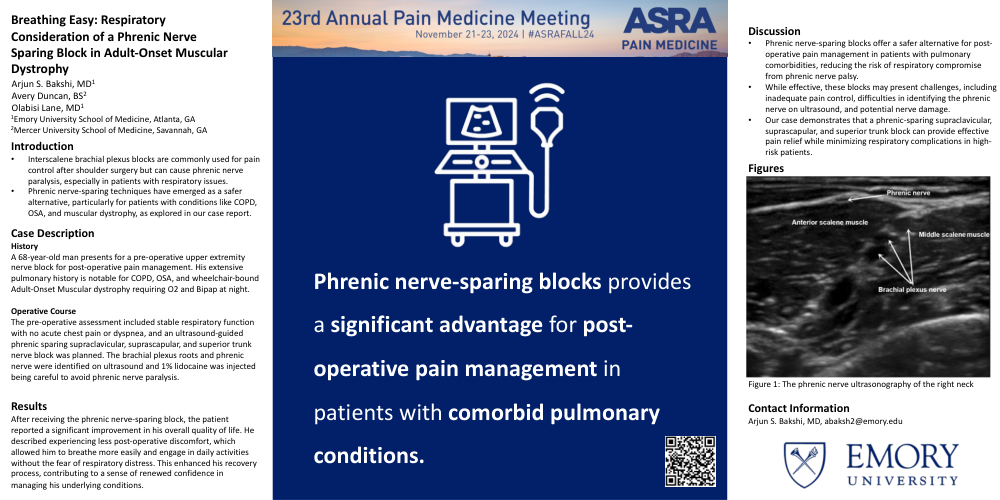
The pre-operative assessment included stable respiratory function with no acute chest pain or dyspnea, and an ultrasound-guided phrenic sparing supraclavicular, suprascapular, and superior trunk nerve block was planned. The brachial plexus roots and phrenic nerve were identified on ultrasound and 1% lidocaine was injected being careful to avoid phrenic nerve paralysis.
Results
After receiving the phrenic nerve-sparing block, the patient reported a significant improvement in his overall quality of life. He
described experiencing less post-operative discomfort, which allowed him to breathe more easily and engage in daily activities without the fear of respiratory distress. This enhanced his recovery process, contributing to a sense of renewed confidence in managing his underlying conditions.
Phrenic nerve-sparing blocks provides a significant advantage for post- operative pain management in patients with comorbid pulmonary conditions.
Discussion
• Phrenic nerve-sparing blocks offer a safer alternative for post- operative pain management in patients with pulmonary
comorbidities, reducing the risk of respiratory compromise
from phrenic nerve palsy.
• While effective, these blocks may present challenges, including
inadequate pain control, difficulties in identifying the phrenic
nerve on ultrasound, and potential nerve damage.
• Our case demonstrates that a phrenic-sparing supraclavicular,
suprascapular, and superior trunk block can provide effective pain relief while minimizing respiratory complications in high- risk patients.