501 posters, 2 videos, 1 audios, 8 topics, 37 sessions, 395 authors, 307 institutions
ePostersLive by SciGen Technologies S.A. All rights reserved.
23rd Annual Pain Medicine Meeting 2024
November 21-23, 2024 | Caesars Palace, Las Vegas, Nevada

6031
A PHYSICAN’S PREDICAMENT: SCS COMPLICATION OR CONFOUNDING VARIABLES?
Poster Presenter
Authors
Affiliations
Part of Topic
Medically Challenging Cases
A Physician’s Predicament: SCS Complication or confounding variables
Introduction:
•Failed Back Surgery Syndrome (FBSS) characterized by chronic back pain following spinal surgery is an increasingly common sequela – lifetime prevalence of 60-80%
•20.4% of adults in the United States suffer from chronic nonmalignant pain
•Treatment of chronic nonmalignant pain requires an individualized and multidisciplinary approach:
•Occupational and physical therapy
•Psychotherapy
•Analgesics and interventional pain treatment
•Conservative management of FBSS can be ineffective in many patients necessitating more invasive interventions - percutaneous fusion, intrathecal pumps, and spinal cord stimulators (SCS)
•SCS uses electrical impulses through electrodes that disrupt pain signals to the brain – reducing the perception of pain
•Complications are rare but can consist of infection, device migration, dural puncture, and spinal cord trauma
•We present a patient with FBSS undergoing SCS placement complicated by unusual and confounding post-operative symptomatology
Case Report:
•51-year-old male
•Past Medical and Surgical History:
•FBSS
•Severe cervical myelomalacia (s/p C3-4, C5-6 ACDF)
•Lumbar spinal stenosis with neurogenic claudication (s/p L2-3, L3-4 laminectomy and decompression
•Treatment:
•Failed multiple multimodal pharmacotherapy and physical therapy
•Trail showed an appreciable decrease in pain leading to permanent SCS implantation
•SCS Procedure:
•T12-L1 interspace was attempted multiple times with inability to thread the leads
•T11-T12 interspace was attempted two additional times before successful lead placement
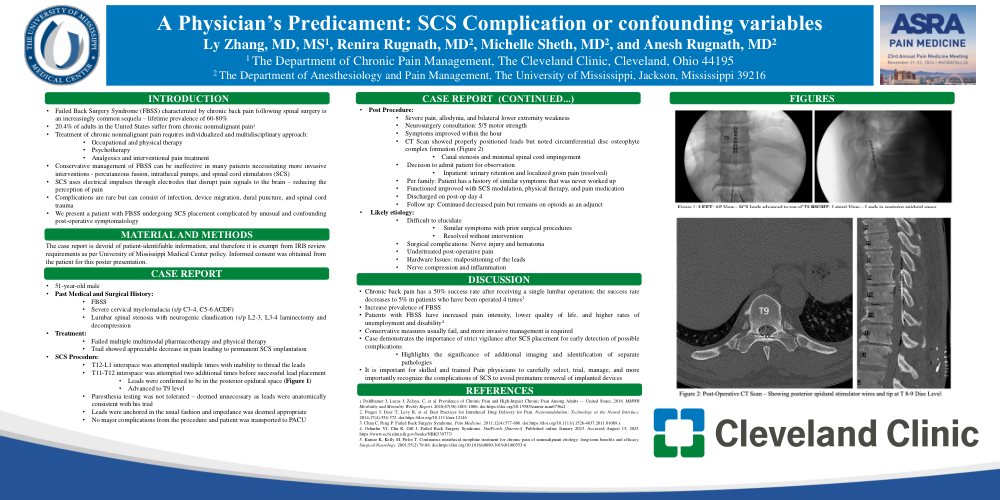
•Leads were confirmed to be in the posterior epidural space (Figure 1)
•Advanced to T9 level
•Paresthesia testing was not tolerated – deemed unnecessary as leads were anatomically consistent with his trial
•Leads were anchored in the usual fashion and impedance was deemed appropriate
•No major complications from the procedure and the patient was transported to PACU
•Post Procedure:
•Severe pain, allodynia, and bilateral lower extremity weakness
•Neurosurgery consultation: 5/5 motor strength
•Symptoms improved within the hour
•CT Scan showed properly positioned leads but noted circumferential disc osteophyte complex formation (Figure 2)
•Canal stenosis and minimal spinal cord impingement
•Decision to admit patient for observation
•Inpatient: urinary retention and localized groin pain (resolved)
•Per family: Patient has a history of similar symptoms that was never worked up
•Functioned improved with SCS modulation, physical therapy, and pain medication
•Discharged on post-op day 4
•Follow up: Continued decreased pain but remains on opioids as an adjunct
•Likely etiology:
•Difficult to elucidate
•Similar symptoms with prior surgical procedures
•Resolved without intervention
•Surgical complications: Nerve injury and hematoma
• Undertreated post-operative pain
•Hardware Issues: malpositioning of the leads
•Nerve compression and inflammation
Discussion:
•Chronic back pain has a 50% success rate after receiving a single lumbar operation; the success rate decreases to 5% in patients who have been operated 4 times
•Increase prevalence of FBSS
•Patients with FBSS have increased pain intensity, lower quality of life, and higher rates of unemployment and disability4
•Conservative measures usually fail, and more invasive management is required
•Case demonstrates the importance of strict vigilance after SCS placement for early detection of possible complications
•Highlights the significance of additional imaging and identification of separate pathologies
• It is important for skilled and trained Pain physicians to carefully select, trial, manage, and more importantly recognize the complications of SCS to avoid premature removal of implanted devices