501 posters, 2 videos, 1 audios, 8 topics, 37 sessions, 395 authors, 307 institutions
ePostersLive by SciGen Technologies S.A. All rights reserved.
23rd Annual Pain Medicine Meeting 2024
November 21-23, 2024 | Caesars Palace, Las Vegas, Nevada

6022
TREATING PEDIATRIC PAIN IN A NONVERBAL CHILD WITH SIGNIFICANT NEURODEVELOPMENTAL IMPAIRMENT
Poster Presenter
Authors
Affiliations
University of California, Irvine, University of California Irvine
Part of Topic
Medically Challenging Cases
Treating Pediatric Pain in a Nonverbal Child with Significant Neurodevelopmental Impairment: A Case Report
Edward J. Chang, DO; Shalini Shah MD, MPH
BACKGROUND
•Pierre Robin Sequence (PRS) is a rare birth defect characterized by anatomic disorders including micrognathia and glossoptosis manifesting into breathing and feeding difficulties with further susceptibility to conductive hearing loss, ocular disease and language development [1,2].
•Not only is there limited information available on recurrent pain in PRS, but treating pain overall in non-verbal and cognitively impaired children can pose a significant challenge leaving them vulnerable to under recognition and undertreatment of their pain [3]
CASE DESCRIPTION
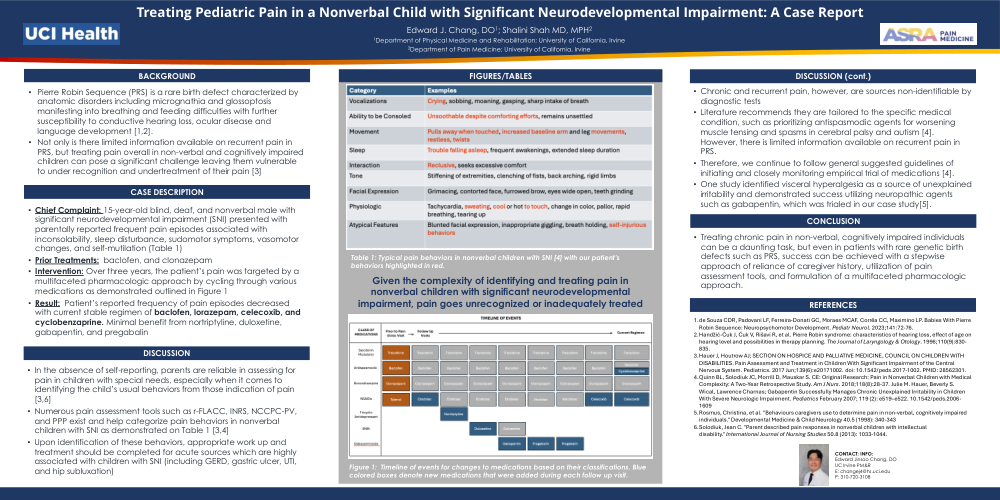
•Chief Complaint: 15-year-old blind, deaf, and nonverbal male with significant neurodevelopmental impairment (SNI) presented with parentally reported frequent pain episodes associated with inconsolability, sleep disturbance, sudomotor symptoms, vasomotor changes, and self-mutilation (Table 1)
•Prior Treatments: baclofen, and clonazepam
•Intervention: Over three years, the patient’s pain was targeted by a multifaceted pharmacologic approach by cycling through various medications as demonstrated outlined in Figure 1
•Result: Patient’s reported frequency of pain episodes decreased with current stable regimen of baclofen, lorazepam, celecoxib, and cyclobenzaprine. Minimal benefit from nortriptyline, duloxetine, gabapentin, and pregabalin
DISCUSSION
•In the absence of self-reporting, parents are reliable in assessing for pain in children with special needs, especially when it comes to identifying the child’s usual behaviors from those indication of pain [3,6]
•Numerous pain assessment tools such as r-FLACC, INRS, NCCPC-PV, and PPP exist and help categorize pain behaviors in nonverbal children with SNI as demonstrated on Table 1 [3,4]
•Upon identification of these behaviors, appropriate work up and treatment should be completed for acute sources which are highly associated with children with SNI (including GERD, gastric ulcer, UTI, and hip subluxation)
•Chronic and recurrent pain, however, are sources non-identifiable by diagnostic tests
•Literature recommends they are tailored to the specific medical condition, such as prioritizing antispasmodic agents for worsening muscle tensing and spasms in cerebral palsy and autism [4]. However, there is limited information available on recurrent pain in PRS.
•Therefore, we continue to follow general suggested guidelines of initiating and closely monitoring empirical trial of medications [4].
•One study identified visceral hyperalgesia as a source of unexplained irritability and demonstrated success utilizing neuropathic agents such as gabapentin, which was trialed in our case study[5].
CONCLUSION
•Treating chronic pain in non-verbal, cognitively impaired individuals can be a daunting task, but even in patients with rare genetic birth defects such as PRS, success can be achieved with a stepwise approach of reliance of caregiver history, utilization of pain assessment tools, and formulation of a multifaceted pharmacologic approach.