501 posters, 2 videos, 1 audios, 8 topics, 37 sessions, 395 authors, 307 institutions
ePostersLive by SciGen Technologies S.A. All rights reserved.
23rd Annual Pain Medicine Meeting 2024
November 21-23, 2024 | Caesars Palace, Las Vegas, Nevada

5959
MEDIAL BRANCH RADIOFREQUENCY THERMOCOAGULATION EFFECTING LUMBAR SPONDYLOLISTHESIS PROGRESSION?
Poster Presenter
Part of Topic
Medically Challenging Cases
Introduction: Currently, there is limited evidence on whether LMB-RFTC worsens spondylolisthesis. A recent study showed that in patients undergoing LMB-RFTC, a mean spondylolisthesis advancement of 1.3% per year is comparable to the estimated maximum rate of natural progression without any intervention (2). However, the power of this study is limited due to small sample size, an additional larger studies with longer follow-up periods must be done. With this particular patient, we hope to begin discussion on the effects of LMB-RFTC on pre-existing spondylolisthesis, and whether caution should be exercised to prevent the pathology from worsening.
Materials and Methods: As this case report is devoid of patient identifiable information, it is exempt from IRB review requirements as per UTMB policy. Patient informed consent was obtained for submission of a case report.
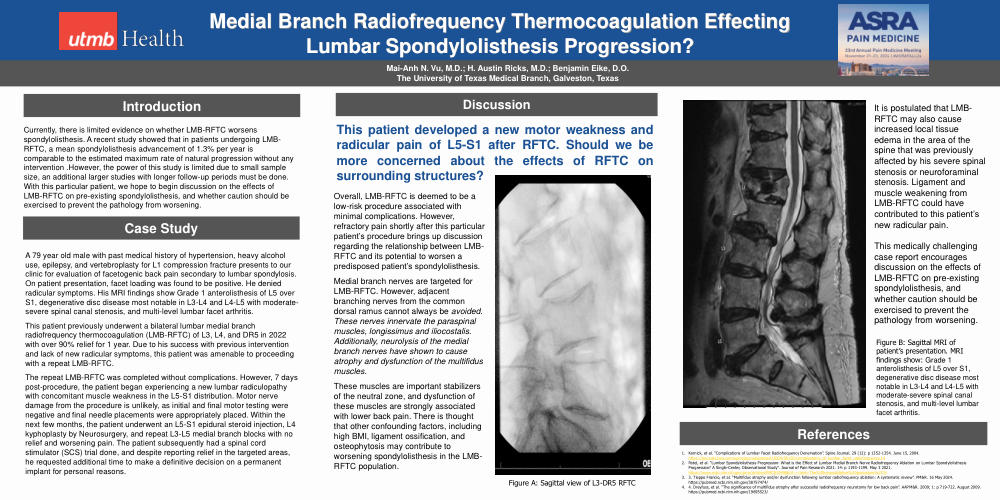
Results/Case Report: A 79 year old male with past medical history of hypertension, heavy alcohol use, epilepsy, and vertebroplasty for L1 compression fracture presents to our clinic for evaluation of facetogenic back pain secondary to lumbar spondylosis. On patient presentation, facet loading was found to be positive. He denied radicular symptoms. His MRI findings show Grade 1 anterolisthesis of L5 over S1, degenerative disc disease most notable in L3-L4 and L4-L5 with moderatesevere spinal canal stenosis, and multi-level lumbar facet arthritis. This patient previously underwent a bilateral lumbar medial branch radiofrequency thermocoagulation (LMB-RFTC) of L3, L4, and DR5 in 2022 with over 90% relief for 1 year. Due to his success with previous intervention and lack of new radicular symptoms, this patient was amenable to proceeding with a repeat LMB-RFTC. The repeat LMB-RFTC was completed without complications. However, 7 days post-procedure, the patient began experiencing a new lumbar radiculopathy with concomitant muscle weakness in the L5-S1 distribution. Motor nerve damage from the procedure is unlikely, as initial and final motor testing were negative and final needle placements were appropriately placed. Within the next few months, the patient underwent an L5-S1 epidural steroid injection, L4 kyphoplasty by Neurosurgery, and repeat L3-L5 medial branch blocks with no relief and worsening pain. The patient subsequently had a spinal cord stimulator (SCS) trial done, and despite reporting relief in the targeted areas, he requested additional time to make a definitive decision on a permanent implant for personal reasons.
Discussion: Overall, LMB-RFTC is deemed to be a low-risk procedure associated with minimal complications (1). However, refractory pain shortly after this particular patient’s procedure brings up discussion regarding the relationship between LMB-RFTC and its potential to worsen a predisposed patient’s spondylolisthesis. Medial branch nerves are targeted for LMB-RFTC. However, adjacent branching nerves from the common dorsal ramus cannot always be avoided. These nerves innervate the paraspinal muscles, longissimus and iliocostalis (2). Additionally, neurolysis of the medial branch nerves have shown to cause atrophy and dysfunction of the multifidus muscles (3). These muscles are important stabilizers of the neutral zone, and dysfunction of these muscles are strongly associated with lower back pain (4). There is thought that other confounding factors, including high BMI, ligament ossification, and osteophytosis may contribute to worsening spondylolisthesis in the LMB-RFTC population (2). It is postulated that LMBRFTC may also cause increased local tissue edema in the area of the spine that was previously affected by his severe spinal stenosis or neuroforaminal stenosis. Ligament and muscle weakening from LMBRFTC could have contributed to this patient’s new radicular pain.
References:
1. Kornick, et al. “Complications of Lumbar Facet Radiofrequency Denervation”. Spine Journal. 29 (12): p 1352-1354. June 15, 2004. https://journals.lww.com/spinejournal/abstract/2004/06150/complications_of_lumbar_facet_radiofrequency.14
2. Patel, et al. “Lumbar Spondylolisthesis Progression: What is the Effect of Lumbar Medial Branch Nerve Radiofrequency Ablation on Lumbar Spondylolisthesis Progression? A Single-Center, Observational Study”. Journal of Pain Research 2021. 14: p 1193-1199. May 3 2021. https://www.ncbi.nlm.nih.gov/pmc/articles/PMC8104986/#:~:text=The%20neuroablative%20procedure%2C%
3. Tieppo Francio, et al. “Multifidus atrophy and/or dysfunction following lumbar radiofrequency ablation: A systematic review”. PM&R. 16 May 2024. https://pubmed.ncbi.nlm.nih.gov/38757474/
4. Dreyfuss, et al. “The significance of multifidus atrophy after successful radiofrequency neurotomy for low back pain”. AAPM&R. 2009; 1: p 719-722. August 2009. https://pubmed.ncbi.nlm.nih.gov/19695523/