501 posters, 2 videos, 1 audios, 8 topics, 37 sessions, 395 authors, 307 institutions
ePostersLive by SciGen Technologies S.A. All rights reserved.
23rd Annual Pain Medicine Meeting 2024
November 21-23, 2024 | Caesars Palace, Las Vegas, Nevada

5958
NEURAXIAL ANALGESIA IN COMPLEX PARTURIENT WITH SCOLIOSIS AND PREVIOUS CROSS-SEX HORMONE THERAPY (CSHT)
Poster Presenter
Part of Topic
Medically Challenging Cases
Introduction: This interesting case highlights important topics in pain management, including: fetal radiograph risk, gender-affirming care, and prevention of traumatic, complex neuraxial placements.
Materials and Methods: As this case report is devoid of patient identifiable information, it is exempt from IRB review requirements as per UTMB policy. Patient informed consent was obtained for submission of a case report.
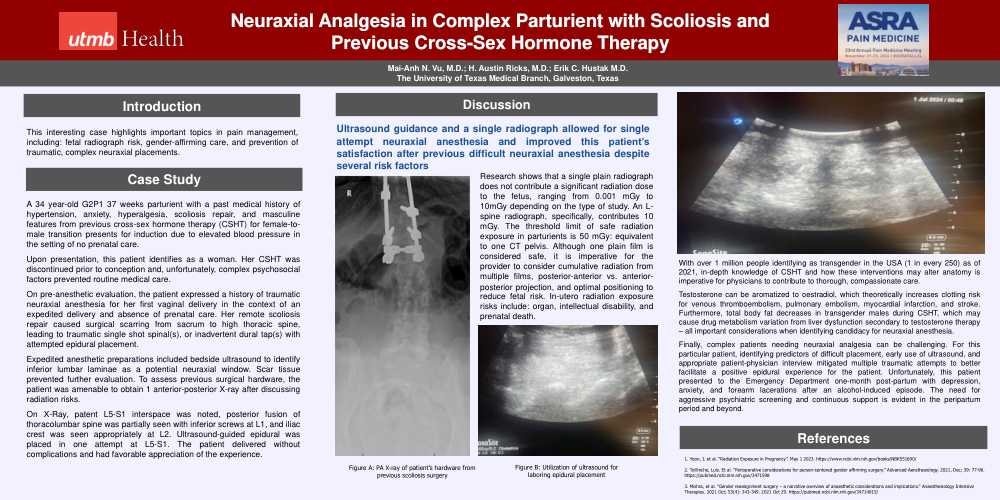
Results/Case Report: A 34 year-old G2P1 37 weeks parturient with a past medical history of hypertension, anxiety, hyperalgesia, scoliosis repair, and masculine features from previous cross-sex hormone therapy (CSHT) for female-to-male transition presents for induction due to elevated blood pressure in the setting of no prenatal care. Upon presentation, this patient identifies as a woman. Her CSHT was discontinued prior to conception and, unfortunately, complex psychosocial factors prevented routine medical care. On pre-anesthetic evaluation, the patient expressed a history of traumatic neuraxial anesthesia for her first vaginal delivery in the context of an expedited delivery and absence of prenatal care. Her remote scoliosis repair caused surgical scarring from sacrum to high thoracic spine, leading to traumatic single shot spinal(s), or inadvertent dural tap(s) with attempted epidural placement. Expedited anesthetic preparations included bedside ultrasound to identify inferior lumbar laminae as a potential neuraxial window. Scar tissue prevented further evaluation. To assess previous surgical hardware, the patient was amenable to obtain 1 anterior-posterior X-ray after discussing radiation risks. On X-Ray, patent L5-S1 interspace was noted, posterior fusion of thoracolumbar spine was partially seen with inferior screws at L1, and iliac crest was seen appropriately at L2. Ultrasound-guided epidural was placed in one attempt at L5-S1. The patient delivered without complications and had favorable appreciation of the experience.
Discussion: Research shows that a single plain radiograph does not contribute a significant radiation dose to the fetus, ranging from 0.001 mGy to 10mGy depending on the type of study. An L-spine radiograph, specifically, contributes 10 mGy. The threshold limit of safe radiation exposure in parturients is 50 mGy: equivalent to one CT pelvis. Although one plain film is considered safe, it is imperative for the provider to consider cumulative radiation from multiple films, posterior-anterior vs. anterior-posterior projection, and optimal positioning to reduce fetal risk. In-utero radiation exposure risks include: organ, intellectual disability, and prenatal death (1). With over 1 million people identifying as transgender in the USA (1 in every 250) as of 2021, in-depth knowledge of CSHT and how these interventions may alter anatomy is imperative for physicians to contribute to thorough, compassionate care. Testosterone can be aromatized to oestradiol, which theoretically increases clotting risk for venous thromboembolism, pulmonary embolism, myocardial infarction, and stroke (2). Furthermore, total body fat decreases in transgender males during CSHT, which may cause drug metabolism variation from liver dysfunction secondary to testosterone therapy (3) – all important considerations when identifying candidacy for neuraxial anesthesia. Finally, complex patients needing neuraxial analgesia can be challenging. For this particular patient, identifying predictors of difficult placement, early use of ultrasound, and appropriate patient-physician interview mitigated multiple traumatic attempts to better facilitate a positive epidural experience for the patient. Unfortunately, this patient presented to the Emergency Department one month post-partum with depression, anxiety, and forearm lacerations after an alcohol-induced episode. The need for aggressive psychiatric screening and continuous support is evident in the peripartum period and beyond.
References:
1. Yoon, I. et al. “Radiation Exposure in Pregnancy”. May 1 2023. https://www.ncbi.nlm.nih.gov/books/NBK551690/
2. Tolllinche, Luis. Et al. “Perioperative considerations for person-centered gender affirming surgery.” Advanced Aensthesiology. 2021, Dec; 39: 77-96. https://pubmed.ncbi.nlm.nih.gov/34715982/
3. Mishra, et al. “Gender reassignment surgery – a narrative overview of anaesthetic considerations and implications.” Anaesthesiology Intensive Therapies. 2021 Oct; 53(4): 343-349. 2021 Oct 29. https://pubmed.ncbi.nlm.nih.gov/34714015/