501 posters, 2 videos, 1 audios, 8 topics, 37 sessions, 395 authors, 307 institutions
ePostersLive by SciGen Technologies S.A. All rights reserved.
23rd Annual Pain Medicine Meeting 2024
November 21-23, 2024 | Caesars Palace, Las Vegas, Nevada

5929
PERIPHERAL NERVE STIMULATION FOR NEUROGENIC THORACIC OUTLET SYNDROME WITH RE-IMPLANTATION FOLLOWING LEAD MIGRATION: A CASE REPORT
Poster Presenter
Authors
Affiliations
Part of Topic
Medically Challenging Cases
Peripheral Nerve Stimulation for Neurogenic Thoracic Outlet Syndrome with Re-implantation following Lead Migration: A Case Report
Kevin Nasre-Esfahani DO, Gary Moy BS, Charles De Mesa DO, Chinar Sanghvi MD
UC Davis Health, Department of Anesthesia and Pain Medicine
Intro
Thoracic Outlet Syndrome (TOS) encompasses a group of disorders caused by compression of neurovascular structures at the thoracic outlet, affecting the brachial plexus, subclavian artery, and/or subclavian vein.1 Neurogenic TOS (nTOS) is the most prevalent form, accounting for 82% of TOS cases in the USA, presenting with paresthesias, pain, and weakness in the upper limbs, neck, trapezius, and shoulder.1,2 While conservative treatments are effective in 60% of cases, refractory cases necessitate advanced interventions.2,3 Neuromodulation, including Peripheral Nerve Stimulation (PNS) and Spinal Cord Stimulation (SCS), is emerging as a novel treatment modality for refractory nTOS.4,5
Methods
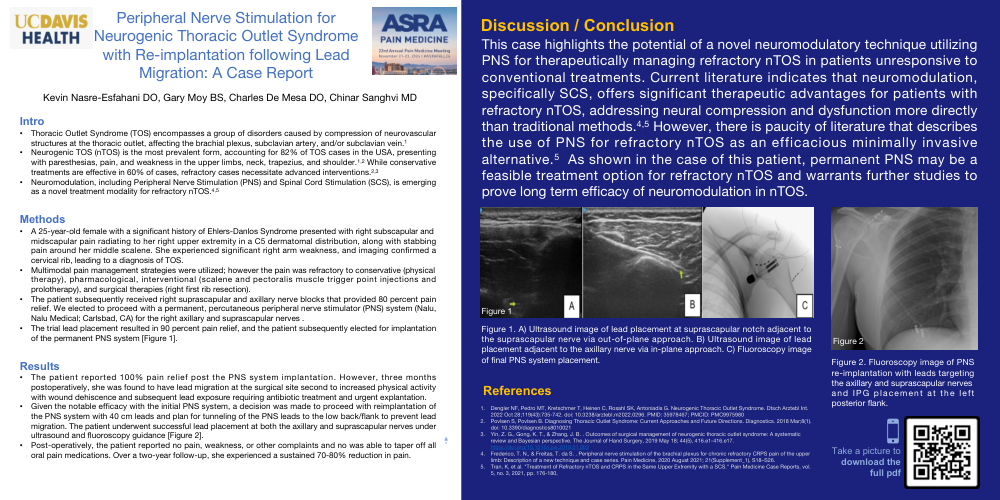
A 25-year-old female with a significant history of Ehlers-Danlos Syndrome presented with right subscapular and midscapular pain radiating to her right upper extremity in a C5 dermatomal distribution, along with stabbing pain around her middle scalene. She experienced significant right arm weakness, and imaging confirmed a cervical rib, leading to a diagnosis of TOS. Multimodal pain management strategies were utilized; however the pain was refractory to conservative (physical therapy), pharmacological, interventional (scalene and pectoralis muscle trigger point injections and prolotherapy), and surgical therapies (right first rib resection). The patient subsequently received right suprascapular and axillary nerve blocks that provided 80 percent pain relief. We elected to proceed with a permanent, percutaneous peripheral nerve stimulator (PNS) system (Nalu, Nalu Medical; Carlsbad, CA) for the right axillary and suprascapular nerves . The trial lead placement resulted in 90 percent pain relief, and the patient subsequently elected for implantation of the permanent PNS system [Figure 1].
Results
The patient reported 100% pain relief post the PNS system implantation. However, three months postoperatively, she was found to have lead migration at the surgical site second to increased physical activity with wound dehiscence and subsequent lead exposure requiring antibiotic treatment and urgent explantation. Given the notable efficacy with the initial PNS system, a decision was made to proceed with reimplantation of the PNS system with 40 cm leads and plan for tunneling of the PNS leads to the low back/flank to prevent lead migration. The patient underwent successful lead placement at both the axillary and suprascapular nerves under ultrasound and fluoroscopy guidance [Figure 2]. Post-operatively, the patient reported no pain, weakness, or other complaints and no was able to taper off all oral pain medications. Over a two-year follow-up, she experienced a sustained 70-80% reduction in pain.
Discussion/Conclusion
This case highlights the potential of a novel neuromodulatory technique utilizing PNS for therapeutically managing refractory nTOS in patients unresponsive to conventional treatments. Current literature indicates that neuromodulation, specifically SCS, offers significant therapeutic advantages for patients with refractory nTOS, addressing neural compression and dysfunction more directly than traditional methods.4,5 However, there is paucity of literature that describes the use of PNS for refractory nTOS as an efficacious minimally invasive alternative.5 As shown in the case of this patient, permanent PNS may be a feasible treatment option for refractory nTOS and warrants further studies to prove long term efficacy of neuromodulation in nTOS.