501 posters, 2 videos, 1 audios, 8 topics, 37 sessions, 395 authors, 307 institutions
ePostersLive by SciGen Technologies S.A. All rights reserved.
23rd Annual Pain Medicine Meeting 2024
November 21-23, 2024 | Caesars Palace, Las Vegas, Nevada

5848
TIME IS BLEEDING RISK: EPIDURAL CATHETER MANAGEMENT IN PATIENTS RECEIVING EMERGENT ANTITHROMBOTIC THERAPY
Poster Presenter
Authors
Affiliations
Part of Topic
Medically Challenging Cases
Introduction:
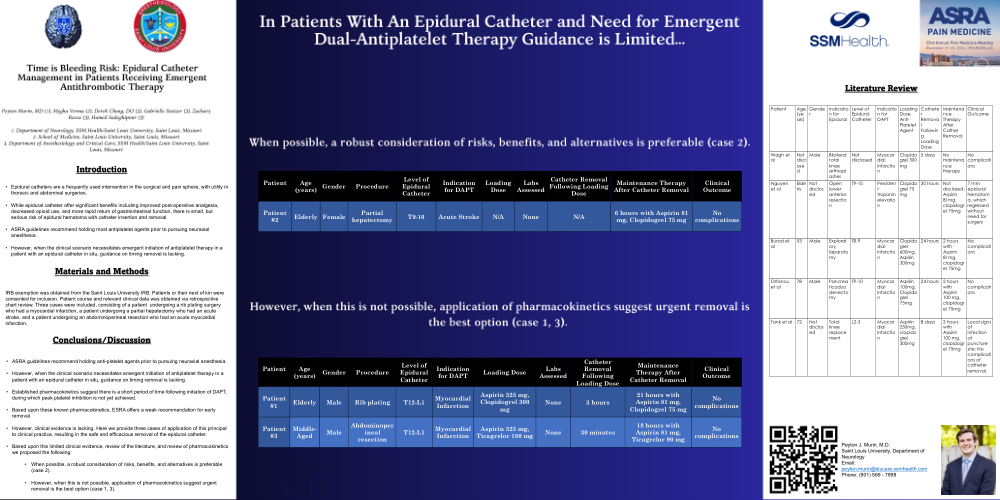
Epidural catheters are a frequently used intervention in the surgical and pain sphere, with utility in thoracic and abdominal surgeries. While epidural catheter offer significant benefits including improved post-operative analgesia, decreased opioid use, and more rapid return of gastrointestinal function, there is small, but serious risk of epidural hematoma with catheter insertion and removal. ASRA guidelines recommend holding most antiplatelet agents prior to pursuing neuraxial anesthesia. However, when the clinical scenario necessitates emergent initiation of antiplatelet therapy in a patient with an epidural catheter in situ, guidance on timing removal is lacking.
Materials and Methods:
IRB exemption was obtained from the Saint Louis University IRB. Patients or their next of kin were consented for inclusion. Patient course and relevant clinical data was obtained via retrospective chart review. Three cases were included, consisting of a patient undergoing a rib plating surgery who had a myocardial infarction, a patient undergoing a partial hepatectomy who had an acute stroke, and a patient undergoing an abdominoperineal resection who had an acute myocardial infarction.
Conclusions/Discussion:
ASRA guidelines recommend holding anti-platelet agents prior to pursuing neuraxial anesthesia. However, when the clinical scenario necessitates emergent initiation of antiplatelet therapy in a patient with an epidural catheter in situ, guidance on timing removal is lacking. Established pharmacokinetics suggest there is a short period of time following initiation of DAPT, during which peak platelet inhibition is not yet achieved. Based upon these known pharmacokinetics, ESRA offers a weak recommendation for early removal. However, clinical evidence is lacking. Here we provide three cases of application of this principal to clinical practice, resulting in the safe and efficacious removal of the epidural catheter. Based upon this limited clinical evidence, review of the literature, and review of pharmacokinetics we proposed the following: When possible, a robust consideration of risks, benefits, and alternatives is preferable (case 2). However, when this is not possible, application of pharmacokinetics suggest urgent removal is the best option (case 1, 3).