501 posters, 2 videos, 1 audios, 8 topics, 37 sessions, 395 authors, 307 institutions
ePostersLive by SciGen Technologies S.A. All rights reserved.
23rd Annual Pain Medicine Meeting 2024
November 21-23, 2024 | Caesars Palace, Las Vegas, Nevada

6262
OVERCOMING POSTOPERATIVE PAIN CHALLENGES IN ACUTE INPATIENT REHABILITATION: A CASE STUDY
Poster Presenter
Authors
Affiliations
Montefiore Medical Center/Albert Einstein College of Medicine
Part of Topic
Medically Challenging Cases
Background:
Surgical interventions for scoliosis are complex and are associated with a high rate of complications [1]. Postoperative pain is common, but etiologies can be hard to discern, often leading to universal rather than targeted pain management.
Case Description:
A 36-year-old female with history of adolescent idiopathic scoliosis underwent a Harrington rod placement. It was later removed because of pseudoarthrosis, leading to severe back pain that remained unresponsive to conservative treatments including injections, physical therapy, gabapentin, and oxycodone. She presented to acute inpatient rehabilitation after spinal revision surgery with T10-L3 osteotomy, T4-L4 fusion, and L3-4 TLIF.
While in acute rehab, the patient reported persistent “12/10” left lower back burning pain radiating into her left lateral thigh and knee. Pain management was attempted with standing NSAIDs, lidocaine patches, lorazepam, pregabalin, and tizanidine, supplemented by as-needed oral hydromorphone.
Despite these efforts, her pain remained all-consuming and significantly hindered her rehabilitation progress.
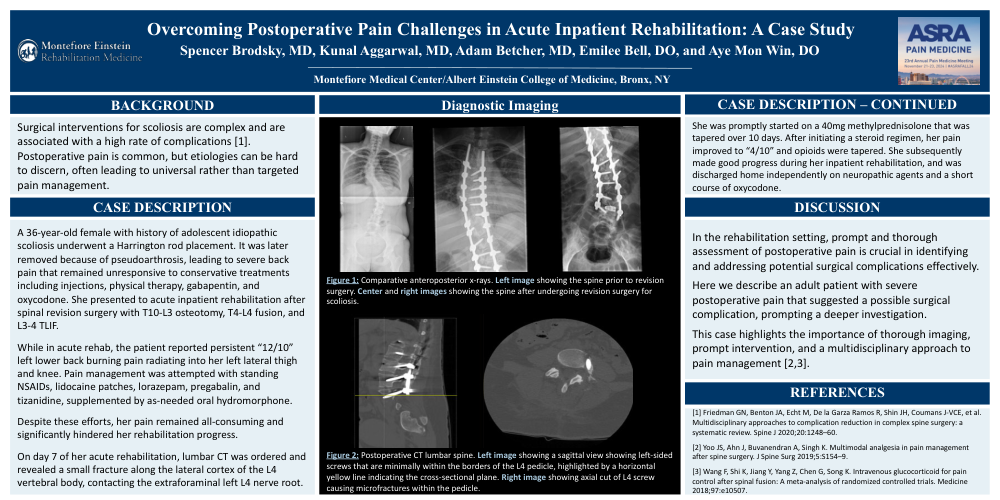
On day 7 of her acute rehabilitation, lumbar CT was ordered and revealed a small fracture along the lateral cortex of the L4 vertebral body, contacting the extraforaminal left L4 nerve root.
She was promptly started on a 40mg methylprednisolone that was tapered over 10 days. After initiating a steroid regimen, her pain improved to “4/10” and opioids were tapered. She subsequently made good progress during her inpatient rehabilitation, and was discharged home independently on neuropathic agents and a short course of oxycodone.
Discussion:
In the rehabilitation setting, prompt and thorough assessment of postoperative pain is crucial in identifying and addressing potential surgical complications effectively.
Here we describe an adult patient with severe postoperative pain that suggested a possible surgical complication, prompting a deeper investigation.
This case highlights the importance of thorough imaging, prompt intervention, and a multidisciplinary approach to pain management [2,3].
References:
[1] Friedman GN, Benton JA, Echt M, De la Garza Ramos R, Shin JH, Coumans J-VCE, et al. Multidisciplinary approaches to complication reduction in complex spine surgery: a systematic review. Spine J 2020;20:1248–60.
[2] Yoo JS, Ahn J, Buvanendran A, Singh K. Multimodal analgesia in pain management after spine surgery. J Spine Surg 2019;5:S154–9.
[3] Wang F, Shi K, Jiang Y, Yang Z, Chen G, Song K. Intravenous glucocorticoid for pain control after spinal fusion: A meta-analysis of randomized controlled trials. Medicine 2018;97:e10507.