501 posters, 2 videos, 1 audios, 8 topics, 37 sessions, 395 authors, 307 institutions
ePostersLive by SciGen Technologies S.A. All rights reserved.
23rd Annual Pain Medicine Meeting 2024
November 21-23, 2024 | Caesars Palace, Las Vegas, Nevada

6258
REGRESSION TO RELATIVE OPIOID NAIVETY DUE TO A MALFUNCTIONING INTRATHECAL OPIOID PUMP
Poster Presenter
Authors
Affiliations
Part of Topic
Medically Challenging Cases
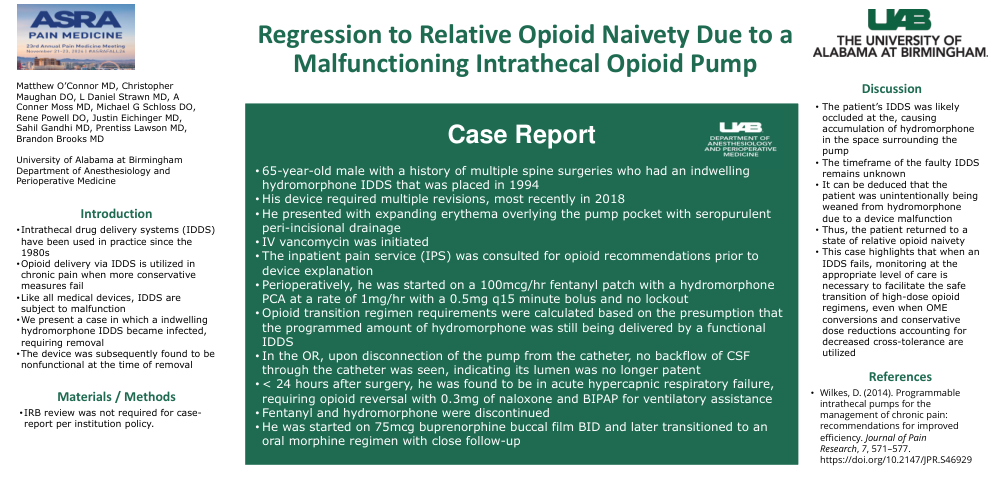
Regression to Relative Opioid Naivety Due to a Malfunctioning Intrathecal Opioid Pump
Introduction
•Intrathecal drug delivery systems (IDDS) have been used in practice since the 1980s
•Opioid delivery via IDDS is utilized in chronic pain when more conservative measures fail
•Like all medical devices, IDDS are subject to malfunction
•We present a case in which a indwelling hydromorphone IDDS became infected, requiring removal
•The device was subsequently found to be nonfunctional at the time of removal
Materials / Methods
•IRB review was not required for case-report per institution policy.
Case Report
•65-year-old male with a history of multiple spine surgeries who had an indwelling hydromorphone IDDS that was placed in 1994
•His device required multiple revisions, most recently in 2018
•He presented with expanding erythema overlying the pump pocket with seropurulent peri-incisional drainage
•IV vancomycin was initiated
•The inpatient pain service (IPS) was consulted for opioid recommendations prior to device explanation
•Perioperatively, he was started on a 100mcg/hr fentanyl patch with a hydromorphone PCA at a rate of 1mg/hr with a 0.5mg q15 minute bolus and no lockout
•Opioid transition regimen requirements were calculated based on the presumption that the programmed amount of hydromorphone was still being delivered by a functional IDDS
•In the OR, upon disconnection of the pump from the catheter, no backflow of CSF through the catheter was seen, indicating its lumen was no longer patent
•< 24 hours after surgery, he was found to be in acute hypercapnic respiratory failure, requiring opioid reversal with 0.3mg of naloxone and BIPAP for ventilatory assistance
•Fentanyl and hydromorphone were discontinued
•He was started on 75mcg buprenorphine buccal film BID and later transitioned to an oral morphine regimen with close follow-up
Discussion
•The patient’s IDDS was likely occluded at the, causing accumulation of hydromorphone in the space surrounding the pump
•The timeframe of the faulty IDDS remains unknown
•It can be deduced that the patient was unintentionally being weaned from hydromorphone due to a device malfunction
•Thus, the patient returned to a state of relative opioid naivety
•This case highlights that when an IDDS fails, monitoring at the appropriate level of care is necessary to facilitate the safe transition of high-dose opioid regimens, even when OME conversions and conservative dose reductions accounting for decreased cross-tolerance are utilized