501 posters, 2 videos, 1 audios, 8 topics, 37 sessions, 395 authors, 307 institutions
ePostersLive by SciGen Technologies S.A. All rights reserved.
23rd Annual Pain Medicine Meeting 2024
November 21-23, 2024 | Caesars Palace, Las Vegas, Nevada

6245
ULTRASOUND GUIDED PELVIC FLOOR TRIGGER POINT INJECTIONS FOR HYPERTONIC PELVIC FLOOR IN MALE PATIENT
Poster Presenter
Authors
Affiliations
Part of Topic
Medically Challenging Cases
Introduction:
Myofascial pelvic pain syndrome is characterized by chronic episodes of pain secondary to muscular and fascial dysfunction of the pelvic floor muscles. Treatment includes suppositories, pelvic physical therapy, and pelvic TPI’s. We present three male patients (33, 43, and 50) with pelvic pain of greater than one year. They each received pelvic TPIs over five, four, and three sessions, respectively. All patients reported near 100% relief in their symptoms for many weeks. The patients who receive TPI have shown significant improvement in pain and return to ADLs, and recurring pain was reported to be lower than their baseline pain.
Case Description:
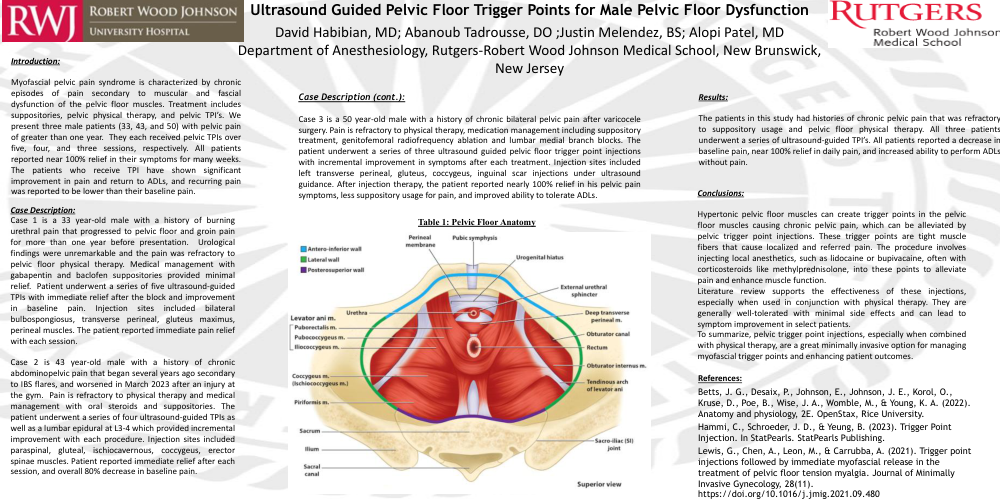
Case 1 is a 33 year-old male with a history of burning urethral pain that progressed to pelvic floor and groin pain for more than one year before presentation. Urological findings were unremarkable and the pain was refractory to pelvic floor physical therapy. Medical management with gabapentin and baclofen suppositories provided minimal relief. Patient underwent a series of five ultrasound-guided TPIs with immediate relief after the block and improvement in baseline pain. Injection sites included bilateral bulbospongiosus, transverse perineal, gluteus maximus, perineal muscles. The patient reported immediate pain relief with each session.
Case 2 is 43 year-old male with a history of chronic abdominopelvic pain that began several years ago secondary to IBS flares, and worsened in March 2023 after an injury at the gym. Pain is refractory to physical therapy and medical management with oral steroids and suppositories. The patient underwent a series of four ultrasound-guided TPIs as well as a lumbar epidural at L3-4 which provided incremental improvement with each procedure. Injection sites included paraspinal, gluteal, ischiocavernous, coccygeus, erector spinae muscles. Patient reported immediate relief after each session, and overall 80% decrease in baseline pain.
Case 3 is a 50 year-old male with a history of chronic bilateral pelvic pain after varicocele surgery. Pain is refractory to physical therapy, medication management including suppository treatment, genitofemoral radiofrequency ablation and lumbar medial branch blocks. The patient underwent a series of three ultrasound guided pelvic floor trigger point injections with incremental improvement in symptoms after each treatment. Injection sites included left transverse perineal, gluteus, coccygeus, inguinal scar injections under ultrasound guidance. After injection therapy, the patient reported nearly 100% relief in his pelvic pain symptoms, less suppository usage for pain, and improved ability to tolerate ADLs.
The patients in this study had histories of chronic pelvic pain that was refractory to suppository usage and pelvic floor physical therapy. All three patients underwent a series of ultrasound-guided TPI’s. All patients reported a decrease in baseline pain, near 100% relief in daily pain, and increased ability to perform ADLs without pain.
Hypertonic pelvic floor muscles can create trigger points in the pelvic floor muscles causing chronic pelvic pain, which can be alleviated by pelvic trigger point injections. These trigger points are tight muscle fibers that cause localized and referred pain. The procedure involves injecting local anesthetics, such as lidocaine or bupivacaine, often with corticosteroids like methylprednisolone, into these points to alleviate pain and enhance muscle function.
Literature review supports the effectiveness of these injections, especially when used in conjunction with physical therapy. They are generally well-tolerated with minimal side effects and can lead to symptom improvement in select patients.
To summarize, pelvic trigger point injections, especially when combined with physical therapy, are a great minimally invasive option for managing myofascial trigger points and enhancing patient outcomes.