501 posters, 2 videos, 1 audios, 8 topics, 37 sessions, 395 authors, 307 institutions
ePostersLive by SciGen Technologies S.A. All rights reserved.
23rd Annual Pain Medicine Meeting 2024
November 21-23, 2024 | Caesars Palace, Las Vegas, Nevada

6218
TREATMENT-INDUCED DIABETIC NEUROPATHY: A CASE REPORT ON MULTIMODAL PAIN MANAGEMENT IN A YOUNG PATIENT WITH TYPE I DIABETES
Poster Presenter
Authors
Affiliations
Part of Topic
Medically Challenging Cases
Background
Overview:
- The case focuses on treatment-induced diabetic neuropathy and the utilization of multimodal pain management.
- Chronic neuropathic pain can originate from peripheral or central sources, e.g., diabetic neuropathy, trigeminal neuralgia, spinal cord injury, post-stroke pain, polyneuropathy,
and radiculopathy (Vinik et al., 2013).
Diagnosis Challenges:
- Some patients may present with neuropathic pain that remains undiagnosed, even after ruling out common causes.
- Treatment-induced diabetic neuropathy, although rare, should be considered, especially after rapid glycemic control correction (Gibbons & Freeman, 2010).
Condition Characteristics:
- Although it is rare, some patients with long-standing uncontrolled diabetes may experience worsening neuropathy symptoms like pain and autonomic dysfunction
with improved glycemic control.
Management Approach:
- A multimodal treatment strategy is essential, incorporating medications, physical therapy, psychological support, and interventional procedures (Tracy & Dyck, 2008).
Case Presentation:
Patient Background:
- In 2019, a 19-year-old male with type 1 diabetes on insulin therapy, without good glycemic control, was referred for bilateral lower extremity pain. He reported a burning sensation in a glove-and-stocking distribution, which worsened in cold weather and at night, but was relieved by rest.
Clinical Findings:
- In May 2023, the patient's HbA1c level was elevated at 14.7%, later reduced to 6.7% following the initiation of insulin pump therapy. Diagnostic tests, including EMG, spinal MRI, and rheumatologic markers, were normal. A skin biopsy revealed reduced nerve fiber density.
Treatment and Management:
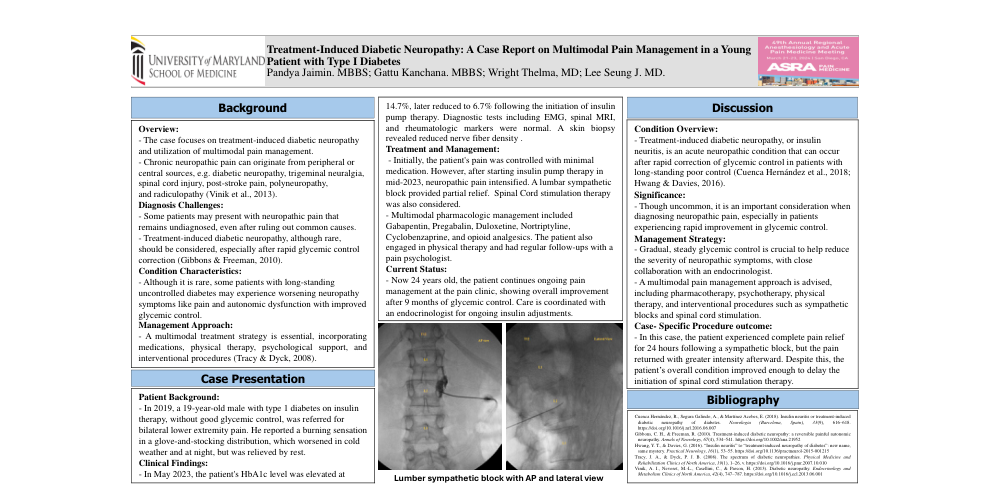
- Initially, the patient's pain was controlled with minimal medication. However, after starting insulin pump therapy in mid-2023, neuropathic pain intensified. A lumbar sympathetic block provided partial relief. Spinal Cord stimulation therapy was also considered.
- Multimodal pharmacologic management included Gabapentin, Pregabalin, Duloxetine, Nortriptyline, Cyclobenzaprine, and opioid analgesics. The patient also engaged in physical therapy and had regular follow-ups with a pain psychologist.
Current Status:
- Now 24 years old, the patient continues ongoing pain management at the pain clinic, showing overall improvement after 9 months of glycemic control. Care is coordinated with an endocrinologist for ongoing insulin adjustments.
Discussion
Condition Overview:
- Treatment-induced diabetic neuropathy, or insulin neuritis, is an acute neuropathic condition that can occur after rapid correction of glycemic control in patients with long-standing poor control (Cuenca Hernández et al., 2018; Hwang & Davies, 2016).
Significance:
- Though uncommon, it is an important consideration when diagnosing neuropathic pain, especially in patients experiencing rapid improvement in glycemic control.
Management Strategy:
- Gradual, steady glycemic control is crucial to help reduce the severity of neuropathic symptoms, with close collaboration with an endocrinologist.
- A multimodal pain management approach is advised, including pharmacotherapy, psychotherapy, physical therapy, and interventional procedures such as sympathetic blocks and spinal cord stimulation.
Case-Specific Procedure Outcome:
- In this case, the patient experienced complete pain relief for 24 hours following a sympathetic block, but the pain returned with greater intensity afterward. Despite this, the patient’s overall condition improved enough to delay the initiation of spinal cord stimulation therapy.
Cuenca Hernández, R., Segura Galindo, A., & Martínez Acebes, E. (2018). Insulin neuritis or treatment-induced diabetic neuropathy of diabetes. Neurologia (Barcelona, Spain), 33(9), 616–618. https://doi.org/10.1016/j.nrl.2016.06.007
Gibbons, C. H., & Freeman, R. (2010). Treatment-induced diabetic neuropathy: a reversible painful autonomic neuropathy. Annals of Neurology, 67(4), 534–541. https://doi.org/10.1002/ana.21952
Hwang, Y. T., & Davies, G. (2016). “Insulin neuritis” to “treatment-induced neuropathy of diabetes”: new name, same mystery. Practical Neurology, 16(1), 53–55. https://doi.org/10.1136/practneurol-2015-001215
Tracy, J. A., & Dyck, P. J. B. (2008). The spectrum of diabetic neuropathies. Physical Medicine and Rehabilitation Clinics of North America, 19(1), 1–26, v. https://doi.org/10.1016/j.pmr.2007.10.010
Vinik, A. I., Nevoret, M.-L., Casellini, C., & Parson, H. (2013). Diabetic neuropathy. Endocrinology and Metabolism Clinics of North America, 42(4), 747–787. https://doi.org/10.1016/j.ecl.2013.06.001