501 posters, 2 videos, 1 audios, 8 topics, 37 sessions, 395 authors, 307 institutions
ePostersLive by SciGen Technologies S.A. All rights reserved.
23rd Annual Pain Medicine Meeting 2024
November 21-23, 2024 | Caesars Palace, Las Vegas, Nevada

6004
TRANSIENT QUADRIPARESIS AFTER CERVICAL EPIDURAL STEROID INJECTION – IS THAT STEROID ALLERGY? AN UNUSUAL PRESENTATION.
Poster Presenter
Authors
Affiliations
Part of Topic
Medically Challenging Cases
Transient Quadriparesis after Cervical Epidural Steroid Injection – Is that Steroid Allergy?
An Unusual Presentation.
Submitting/presenting author: Mushtaq H. Qureshi, MD
Division of Pain Medicine, Department of Anesthesiology, Emory University School of Medicine, Mushtaq.Qureshi@emory.edu
Introduction:
Due to its symptomatic effect, corticosteroids are used very frequently in epidural injections in the treatment of radicular pain. Although, uses of steroid injections are well tolerated and associated with fewer side effects, complications from use of steroids are not uncommon. Among other complications, hypersensitive response to corticosteroids is rare in general population. We present a case of a 37-year-old man who presented with quadriparesis after receiving cervical epidural injection containing dexamethasone.
Methods:
Patient’s informed consent was obtained for submission of this case report, which is devoid of patient identifiable information and thus exempt from IRB review per Northeast Georgia Medical Center policy.
Case report:
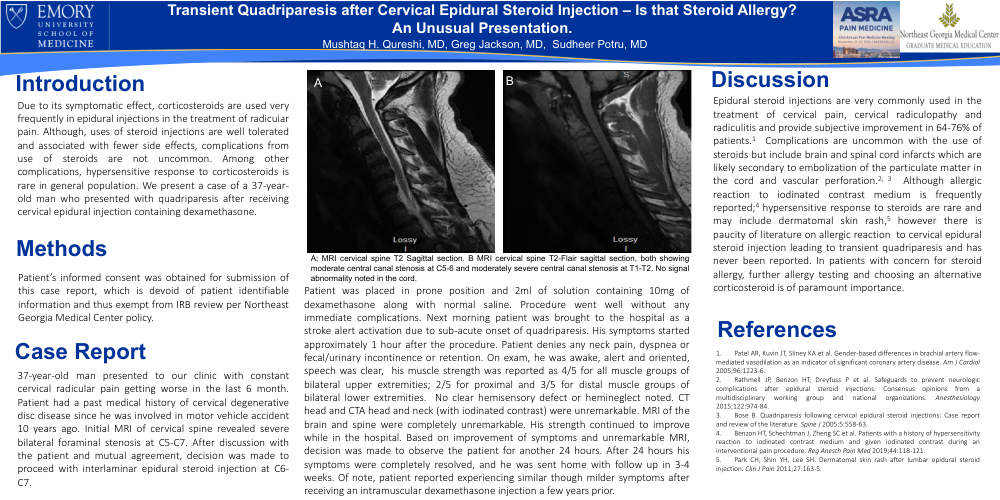
37-year-old man presented to our clinic with constant cervical radicular pain getting worse in the last 6 month. Patient had a past medical history of cervical degenerative disc disease since he was involved in motor vehicle accident 10 years ago. Initial MRI of cervical spine revealed severe bilateral foraminal stenosis at C5-C7. After discussion with the patient and mutual agreement, decision was made to proceed with interlaminar epidural steroid injection at C6-C7. Patient was placed in prone position and 2ml of solution containing 10mg of dexamethasone along with normal saline. Procedure went well without any immediate complications. Next morning patient was brought to the hospital as a stroke alert activation due to sub-acute onset of quadriparesis. His symptoms started approximately 1 hour after the procedure. Patient denies any neck pain, dyspnea or fecal/urinary incontinence or retention. On exam, he was awake, alert and oriented, speech was clear, his muscle strength was reported as 4/5 for all muscle groups of bilateral upper extremities; 2/5 for proximal and 3/5 for distal muscle groups of bilateral lower extremities. No clear hemisensory defect or hemineglect noted. CT head and CTA head and neck (with iodinated contrast) were unremarkable. MRI of the brain and spine were completely unremarkable. His strength continued to improve while in the hospital. Based on improvement of symptoms and unremarkable MRI, decision was made to observe the patient for another 24 hours. After 24 hours his symptoms were completely resolved, and he was sent home with follow up in 3-4 weeks. Of note, patient reported experiencing similar though milder symptoms after receiving an intramuscular dexamethasone injection a few years prior.
Discussion:
Epidural steroid injections are very commonly used in the treatment of cervical pain, cervical radiculopathy and radiculitis and provide subjective improvement in 64-76% of patients.1 Complications are uncommon with the use of steroids but include brain and spinal cord infarcts which are likely secondary to embolization of the particulate matter in the cord and vascular perforation.2; 3 Although allergic reaction to iodinated contrast medium is frequently reported;4 hypersensitive response to steroids are rare and may include dermatomal skin rash,5 however there is paucity of literature on allergic reaction to cervical epidural steroid injection leading to transient quadriparesis and has never been reported. In patients with concern for steroid allergy, further allergy testing and choosing an alternative corticosteroid is of paramount importance.
References:
1. Patel AR, Kuvin JT, Sliney KA et al. Gender-based differences in brachial artery flow-mediated vasodilation as an indicator of significant coronary artery disease. Am J Cardiol 2005;96:1223-6.
2. Rathmell JP, Benzon HT, Dreyfuss P et al. Safeguards to prevent neurologic complications after epidural steroid injections: Consensus opinions from a multidisciplinary working group and national organizations. Anesthesiology 2015;122:974-84.
3. Bose B. Quadriparesis following cervical epidural steroid injections: Case report and review of the literature. Spine J 2005;5:558-63.
4. Benzon HT, Schechtman J, Zheng SC et al. Patients with a history of hypersensitivity reaction to iodinated contrast medium and given iodinated contrast during an interventional pain procedure. Reg Anesth Pain Med 2019;44:118-121.
5. Park CH, Shin YH, Lee SH. Dermatomal skin rash after lumbar epidural steroid injection. Clin J Pain 2011;27:163-5.