501 posters, 2 videos, 1 audios, 8 topics, 37 sessions, 395 authors, 307 institutions
ePostersLive by SciGen Technologies S.A. All rights reserved.
23rd Annual Pain Medicine Meeting 2024
November 21-23, 2024 | Caesars Palace, Las Vegas, Nevada

6000
CRPS FROM A FORKLIFT INJURY
Poster Presenter
Authors
Affiliations
Part of Topic
Medically Challenging Cases
CRPS from a Forklift Injury: A Case Report
Authors: Leslie Wong, DO; Elliott Berry, MD; Petter Atallah, DO, Karthik Kamath, DO; Jenzel Espares, DO; Adam Isaacson, MD
Department: Physical Medicine and Rehabilitation
CRPS is a chronic pain condition that can be notoriously difficult to treat. A part of the difficulty of treating this condition is that the pathogenesis of this disease has still not yet been elucidated. Numerous studies have shown different possible pathways which have led to a myriad of different treatment strategies. These pathways/factors include neuropathic inflammation, particularly activation of peripheral nociceptors of C-fibers, the autonomic nervous system and norepinephrine levels, as well as psychological factors. Possible treatment options include physical therapy, pharmacotherapy, and interventional techniques such as neuromodulation. In this case report, a patient experienced great but temporary relief with a peroneal nerve block after failing trials of physical therapy, oral medications such as duloxetine, and oral corticosteroids.
As per Nassau University Medical Center policy, this case report is exempt from IRB review requirements as all patient information has been deidentified. Informed consent was obtained from the patient.
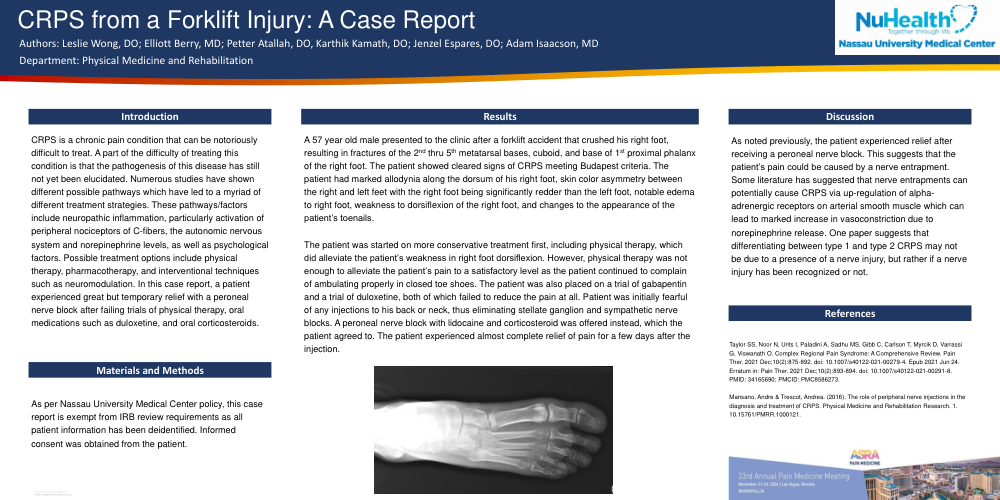
A 57 year old male presented to the clinic after a forklift accident that crushed his right foot, resulting in fractures of the 2nd thru 5th metatarsal bases, cuboid, and base of 1st proximal phalanx of the right foot. The patient showed cleared signs of CRPS meeting Budapest criteria. The patient had marked allodynia along the dorsum of his right foot, skin color asymmetry between the right and left feet with the right foot being significantly redder than the left foot, notable edema to right foot, weakness to dorsiflexion of the right foot, and changes to the appearance of the patient’s toenails.
The patient was started on more conservative treatment first, including physical therapy, which did alleviate the patient’s weakness in right foot dorsiflexion. However, physical therapy was not enough to alleviate the patient’s pain to a satisfactory level as the patient continued to complain of ambulating properly in closed toe shoes. The patient was also placed on a trial of gabapentin and a trial of duloxetine, both of which failed to reduce the pain at all. Patient was initially fearful of any injections to his back or neck, thus eliminating stellate ganglion and sympathetic nerve blocks. A peroneal nerve block with lidocaine and corticosteroid was offered instead, which the patient agreed to. The patient experienced almost complete relief of pain for a few days after the injection.
As noted previously, the patient experienced relief after receiving a peroneal nerve block. This suggests that the patient’s pain could be caused by a nerve entrapment. Some literature has suggested that nerve entrapments can potentially cause CRPS via up-regulation of alpha-adrenergic receptors on arterial smooth muscle which can lead to marked increase in vasoconstriction due to norepinephrine release. One paper suggests that differentiating between type 1 and type 2 CRPS may not be due to a presence of a nerve injury, but rather if a nerve injury has been recognized or not.