501 posters, 2 videos, 1 audios, 8 topics, 37 sessions, 395 authors, 307 institutions
ePostersLive by SciGen Technologies S.A. All rights reserved.
23rd Annual Pain Medicine Meeting 2024
November 21-23, 2024 | Caesars Palace, Las Vegas, Nevada

5977
IS IT LEAKING OR KNOT? AN UNEXPECTED COMPLICATION OF INTRATHECAL THERAPY
Poster Presenter
Part of Topic
Medically Challenging Cases
Is it Leaking or Knot? An Unexpected Complication of Intrathecal Therapy
Introduction
•Intrathecal therapy has traditionally been used for pain amelioration in cancer patients, but now has indications for nonmalignant chronic pain.
•Due to its expanding use, it is imperative to understand the risks associated with management and removal.
Case report
•52-year-old female with uncontrolled neck and bilateral arm pain secondary to CRPS.
•Flowonix intrathecal pump placed in right gluteal region.
•Pump malfunctioned, replaced with Medtronic intrathecal pump and catheter. Old (Flowonix) catheter tied off within the gluteal pocket using a suture and left in place.
•Years later, she had significant weight loss and began experiencing swelling/tenderness in the pocket.
•Capsulectomy along with removal of the intrathecal pump was performed. Pump was placed in the abdomen for improved patient comfort using an extension and tunneling device.
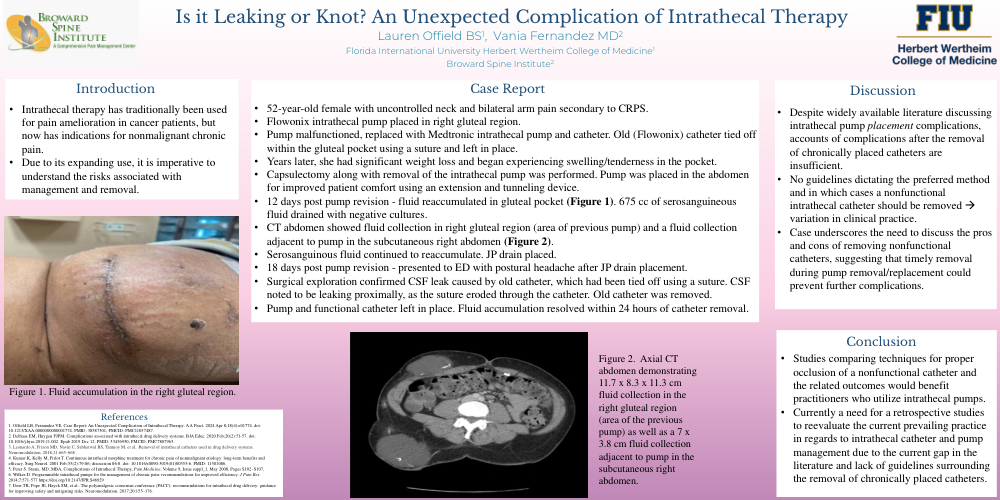
•12 days post pump revision - fluid reaccumulated in gluteal pocket (Figure 1). 675 cc of serosanguineous fluid drained with negative cultures.
•CT abdomen showed fluid collection in right gluteal region (area of previous pump) and a fluid collection adjacent to pump in the subcutaneous right abdomen (Figure 2).
•Serosanguinous fluid continued to reaccumulate. JP drain placed.
•18 days post pump revision - presented to ED with postural headache after JP drain placement.
•Surgical exploration confirmed CSF leak caused by old catheter, which had been tied off using a suture. CSF noted to be leaking proximally, as the suture eroded through the catheter. Old catheter was removed.
•Pump and functional catheter left in place. Fluid accumulation resolved within 24 hours of catheter removal.
Discussion
•Despite widely available literature discussing intrathecal pump placementcomplications, accounts of complications after the removal of chronically placed catheters are insufficient.
•No guidelines dictating the preferred method and in which cases a nonfunctional intrathecal catheter should be removed --> variation in clinical practice.
•Case underscores the need to discuss the pros and cons of removing nonfunctional catheters, suggesting that timely removal during pump removal/replacement could prevent further complications.
Conclusion
•Studies comparing techniques for proper occlusion of a nonfunctional catheter and the related outcomes would benefit practitioners who utilize intrathecal pumps.
•Currently a need for a retrospective studies to reevaluate the current prevailing practice in regards to intrathecal catheter and pump management due to the current gap in the literature and lack of guidelines surrounding the removal of chronically placed catheters.