501 posters, 2 videos, 1 audios, 8 topics, 37 sessions, 395 authors, 307 institutions
ePostersLive by SciGen Technologies S.A. All rights reserved.
23rd Annual Pain Medicine Meeting 2024
November 21-23, 2024 | Caesars Palace, Las Vegas, Nevada

5938
DIFFICULT SPINAL CORD STIMULATION LEAD PLACEMENT DUE TO THORACIC SPINAL STENOSIS IN A PATIENT WITH MULTI-LEVEL SPINAL SURGERY
Poster Presenter
Authors
Affiliations
Part of Topic
Medically Challenging Cases
Spinal cord stimulators (SCS) are recognized as effective for managing chronic pain in patients with spinal stenosis following lumbar surgery. [1] Percutaneous lead insertion offers a less invasive alternative, reducing complications. [2] However, in patients with multi-level fusion and thoracic ossification of the ligamentum flavum, this method can fail. We present a case requiring surgical SCS lead placement following unsuccessful percutaneous attempts due to thoracic stenosis after multi-level fusion. This case underscores the need for early, comprehensive imaging and surgical consultation in patients with complex anatomical challenges from prior surgeries or activity limitations. Our experience suggests that a customized SCS lead placement strategy is crucial for optimal therapeutic results.
According to Asan Medical Center policy, the case report is exempt from IRB review requirements as it does not contain any patient-identifiable information.
The informed consent for the publication of this case report was obtained from the patient.
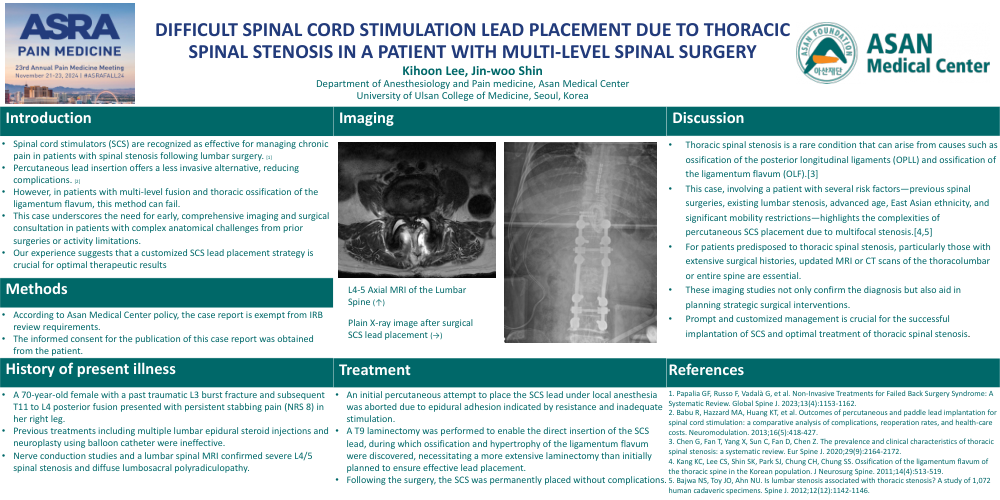
A 70-year-old female with a past traumatic L3 burst fracture and subsequent T11 to L4 posterior fusion presented with persistent stabbing pain (NRS 8) in her right. The patient requires the use of a walker for ambulation due to sensory and motor impairments. Previous treatments including multiple lumbar epidural steroid injections and neuroplasty were ineffective. Nerve conduction studies and a lumbar spinal MRI confirmed severe L4/5 spinal stenosis and diffuse lumbosacral polyradiculopathy.
Due to minimal relief from pharmacotherapy and significant impairment in daily activities, we opted for spinal cord stimulation (SCS). An initial percutaneous attempt to place the SCS lead under local anesthesia was aborted due to epidural adhesion indicated by resistance and inadequate stimulation.
The patient’s strong preference for SCS led to a referral for surgical placement. A T9 laminectomy was performed to enable the direct insertion of the SCS lead, during which ossification and hypertrophy of the ligamentum flavum were discovered, necessitating a more extensive laminectomy than initially planned to ensure effective lead placement.
Following the surgery, a one-week trial of spinal cord stimulation resulted in a significant reduction in her right leg pain, decreasing from an NRS of 8 to 3, without any adverse effects. Eight days later, the SCS was permanently placed without complications. The patient was subsequently discharged and continued her recovery on an outpatient basis.
Thoracic spinal stenosis is a rare condition that can arise from causes such as ossification of the posterior longitudinal ligaments (OPLL) and ossification of the ligamentum flavum (OLF).[3] This case, involving a patient with several risk factors—previous spinal surgeries, existing lumbar stenosis, advanced age, East Asian ethnicity, and significant mobility restrictions—highlights the complexities of percutaneous SCS placement due to multifocal stenosis.[4,5] Proper preoperative preparation is critical in such scenarios. For patients predisposed to thoracic spinal stenosis, particularly those with extensive surgical histories, updated MRI or CT scans of the thoracolumbar or entire spine are essential. These imaging studies not only confirm the diagnosis but also aid in planning strategic surgical interventions. Prompt and customized management is crucial for the successful implantation of SCS and optimal treatment of thoracic spinal stenosis.
1. Papalia GF, Russo F, Vadalà G, et al. Non-Invasive Treatments for Failed Back Surgery Syndrome: A Systematic Review. Global Spine J. 2023;13(4):1153-1162. doi:10.1177/21925682221141385
2. Babu R, Hazzard MA, Huang KT, et al. Outcomes of percutaneous and paddle lead implantation for spinal cord stimulation: a comparative analysis of complications, reoperation rates, and health-care costs. Neuromodulation. 2013;16(5):418-427. doi:10.1111/ner.12065
3. Chen G, Fan T, Yang X, Sun C, Fan D, Chen Z. The prevalence and clinical characteristics of thoracic spinal stenosis: a systematic review. Eur Spine J. 2020;29(9):2164-2172. doi:10.1007/s00586-020-06520-6
4. Kang KC, Lee CS, Shin SK, Park SJ, Chung CH, Chung SS. Ossification of the ligamentum flavum of the thoracic spine in the Korean population. J Neurosurg Spine. 2011;14(4):513-519. doi:10.3171/2010.11.SPINE10405
5. Bajwa NS, Toy JO, Ahn NU. Is lumbar stenosis associated with thoracic stenosis? A study of 1,072 human cadaveric specimens. Spine J. 2012;12(12):1142-1146. doi:10.1016/j.spinee.2012.10.029