501 posters, 2 videos, 1 audios, 8 topics, 37 sessions, 395 authors, 307 institutions
ePostersLive by SciGen Technologies S.A. All rights reserved.
23rd Annual Pain Medicine Meeting 2024
November 21-23, 2024 | Caesars Palace, Las Vegas, Nevada

5923
PROLONGED PAIN RELIEF AFTER SPINAL CORD STIMULATION (SCS) TRIAL: A CASE REPORT OF EXTENDED WASHOUT PERIOD IN CERVICAL SCS THERAPY
Poster Presenter
Authors
Affiliations
Part of Topic
Medically Challenging Cases
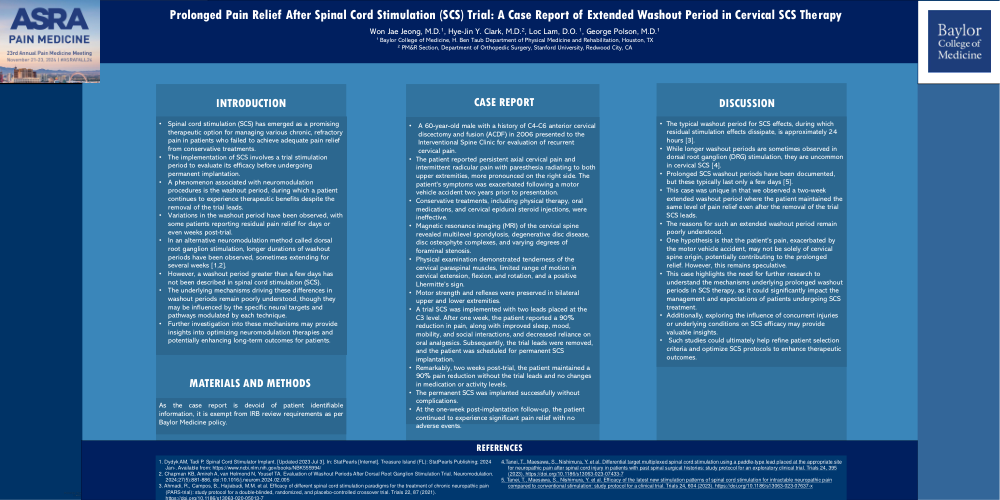
Title Prolonged Pain Relief After Spinal Cord Stimulation (SCS) Trial: A Case Report of Extended Washout Period in Cervical SCS Therapy
Introduction
Spinal cord stimulation (SCS) has emerged as a promising therapeutic option for managing various chronic, refractory pain in patients who failed to achieve adequate pain relief from conservative treatments. The implementation of SCS involves a trial stimulation period to evaluate its efficacy before undergoing permanent implantation. A phenomenon associated with neuromodulation procedures is the washout period, during which a patient continues to experience therapeutic benefits despite the removal of the trial leads. Variations in the washout period have been observed, with some patients reporting residual pain relief for days or even weeks post-trial.
In an alternative neuromodulation method called dorsal root ganglion stimulation, longer durations of washout periods have been observed, sometimes extending for several weeks [1,2]. However, a washout period greater than a few days has not been described in spinal cord stimulation (SCS). The underlying mechanisms driving these differences in washout periods remain poorly understood, though they may be influenced by the specific neural targets and pathways modulated by each technique. Further investigation into these mechanisms may provide insights into optimizing neuromodulation therapies and potentially enhancing long-term outcomes for patients.
Material and Method
As the case report is devoid of patient identifiable information, it is exempt from IRB review requirements as per Baylor Medicine policy.
Case Report
A 60-year-old male with a history of C4-C6 anterior cervical discectomy and fusion (ACDF) in 2006 presented to the Interventional Spine Clinic for evaluation of recurrent cervical pain. The patient reported persistent axial cervical pain and intermittent radicular pain with paresthesia radiating to both upper extremities, more pronounced on the right side. The patient's symptoms was exacerbated following a motor vehicle accident two years prior to presentation. Conservative treatments, including physical therapy, oral medications, and cervical epidural steroid injections, were ineffective.
Magnetic resonance imaging (MRI) of the cervical spine revealed multilevel spondylosis, degenerative disc disease, disc osteophyte complexes, and varying degrees of foraminal stenosis. Physical examination demonstrated tenderness of the cervical paraspinal muscles, limited range of motion in cervical extension, flexion, and rotation, and a positive Lhermitte’s sign. Motor strength and reflexes were preserved in bilateral upper and lower extremities. A trial SCS was implemented with two leads placed at the C3 level. After one week, the patient reported a 90% reduction in pain, along with improved sleep, mood, mobility, and social interactions, and decreased reliance on oral analgesics. Subsequently, the trial leads were removed, and the patient was scheduled for permanent SCS implantation.
Remarkably, two weeks post-trial, the patient maintained a 90% pain reduction without the trial leads and no changes in medication or activity levels. The permanent SCS was implanted successfully without complications. At the one-week post-implantation follow-up, the patient continued to experience significant pain relief with no adverse events.
Discussion
The typical washout period for SCS effects, during which residual stimulation effects dissipate, is approximately 24 hours [3]. While longer washout periods are sometimes observed in dorsal root ganglion (DRG) stimulation, they are uncommon in cervical SCS [4]. Prolonged SCS washout periods have been documented, but these typically last only a few days [5]. This case was unique in that we observed a two-week extended washout period where the patient maintained the same level of pain relief even after the removal of the trial SCS leads. The reasons for such an extended washout period remain poorly understood. One hypothesis is that the patient's pain, exacerbated by the motor vehicle accident, may not be solely of cervical spine origin, potentially contributing to the prolonged relief. However, this remains speculative.
This case highlights the need for further research to understand the mechanisms underlying prolonged washout periods in SCS therapy, as it could significantly impact the management and expectations of patients undergoing SCS treatment. Additionally, exploring the influence of concurrent injuries or underlying conditions on SCS efficacy may provide valuable insights. Such studies could ultimately help refine patient selection criteria and optimize SCS protocols to enhance therapeutic outcomes.
References
1. Dydyk AM, Tadi P. Spinal Cord Stimulator Implant. [Updated 2023 Jul 3]. In: StatPearls [Internet]. Treasure Island (FL): StatPearls Publishing; 2024 Jan-. Available from: https://www.ncbi.nlm.nih.gov/books/NBK555994/
2. Chapman KB, Amireh A, van Helmond N, Yousef TA. Evaluation of Washout Periods After Dorsal Root Ganglion Stimulation Trial. Neuromodulation. 2024;27(5):881-886. doi:10.1016/j.neurom.2024.02.005
3. Ahmadi, R., Campos, B., Hajiabadi, M.M. et al. Efficacy of different spinal cord stimulation paradigms for the treatment of chronic neuropathic pain (PARS-trial): study protocol for a double-blinded, randomized, and placebo-controlled crossover trial. Trials 22, 87 (2021). https://doi.org/10.1186/s13063-020-05013-7
4.Tanei, T., Maesawa, S., Nishimura, Y. et al. Differential target multiplexed spinal cord stimulation using a paddle-type lead placed at the appropriate site for neuropathic pain after spinal cord injury in patients with past spinal surgical histories: study protocol for an exploratory clinical trial. Trials 24, 395 (2023). https://doi.org/10.1186/s13063-023-07433-7