501 posters, 2 videos, 1 audios, 8 topics, 37 sessions, 395 authors, 307 institutions
ePostersLive by SciGen Technologies S.A. All rights reserved.
23rd Annual Pain Medicine Meeting 2024
November 21-23, 2024 | Caesars Palace, Las Vegas, Nevada

5893
DIVERSIFYING THE APPROACH TO FLUOROSCOPIC GUIDED THORACIC EPIDURAL STEROID INJECTIONS IN PATIENTS WITH COMPLEX SURGICAL FACTORS
Poster Presenter
Authors
Affiliations
Part of Topic
Medically Challenging Cases
Diversifying the Approach to Fluoroscopic Guided Thoracic Epidural Steroid Injections in Patients with Complex Surgical Factors
Veronica Takougang, MD, MS, Melanie Russell, MD, Lady Christine Ong Sio, MD, Laura DeVita, MD
Department of Anesthesiology, University of Cincinnati College of Medicine, Cincinnati, OH
Introduction:
Thoracic epidural steroid injections
(TESIs) are utilized for the treatment of
disc herniation, post-surgical spine
syndrome, spinal stenosis and post-
thoracotomy pain syndrome. The
standard procedural approach for a
TESI is in the prone position.
Successful epidural steroid injections
(ESIs) are a cost-effective option for
patients to achieve pain relief, restore
function, and return to physical therapy
when indicated. Complex surgical
factors can be a contraindication to
TESI placement due to limitations in
patient positioning.
Objectives:
• Identify appropriate indications for TESI
placement based on a patient’s medical
and surgical history and severity of
symptoms.
• Discuss how complex surgical factors
can lead to limitations in patient
positioning for steroid injections.
• Emphasize the importance of
diversifying one’s approach to the
current standard of care of ESIs to
ensure appropriate patient access.
Case Description:
4-year-old male with a past medical history significant for coronary artery disease status-post
CABG, degenerative disc disease and radiculopathy who presented for a T6-T7 ESI. Patient’s
surgical course was complicated by a nonunion closed sternal plating along the fifth, sixth, and
seventh ribs. Conventional TESI administration in the prone position was precluded due to the
patient’s mobile chest plate and inability to lie flat. We broadened our approach to traditional
positioning and utilized fluoroscopic guidance to perform the TESI in the seated position with
constant communication between our X-ray technician and the pain physician. Once in the
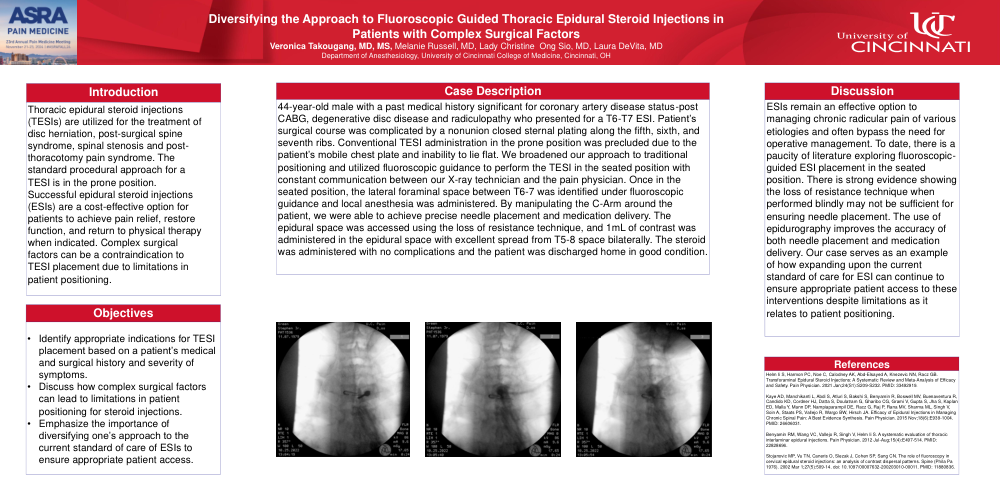
seated position, the lateral foraminal space between T6-7 was identified under fluoroscopic
guidance and local anesthesia was administered. By manipulating the C-Arm around the
patient, we were able to achieve precise needle placement and medication delivery. The
epidural space was accessed using the loss of resistance technique, and 1mL of contrast was
administered in the epidural space with excellent spread from T5-8 space bilaterally. The steroid
was administered with no complications and the patient was discharged home in good condition.
Discussion:
ESIs remain an effective option to
managing chronic radicular pain of various
etiologies and often bypass the need for
operative management. To date, there is a
paucity of literature exploring fluoroscopic-
guided ESI placement in the seated
position. There is strong evidence showing
the loss of resistance technique when
performed blindly may not be sufficient for
ensuring needle placement. The use of
epidurography improves the accuracy of
both needle placement and medication
delivery. Our case serves as an example
of how expanding upon the current
standard of care for ESI can continue to
ensure appropriate patient access to these
interventions despite limitations as it
relates to patient positioning.
References:
Helm Ii S, Harmon PC, Noe C, Calodney AK, Abd-Elsayed A, Knezevic NN, Racz GB.
Transforaminal Epidural Steroid Injections: A Systematic Review and Meta-Analysis of Efficacy
and Safety. Pain Physician. 2021 Jan;24(S1):S209-S232. PMID: 33492919.
Kaye AD, Manchikanti L, Abdi S, Atluri S, Bakshi S, Benyamin R, Boswell MV, Buenaventura R,
Candido KD, Cordner HJ, Datta S, Doulatram G, Gharibo CG, Grami V, Gupta S, Jha S, Kaplan
ED, Malla Y, Mann DP, Nampiaparampil DE, Racz G, Raj P, Rana MV, Sharma ML, Singh V,
Soin A, Staats PS, Vallejo R, Wargo BW, Hirsch JA. Efficacy of Epidural Injections in Managing
Chronic Spinal Pain: A Best Evidence Synthesis. Pain Physician. 2015 Nov;18(6):E939-1004.
PMID: 26606031.
Benyamin RM, Wang VC, Vallejo R, Singh V, Helm Ii S. A systematic evaluation of thoracic
interlaminar epidural injections. Pain Physician. 2012 Jul-Aug;15(4):E497-514. PMID:
22828696.
Stojanovic MP, Vu TN, Caneris O, Slezak J, Cohen SP, Sang CN. The role of fluoroscopy in
cervical epidural steroid injections: an analysis of contrast dispersal patterns. Spine (Phila Pa
1976). 2002 Mar 1;27(5):509-14. doi: 10.1097/00007632-200203010-00011. PMID: 11880836.