501 posters, 2 videos, 1 audios, 8 topics, 37 sessions, 395 authors, 307 institutions
ePostersLive by SciGen Technologies S.A. All rights reserved.
23rd Annual Pain Medicine Meeting 2024
November 21-23, 2024 | Caesars Palace, Las Vegas, Nevada

5808
INTRACTABLE CRPS LEADING TO MULTI-LIMB AMPUTATION
Poster Presenter
Authors
Affiliations
Part of Topic
Medically Challenging Cases
INTRACTABLE CRPS LEADING TO
MULTI-LIMB AMPUTATION
Jasmine Lin MD, Victor Brozovsky BS, Maryam Jowza MD
University of North Carolina, Chapel Hill, Department of Anesthesiology
Introduction
Complex Regional Pain Syndrome (CRPS) is a chronic pain syndrome that usually affects limbs
Variable disease course that can lead to severe physical and psychological disability.
Two categories: CRPS type 1 (CRPS-I), with no identifiable nerve injury; and CRPS type 2 with identifiable nerve injury.
Symptoms: sensory, vasomotor, sudomotor, motor, and trophic changes
Treatments: supportive care to facilitate movement of the limb
Here we present: a case of intractable CRPS-I in a young woman that was refractory to extensive multimodal therapies, which eventually progressed to debilitating kinesiophobia with multi-limb amputation.
Patient-informed consent was acquired, and as this case report is devoid of patient identifiable information, it is exempt from IRB review requirements as per University of North Carolina policy
Case Presentation
Patient: 38-year-old female. History of hypertension, anxiety, PTSD, psychogenic nonepileptic seizures, and tobacco use.
2003: diagnosed CRPS-I of the upper extremities. Symptoms: swelling, limb atrophy, skin/nail changes, hyperalgesia, allodynia, & decreased range of motion.
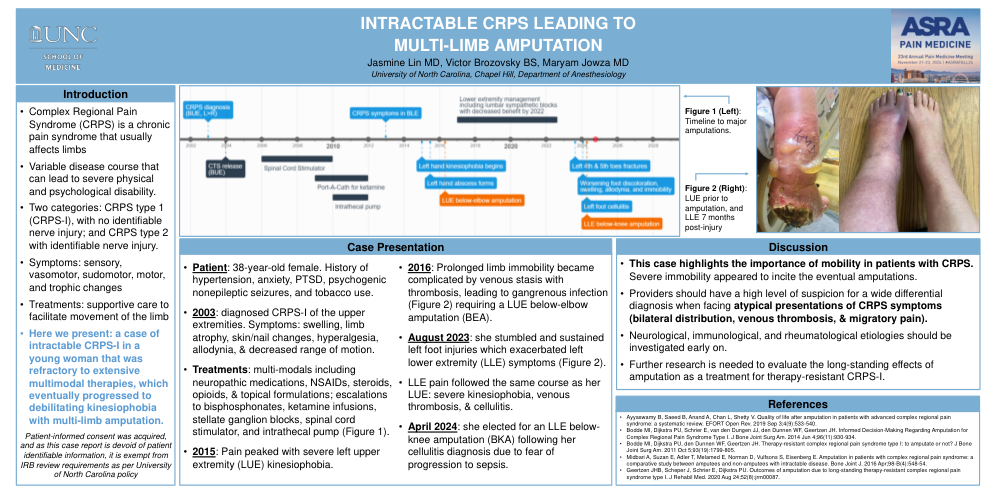
Treatments: multi-modals including neuropathic medications, NSAIDs, steroids, opioids, & topical formulations; escalations to bisphosphonates, ketamine infusions, stellate ganglion blocks, spinal cord stimulator, and intrathecal pump (Figure 1).
2015: Pain peaked with severe left upper extremity (LUE) kinesiophobia.
2016: Prolonged limb immobility became complicated by venous stasis with thrombosis, leading to gangrenous infection (Figure 2) requiring a LUE below-elbow amputation (BEA).
August 2023: she stumbled and sustained left foot injuries which exacerbated left lower extremity (LLE) symptoms (Figure 2).
LLE pain followed the same course as her LUE: severe kinesiophobia, venous thrombosis, & cellulitis.
April 2024: she elected for an LLE below-knee amputation (BKA) following her cellulitis diagnosis due to fear of progression to sepsis.
Discussion
This case highlights the importance of mobility in patients with CRPS. Severe immobility appeared to incite the eventual amputations.
Providers should have a high level of suspicion for a wide differential diagnosis when facing atypical presentations of CRPS symptoms (bilateral distribution, venous thrombosis, & migratory pain).
Neurological, immunological, and rheumatological etiologies should be investigated early on.
Further research is needed to evaluate the long-standing effects of amputation as a treatment for therapy-resistant CRPS-I.