501 posters, 2 videos, 1 audios, 8 topics, 37 sessions, 395 authors, 307 institutions
ePostersLive by SciGen Technologies S.A. All rights reserved.
23rd Annual Pain Medicine Meeting 2024
November 21-23, 2024 | Caesars Palace, Las Vegas, Nevada

5793
STELLATE GANGLION BLOCK: A CRITICAL BRIDGE TO CARDIAC SYMPATHECTOMY FOR RECURRENT VENTRICULAR TACHYCARDIA IN A HIGH-RISK PATIENT
Poster Presenter
Authors
Affiliations
Part of Topic
Medically Challenging Cases
Stellate Ganglion Block: A Critical Bridge to Cardiac
Sympathectomy for Recurrent Ventricular Tachycardia in a High-Risk Patient
Andrew Garcia, MD, PharmD, Peter Huynh, MD, David Cho, MD, MBA
Harbor-UCLA Medical Center, Department of Anesthesiology, Torrance, California, U.S.A.
Introduction:
Stellate ganglion blockade (SGB) is one of several salvage therapies used for refractory or incessant ventricular tachycardia (VT) when conservative measures have failed.1 Considering the close proximity of the ganglion to several major vascular structures and critical nerves, special expertise is needed when performing the block, as well as attention to the various contraindications.2,3 This abstract highlights a patient with several risk factors including triple anticoagulation therapy and recent myocardial infarction (MI) who underwent SGB for recurrent VT episodes refractory to medical management and catheter ablation.
Case Summary:
The case involves a male in his 60s with a history of hypertension, glaucoma, heart failure with reduced ejection fraction with an ejection fraction of 28% on goal-directed medical therapy, and coronary artery disease with recent stents placed in the setting of myocardial ischemia less than one month prior to consultation. After initial presentation of syncope, chest pain, dizziness, and palpitations in the emergency department one week following stent placement, the patient was found to be in sustained VT, with a right bundle branch block seen on EKG, for which he was subsequently managed with lidocaine and amiodarone. He was taken for emergent left heart catheterization showing patent stents and normal left ventricle filling pressures.
One day later, the patient experienced VT arrest necessitating cardiopulmonary resuscitation (CPR) and defibrillation. Subsequent VT ablation was performed, initially resulting in a stable post-procedural course, although the patient was found to have a right brachial vein deep vein thrombosis (DVT) and started on rivaroxaban. While transitioning from IV to oral anti-arrhythmic medications, he had several 30 second episodes of monomorphic VT. The pain service was consulted for SGB consideration. Notably, the patient had several major risk factors for performing SGB, including triple therapy (anticoagulation for his DVT and dual anti-platelet therapy for his coronary stents), glaucoma, recent MI, and cardiac conduction block.
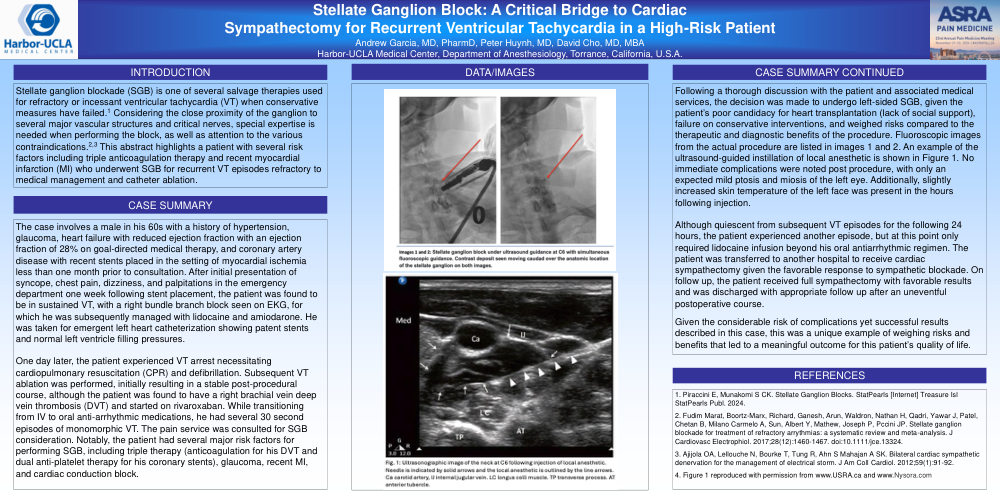
Following a thorough discussion with the patient and associated medical services, the decision was made to undergo left-sided SGB, given the patient’s poor candidacy for heart transplantation (lack of social support), failure on conservative interventions, and weighed risks compared to the therapeutic and diagnostic benefits of the procedure. Fluoroscopic images from the actual procedure are listed in images 1 and 2. An example of the ultrasound-guided instillation of local anesthetic is shown in Figure 1. No immediate complications were noted post procedure, with only an expected mild ptosis and miosis of the left eye. Additionally, slightly increased skin temperature of the left face was present in the hours following injection.
Although quiescent from subsequent VT episodes for the following 24 hours, the patient experienced another episode, but at this point only required lidocaine infusion beyond his oral antiarrhythmic regimen. The patient was transferred to another hospital to receive cardiac sympathectomy given the favorable response to sympathetic blockade. On follow up, the patient received full sympathectomy with favorable results and was discharged with appropriate follow up after an uneventful postoperative course.
Given the considerable risk of complications yet successful results described in this case, this was a unique example of weighing risks and benefits that led to a meaningful outcome for this patient’s quality of life.
References:
1. Piraccini E, Munakomi S CK. Stellate Ganglion Blocks. StatPearls [Internet] Treasure Isl StatPearls Publ. 2024.
2. Fudim Marat, Boortz-Marx, Richard, Ganesh, Arun, Waldron, Nathan H, Qadri, Yawar J, Patel, Chetan B, Milano Carmelo A, Sun, Albert Y, Mathew, Joseph P, Pccini JP. Stellate ganglion blockade for treatment of refractory arrythmias: a systematic review and meta-analysis. J Cardiovasc Electrophiol. 2017;28(12):1460-1467. doi:10.1111/jce.13324.
3. Ajijola OA, Lellouche N, Bourke T, Tung R, Ahn S Mahajan A SK. Bilateral cardiac sympathetic denervation for the management of electrical storm. J Am Coll Cardiol. 2012;59(1):91-92.
4. Figure 1 reproduced with permission from www.USRA.ca and www.Nysora.com