501 posters, 2 videos, 1 audios, 8 topics, 37 sessions, 395 authors, 307 institutions
ePostersLive by SciGen Technologies S.A. All rights reserved.
23rd Annual Pain Medicine Meeting 2024
November 21-23, 2024 | Caesars Palace, Las Vegas, Nevada

5767
INTERSCALENE PERINEURAL CATHETER FOR POST-OPERATIVE PAIN CONTROL FOLLOWING FOREQUARTER AMPUTATION: A CASE REPORT
Poster Presenter
Authors
Affiliations
Part of Topic
Medically Challenging Cases
Interscalene Perineural Catheter for Post-Operative Pain Control Following Forequarter Amputation:
A Case Report
Azeem Sajjad MD, Arvind Murthy MD
INTRO
-
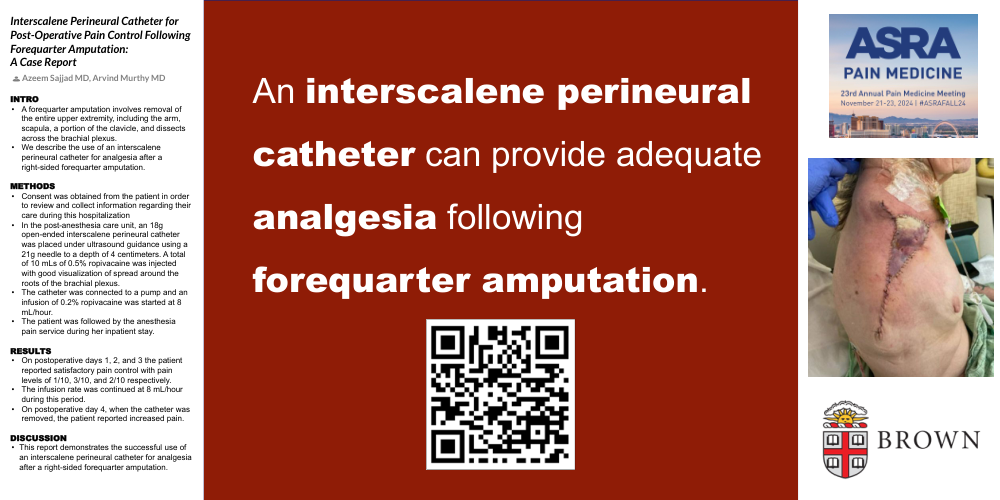
A forequarter amputation involves removal of the entire upper extremity, including the arm, scapula, a portion of the clavicle, and dissects across the brachial plexus.
-
We describe the use of an interscalene perineural catheter for analgesia after a right-sided forequarter amputation.
METHODS
-
Consent was obtained from the patient in order to review and collect information regarding their care during this hospitalization
-
In the post-anesthesia care unit, an 18g open-ended interscalene perineural catheter was placed under ultrasound guidance using a 21g needle to a depth of 4 centimeters. A total of 10 mLs of 0.5% ropivacaine was injected with good visualization of spread around the roots of the brachial plexus.
-
The catheter was connected to a pump and an infusion of 0.2% ropivacaine was started at 8 mL/hour.
-
The patient was followed by the anesthesia pain service during her inpatient stay.
RESULTS
-
On postoperative days 1, 2, and 3 the patient reported satisfactory pain control with pain levels of 1/10, 3/10, and 2/10 respectively.
-
The infusion rate was continued at 8 mL/hour during this period.
-
On postoperative day 4, when the catheter was removed, the patient reported increased pain.
DISCUSSION
-
This report demonstrates the successful use of an interscalene perineural catheter for analgesia after a right-sided forequarter amputation.