501 posters, 2 videos, 1 audios, 8 topics, 37 sessions, 395 authors, 307 institutions
ePostersLive by SciGen Technologies S.A. All rights reserved.
23rd Annual Pain Medicine Meeting 2024
November 21-23, 2024 | Caesars Palace, Las Vegas, Nevada

6329
TRANSIENT DYSPHAGIA FOLLOWING CERVICAL RFA: A RARE CASE REPORT
Poster Presenter
Authors
Affiliations
Part of Topic
Medically Challenging Cases
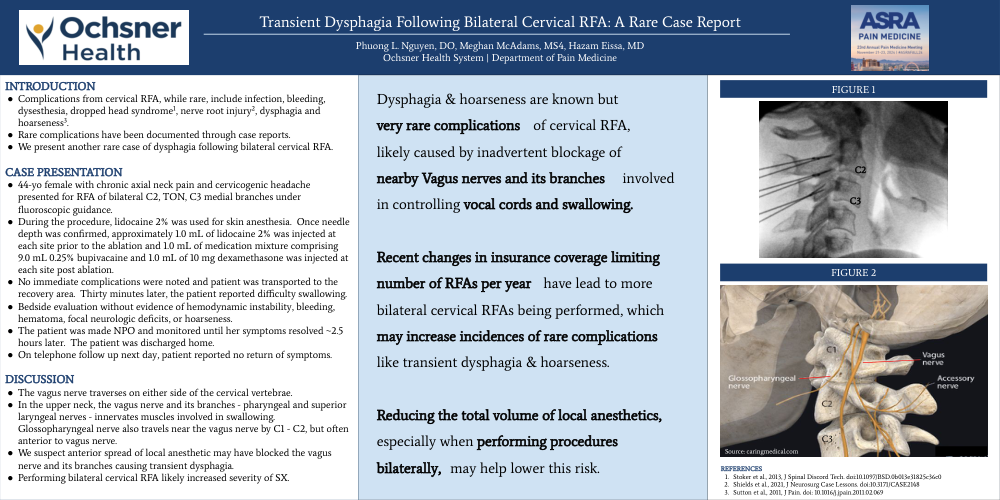
INTRODUCTION ● Complications from cervical RFA, while rare, include infection, bleeding, dysesthesia, dropped head syndrome1 , nerve root injury2 , dysphagia and hoarseness 3. ● Rare complications have been reported through case reports. ● We present another rare incidence of dysphagia following bilateral cervical RFA. CASE PRESENTATION ● 44-yo female with chronic axial neck pain and cervicogenic headache presented for RFA of bilateral C2, TON, C3 medial branches under fluoroscopic guidance. ● During the procedure, lidocaine 2% was used for skin anesthesia. Once needle depth was confirmed, approximately 1.0 mL of lidocaine 2% was injected at each site prior to the ablation and 1.0 mL of medication mixture comprising 9.0 mL 0.25% bupivacaine and 1.0 mL of 10 mg dexamethasone was injected at each site post ablation. ● No immediate complications were noted and patient was transported to the recovery area. Thirty minutes later, the patient reported difficulty swallowing. ● Bedside evaluation without evidence of hemodynamic instability, bleeding, hematoma, focal neurologic deficits, or hoarseness. ● The patient was made NPO and monitored until her symptoms resolved ~2.5 hours later. The patient was discharged home. ● On telephone follow up next day, patient reported no return of symptoms. DISCUSSION ● The vagus nerve traverses on either side of the cervical vertebrae. ● In the upper neck, the vagus nerve and its branches - pharyngeal and superior laryngeal nerves - innervates muscles involved in swallowing. Glossopharyngeal nerve also travels near the vagus nerve by C1 - C2, but often anterior to vagus nerve. ● We suspect anterior spread of local anesthetic may have blocked the vagus nerve and its branches causing transient dysphagia. ● Performing bilateral cervical RFA likely increased severity of SX. TAKE AWAY: Dysphagia & hoarseness are known but very rare complications of cervicalRFA, likely caused by inadvertent blockage of nearby Vagus nerves and its branches involved in controlling vocal cords and swallowing. Recent changes in insurance coverage limiting number of RFAs per year has lead to more bilateral cervical RFAs being performed, which may increase incidences of rare complications like transient dysphagia & hoarseness. Reducing the total volume of local anesthetics, especially when performing procedures bilaterally, may help lower this risk.